A Fighter Hydroplane (1 Viewer)

42
14
Joined
Jul 12, 2008
Hi Forum,

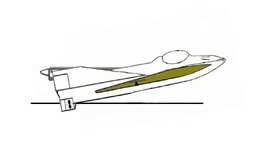
I would like to introduce to you a creation of mine, the fighter hydroplane. Something that was missed to be constructed in WW2, although I mean, it could have been done. The idea is to get fighter cover for conventional ships without presence of aicraft carriers by a plane which is able to cope with a fast enemy warplane (even another fighter, ideally) and can be salvaged after ditching. Catapulted aircraft like the Hawker Hurricane or the Reggiane Re 2000 (not reusable) or floatplane fighters like the Mitsubshi Rufe (too slow) did not have these traits.

So, how to solve this? You know racing hydroplanes are fast and easily tend to lift off, although not being able to fly. What if one could be made flyable? How to do this? German flying boat specialist Dornier created the unsuccessfull project Do 212. It did not really fly, but also did not base on a hydroplane. But what if to combine their characteristics?

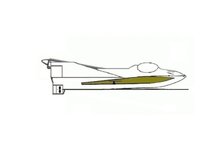
So, take a hydroplane, install a WW2-typical first class inline piston engine behind the pilot and a swiveling propeller mount in the rear. The prop is rigid in beginning of the take-off run, given the aircraft is to rise from water. It is lifted and starts to spin when the bow has left the water by a certain amount. Then - off it goes!

Attached, I show you some primitive graphics to clarify what I mean. You easily get drawings from nearly any WWII aircraft, but it is very hard to get one of a hydroplane. Luckily I found one, and converted it in some steps. Maybe today you can create anything perfectly by using AI, but I thought it is appropriate to use old-style graphic programs like Microsoft Paint, thus producing a rough picture of a rough idea.

In the past, I asked some friends about this idea, without having the chance for a visible showing. One was entusiastic about it. One was reluctant, being sceptical about the hot engine after flight possibly coming in contact with salt water and thus easily disrupt. One did not like the concept at all, telling "I see a gull, not a hawk!", by this neglecting that gulls are agressive birds either...

So, if you please, take a look at the pictures and tell me YOUR opinion!

Regads, RT
 

Attachments

  • Fighter Hydroplane swimming.jpg
    Fighter Hydroplane swimming.jpg
    37.5 KB · Views: 46
  • Fighter Hydroplane lifting off.jpg
    Fighter Hydroplane lifting off.jpg
    42.7 KB · Views: 53
It was tried............................once.


granted is used hydro foils but some of the same problems exist.
 
technically just about all flying boats and float planes are hydroplanes.
Stepped hulls were often called hydroplanes around WW I, and later.
The modern boats were called 3 point hydros, riding on the two sponsons and a narrow strip or even the prop at the rear.
Pre and post WW I there were a number of boats that used more than one step in row and not using two side by side near the front.
Some Italian MAS boats used two steps.
19086_rd.jpg

British WW I 40ft and 55ft MTBs used single steps.
Greatly reduced water friction. Early float planes/flying boats had to use stepped floats to get out of the water.
Problem with stepped hulls was they were sensitive to trim, where loads were placed in the hull as the hull was balancing on the step. Weight to far forward or back and the boat would not be operating at a good angle on the step.
Modern (or old racing boats) only need to carry enough fuel to last the race. Everything else is pretty much fixed.
Stepped hulls need certain conditions. They can only operate at high speeds in certain wave heights.
Some modern off-shore racing boats use multi-steps (5-6, more) to get around this. Not quite as efficient as a single step but less sensitive to waves. You do not want the forward step coming out of the water with the resulting slamming on re-entry and you do not want the rear coming out before you are ready.
 
OK, but while the performance of the A6M2-N aka Suisen 2 ("Hydro fighter type 2") aka Rufe wouldn't allow it to go head-to-head with high performance land-based fighters, it was no slouch. and could certainly threaten all but first line fighters. An allied Rufe would probably be better than a one-shot disposable CAM Hurricane in dealing with FW-200 Condors, possibly allowing ASW patrols (weather permitting).

For the USN, a more capable OS2U Kingfisher would have been nice, and I guess the failed SO3C Seamew was supposed to be an improvement. By the time this failure became apparent, the war had progressed to the point that it almost wasn't worth the effort to develop another floatplane. The Curtiss SC Seahawk barely made it to the fleet in the last few months of the war, and helicopters replaced floatplanes postwar.
 
OK, but while the performance of the A6M2-N aka Suisen 2 ("Hydro fighter type 2") aka Rufe wouldn't allow it to go head-to-head with high performance land-based fighters, it was no slouch. and could certainly threaten all but first line fighters. An allied Rufe would probably be better than a one-shot disposable CAM Hurricane in dealing with FW-200 Condors, possibly allowing ASW patrols (weather permitting).

For the USN, a more capable OS2U Kingfisher would have been nice, and I guess the failed SO3C Seamew was supposed to be an improvement. By the time this failure became apparent, the war had progressed to the point that it almost wasn't worth the effort to develop another floatplane. The Curtiss SC Seahawk barely made it to the fleet in the last few months of the war, and helicopters replaced floatplanes postwar.
The Curtiss SC was a "more capable OS2U Kingfisher," armed with 2x.50 caliber and a top speed of about 250 mph - still not capable of going against first-line fighters, and too late to make a major difference in the war. The Blackburn B.44 was probably the best candidate for this role, with a 360 mph top speed and 4 x 20mm. But it never left the drawing board.
 
It was tried............................once.


granted is used hydro foils but some of the same problems exist.
S Shortround6 beat me to the Piaggio P.7/comments that almost all sea/float planes use stepped hydrofoils.

RC models of the Piaggio P.7 have shown the concept was sound, it just needed more development for air racing.
​
Piaggio P.7 is sort of like the Bugatti 100p - interesting concept for an air racer, but needs a lot of development to become an aircraft which can operate in a seaway
The use of hydrofoils needs development so they don't cavitate (and ideally allowing retraction).
The wings need to higher out of the water - gull wings?​
But do gull wings interfere with pilot visibility?​
Do you want (can you design/manufacture) a folding propeller capable of handling the power of a WWII fighter?​
I'm not sure a 2 blade propeller may absorb the power of a RR Merlin/DB605; and I don't think even horizontal, it could handle the impact of waves in a seaway.​

The Curtiss SC was a "more capable OS2U Kingfisher," armed with 2x.50 caliber and a top speed of about 250 mph - still not capable of going against first-line fighters, and too late to make a major difference in the war. The Blackburn B.44 was probably the best candidate for this role, with a 360 mph top speed and 4 x 20mm. But it never left the drawing board.
Is the Spitfire floatplane, the best Allied opportunity for a Rufe alterative.
I was thinking the Mk. XII would have been better next step than the Mk. IX for the 2nd iteration - low level speed being more important than at altitude.​

I was also thinking about the Kawanishi E15K Shiun (Norm)
1787531530148.png


Laminar high speed airfoil, retractable wing stabilizing floats, and jettisonable central float.
 
Here's the RC equivalent of your idea. This is a newer video there's a older one that's really cool I may actually have it downloaded somewhere.

View: https://youtu.be/GjL3dg2UTcc?is=ZkpS_mOC2XFg_5CS

surprise.... WIG vehicles are not listed as a aeroplanes - by clasification and certifying authorities are counted as a HSV - high speed vessels (ships). Closer to hovercrafts than aircrafts - somehow funny but real...
 
Hi forum,

thank you for your answers!

S Shortround6: I know I omitted the steps. My drawing is a bit primitive, as I said.

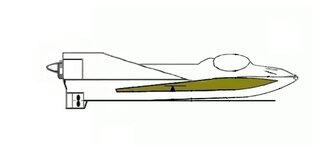
D don4331 : When you look at my pictures, you see the airscrew spinner is in the same position in both. When the aircraft starts running, the pusher prop is lifted, so the air propeller (ideally) would not touch the water. In air, it is moved back to the straight position. The hydroplane should be equipped with a first-class engine.
The Beriev Be-103 shows wings resting on the water surface, so there is no special design necessary. Skis/Pods like in the Piaggo P.7 would probably be necessary.

The video shown by Skyking and JPC shows approximately what I mean. Of course, the Graupner Hydroplane has a power to weight ratio a WWII real aircraft never could have.

The idea is to get a reusable aircraft. Any with float jettisoned would most probably be destroyed by ditching. So, you additionally need items to manage salvaging, if launched from ships.

Further comments welcome!

Regards, RT
 
One problem is the complication and weight of the drives.
The clutch, drive/propeller shaft, etc for the water propeller and the clutch (?) and shaft for the air propeller and the tilting mechanism,
It was done on the Dornier 26
00075454.jpg

But Dornier cheated, the prop shaft was fixed, they tilted the whole engine-shaft-propeller assembly.
German flying boat specialist Dornier created the unsuccessfull project Do 212. It did not really fly, but also did not base on a hydroplane.
I have my doubts about the Do 212. Did it use a tilting shaft or did the whole power unit tilt?
960px-Do212-3.jpg

Is the engine (air cooled) in the fuselage or in the tilting assembly?
I would also be very surprised if the Do 212 did not use a stepped hull.
Here is a translation problem and a change in definition of a word through time.
Hydroplane, in English, for many years meant a stepped hull. It wasn't until after WW II that the 3 point hydros started to be built and these look considerably different from the modern pickle boat hull form. Engine was in front of the driver and the sponsons and steps, were much further aft.
Late 1930s racing/record setting hulls used one or more steps.
ue_Bird_K3_01tech_info.jpg?utm_source=de.wikipedia.jpg

One shallow step, nearly flat bottom.
1950s (?) 3 point hydro
29d238ec09efac96e7efcf1f2de6cb3c.jpg
 
Hi Shortround,

Dornier had experience with tilting shafts, and Germany had no operational aircraft carriers. So I think it would have been logical if Dornier had a hydroplane fighter on the drawing board.

The Do 212's engine was located in mid-fuselage. The fuselage was stepped, otherwise a seaplane could not lift off at all. Unfortunately, the Do 212 could not perform more than little hops. When towed by a Do 24, it proved way unstable, so the efforts had to be stopped. The aircraft also promised not any military profit.

For longitudinal stability reasons, I provided two large fins in my hydroplane draft. These and the tilting mechanism (engine always in fixed position, unlike in the Do 26) plus installations to manage salvaging surely would cause some weight. But I did not intend to create a sea-based fighter champion, able to supersede the best land- or carrier-based ones. I would be satisfied were it just approximately able to cope with them. Maybe being able to chase away a Mosquito shadower or comparable tasks.

Regards, RT
 
Is the Spitfire floatplane, the best Allied opportunity for a Rufe alterative.
I was thinking the Mk. XII would have been better next step than the Mk. IX for the 2nd iteration - low level speed being more important than at altitude.​
Three Spitfire Vb floatplanes were shipped out to Egypt in Oct 1943, the plan being that they would be used from a base in the Dodecanese against Ju 52 traffic between Crete & Greece. Resupply would be by submarine and high speed launches. No operational use was made of them and they were returned to Britain by summer 1944.

The British campaign in the Dodecanese ran from the Italian surrender on 8th Sept 1943 until 22nd Nov 1943. After that the requirement for floatplane Spitfires in that theatre evaporated. After that fighter operations over Crete and the Dodecanese were mostly by Beaufighters.

Only 100 Spitfire XII were built, coming off the production line between Sept 1942 and Nov 1943. They only served with two front line squadrons - 41 (Feb 1943 to Sept 1944) and 91 (April 1943 to March 1944). In both cases they were replaced by Spitfire XIV. But in 1943 they made an important contribution to countering the low level Luftwaffe raids against the south of England. So probably none could have been spared for conversion to odd tasks like floatplanes.

The second phase of Spitfire seaplane development started in Oct 1943 with a request for a Mk.VIII conversion. That went nowhere. But that was followed by the allocation of a single LF.IX with the low rated Merlin 66 serial MJ892 which was converted between 29th Dec 1943 and May 1944. That aircraft came straight off the production line at CBAF. It made its first flight as a seaplane on 6th July 1944 and after trials was passed to the RAF.

Feb 1944 saw a proposal for 8-12 more Mk.V conversions but in March the Air Ministry concluded:-

"The value of a seaplane fighter must always be limited on account of its inferior performance to the landplane and it appears doubtful if Spitfire floatplanes would be of great value if operating within range of enemy shore-based fighters. Fitting of floats to a Spitfire involves a major modification involving the use of special jigs.We are, therefore, faced with the alternatives of going ahead with the construction of 12 seaplane and storing them until required, or abandoning the whole project altogether. It is recommended that as these seaplane will never be required, we cut our losses now and drop the project."

When the spec for the Spitfire F.21 was issued Supermarine were requested by the Air Ministry to submit a proposal for a float variant, but this never progressed beyond the spec stage.

All the conversion work on these Spitfire floatplanes was carried out by Rolland.
 
Three Spitfire Vb floatplanes were shipped out to Egypt in Oct 1943, the plan being that they would be used from a base in the Dodecanese against Ju 52 traffic between Crete & Greece. Resupply would be by submarine and high speed launches. No operational use was made of them and they were returned to Britain by summer 1944.

The British campaign in the Dodecanese ran from the Italian surrender on 8th Sept 1943 until 22nd Nov 1943. After that the requirement for floatplane Spitfires in that theatre evaporated. After that fighter operations over Crete and the Dodecanese were mostly by Beaufighters.

Only 100 Spitfire XII were built, coming off the production line between Sept 1942 and Nov 1943. They only served with two front line squadrons - 41 (Feb 1943 to Sept 1944) and 91 (April 1943 to March 1944). In both cases they were replaced by Spitfire XIV. But in 1943 they made an important contribution to countering the low level Luftwaffe raids against the south of England. So probably none could have been spared for conversion to odd tasks like floatplanes.

The second phase of Spitfire seaplane development started in Oct 1943 with a request for a Mk.VIII conversion. That went nowhere. But that was followed by the allocation of a single LF.IX with the low rated Merlin 66 serial MJ892 which was converted between 29th Dec 1943 and May 1944. That aircraft came straight off the production line at CBAF. It made its first flight as a seaplane on 6th July 1944 and after trials was passed to the RAF.

Feb 1944 saw a proposal for 8-12 more Mk.V conversions but in March the Air Ministry concluded:-

"The value of a seaplane fighter must always be limited on account of its inferior performance to the landplane and it appears doubtful if Spitfire floatplanes would be of great value if operating within range of enemy shore-based fighters. Fitting of floats to a Spitfire involves a major modification involving the use of special jigs.We are, therefore, faced with the alternatives of going ahead with the construction of 12 seaplane and storing them until required, or abandoning the whole project altogether. It is recommended that as these seaplane will never be required, we cut our losses now and drop the project."

When the spec for the Spitfire F.21 was issued Supermarine were requested by the Air Ministry to submit a proposal for a float variant, but this never progressed beyond the spec stage.

All the conversion work on these Spitfire floatplanes was carried out by Rolland.
If you designate the three Spitfire Vb floatplanes as Phase 1, then there WAS a Phase 0 - nicknamed the "Narvik Nightmare," i was created on an urgent basis for the Norwegian campaign. It was a Spitfire Mk I mounted on Blackburn Roc floats. The result was a very slow "fighter" with poor maneuverability. It was never deployed to Norway (or anywhere else).
 
One problem is the complication and weight of the drives.
The clutch, drive/propeller shaft, etc for the water propeller and the clutch (?) and shaft for the air propeller and the tilting mechanism,
It was done on the Dornier 26
View attachment 892565
But Dornier cheated, the prop shaft was fixed, they tilted the whole engine-shaft-propeller assembly.

I have my doubts about the Do 212. Did it use a tilting shaft or did the whole power unit tilt?
960px-Do212-3.jpg

Is the engine (air cooled) in the fuselage or in the tilting assembly?
I would also be very surprised if the Do 212 did not use a stepped hull.
Here is a translation problem and a change in definition of a word through time.
Hydroplane, in English, for many years meant a stepped hull. It wasn't until after WW II that the 3 point hydros started to be built and these look considerably different from the modern pickle boat hull form. Engine was in front of the driver and the sponsons and steps, were much further aft.
Late 1930s racing/record setting hulls used one or more steps.
View attachment 892566
One shallow step, nearly flat bottom.
1950s (?) 3 point hydro
View attachment 892567
Ultimate work on flying boat hull design has been made by Martin company. If you are looking for good reference in this matter, take a closer look on P6M and Marlin design details. They come with airframe solutions close to optimal - at least in a term of hull design. Shin Maywa is development of the Martin's concepts. Not everyting loking fast is fast in fact and aircraft design is series of trades...
 
The comments about Spifires on floats showed why this concept is no real option. That is why I created this kind of hydroplane. I add a further picture showing it swimming an with tilted airscrew.

Regards, RT
 

Attachments

  • Fighter Hydroplane swimming w-tilted airscrew.jpg
    Fighter Hydroplane swimming w-tilted airscrew.jpg
    41.8 KB · Views: 37
I was also thinking about the Kawanishi E15K Shiun (Norm)
The Aichi M6A actually had better performance, even with it's fixed twin floats.
 
Who doesn't love Porco Rosso.

1000018868.jpg
 

Users who are viewing this thread

Back