AspiringHowardHughes
Airman
- 70
- Nov 26, 2025
Hello, nephew of BiffF15 here.
Thank you to all who chimed in to answer my previous questions. The depth of knowledge on this forum is impressive.
Having freed up my schedule as the school year comes to a close (and being in sore need of a pastime besides sleeping) I have decided to do more than lurk here. Enjoy my debut question, and expect more!
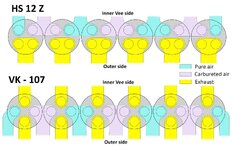
The valvetrain of the soviet M-107 (and following developments) is quite interesting - no explanation of mine could best this diagram produced by Bill Pearce for Old Machine Press:

On the aforementioned site, it is discussed that a benefit of this design was that the timings of the air induction versus the charge mixture could be independently adjusted. The air valve is said to have opened 65 degrees earlier than the charge valve, to allow for cooling and scavenging out through the (presumably still open) exhaust valves. All this is reasonable to me.
What I do not understand is closing the air valve after the charge valve, leaning out the mixture late.
Is there some minute technical reason for this?
Is carburetion easier to accomplish for a richer mixture? (I would assume the opposite)
Additionally, the intake valves were directly acted on by the single camshaft, while the exhaust valves moved together with a central follower.
I know that DOHC was not the norm back then, for various reasons. Did the DOHC-esque operation of the intake valves (if not also the exhaust valves, as I struggle to imagine how one would easily produce a rocker-like motion ratio with this arrangement) likely solve or introduce other problems?
Assuming preserving the externally-mounted induction system was a design priority, why was a typical hot-vee out of the question?
The exhaust could have been routed around the engine like the inner ports are done on the above diagram, or simply sent directly out of the hood, like the inner exhausts of this installation of the similar M-108 into a Yak-3. (also from Old Machine Press)

It seems this valve arrangement was owing to the predecessor of the M-series engines (the Hispano-Suiza 12Y).
Pictured below is the M-105, using a three-valve reverse-flow head that may have dictated the design direction of the more advanced models.
 Am I correct in my assumption that this arrangement was devised to accommodate the love for motor-cannons that so captivated the French and Soviets alike?
I forget how I initially came across this curiosity - it was likely either through digital examination of the Yak-9U in war thunder, or reading a post on this forum.

(The digital beast in question)
I sorely wish there existed an equivalent to The Secret Horsepower Race for the eastern front. I am curious how the combat experience of both sides engaged therein influenced their engine development. Sadly it seems I will need to learn Russian to get much further on my own.
I apologize if I have made any formatting errors - the post creation window is rather cramped and I am far from tech-savvy for my age.
Thank you all for any insights you may have.
Links in order of appearance:
Yakovlev Yak-3 VK-108 Fighter (Images 1 and 2)
Klimov M-105 - Wikipedia (Image 3)
War Thunder, by Gaijin Entertainment (Image 4)
Thank you to all who chimed in to answer my previous questions. The depth of knowledge on this forum is impressive.
Having freed up my schedule as the school year comes to a close (and being in sore need of a pastime besides sleeping) I have decided to do more than lurk here. Enjoy my debut question, and expect more!
The valvetrain of the soviet M-107 (and following developments) is quite interesting - no explanation of mine could best this diagram produced by Bill Pearce for Old Machine Press:
On the aforementioned site, it is discussed that a benefit of this design was that the timings of the air induction versus the charge mixture could be independently adjusted. The air valve is said to have opened 65 degrees earlier than the charge valve, to allow for cooling and scavenging out through the (presumably still open) exhaust valves. All this is reasonable to me.
What I do not understand is closing the air valve after the charge valve, leaning out the mixture late.
Is there some minute technical reason for this?
Is carburetion easier to accomplish for a richer mixture? (I would assume the opposite)
Additionally, the intake valves were directly acted on by the single camshaft, while the exhaust valves moved together with a central follower.
I know that DOHC was not the norm back then, for various reasons. Did the DOHC-esque operation of the intake valves (if not also the exhaust valves, as I struggle to imagine how one would easily produce a rocker-like motion ratio with this arrangement) likely solve or introduce other problems?
Assuming preserving the externally-mounted induction system was a design priority, why was a typical hot-vee out of the question?
The exhaust could have been routed around the engine like the inner ports are done on the above diagram, or simply sent directly out of the hood, like the inner exhausts of this installation of the similar M-108 into a Yak-3. (also from Old Machine Press)
It seems this valve arrangement was owing to the predecessor of the M-series engines (the Hispano-Suiza 12Y).
Pictured below is the M-105, using a three-valve reverse-flow head that may have dictated the design direction of the more advanced models.
I forget how I initially came across this curiosity - it was likely either through digital examination of the Yak-9U in war thunder, or reading a post on this forum.
(The digital beast in question)
I sorely wish there existed an equivalent to The Secret Horsepower Race for the eastern front. I am curious how the combat experience of both sides engaged therein influenced their engine development. Sadly it seems I will need to learn Russian to get much further on my own.
I apologize if I have made any formatting errors - the post creation window is rather cramped and I am far from tech-savvy for my age.
Thank you all for any insights you may have.
Links in order of appearance:
Yakovlev Yak-3 VK-108 Fighter (Images 1 and 2)
Klimov M-105 - Wikipedia (Image 3)
War Thunder, by Gaijin Entertainment (Image 4)