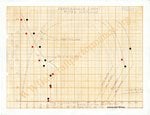
Here's a chart of the P-39K vs the P-40E in red and P-40F (Merlin) in black. These are representative of the early models with the 8.8 supercharger gears in the Allison.
As you can see the Merlin provided the P-40F with substantially improved performance both in speed and climb over the P-40E. The P-40E clean without drop tank climbed at about the same rate as the P-39K WITH a drop tank. Climb was the major problem for both these planes. Combat ceiling was generally described as the altitude at which a plane could no longer climb at over 1000ft/min. A clean P-40E (virtually all AAf fighters carried drop tanks on combat missions) could barely climb to 19000' which is too low for almost any combat theater. Add the ubiquitous drop tank and combat ceiling was even lower.
Even after the significant performance increase provided by the Merlin the P-40F was still slower than the P-39K up to 20000'. Climb would have been about the same for both planes at 3000rpm (combat power). Climb on the chart was at 2850rpm for the P-40F and 2600rpm for the P-39K above 12500'.
Weight was the major problem for both these planes. The P-40E weighed 8260# clean and the P-39 weighed 7650# while a comparable SpitfireV weighed 6600#, a 109G weighed 6900# and an early Zero weighed 5500#.
In summary the P-39K performed substantially better than the P-40E and a little better then the P-40F. Later (Nov. '42) Allison models with the 9.6 supercharger gears provided substantial performance improvements for the P-39N and the P-40N but the P-39N was still substantially faster and climbed a lot faster than the P-40N. Any perceived superiority of the P-40 was due to pilot quality of both the AAF and their opposition.
Couple of points on the above...
The P-39s mentioned in Volume IV of MAW were P-39L, which I had never even heard of. Is that V-1710-85? But anyway I think the ones they were using in some of the earlier debacles in fall 1942 or winter 42/43 were much earlier versions. Not certain though I'd have to check.
The P-40E's as delivered and under official rules for engine management were quite underpowered but they seem to have worked around that by mid 1942 in the Med. Of course only the English and the Russians ever used P-40E's as far as I know. Initially the Kittyhawks (P-40D and E) were doing worse than the Tomahawks, but various changes to engine management and / or maintenance seemed to have changed that by mid 1942, coinciding with a change in strategy. Per Australian double P-40 Ace Bobby Gibbes:
"Well it was basically the same aeroplane. We were a little disappointed when we first got the Kitty, we thought it'd be way ahead of the Tomahawk. In actual fact, it was a little bit better. One thing I personally didn't like about it was the Tomahawk had fairly high sides and you'd be sitting behind a thin sheet of metal but you felt safer. The Kittyhawk had perspex coming way down and you felt as if you were sitting up, very vulnerable, because you could see out so much. That was one feature I do remember. However, later when we got our Kittyhawks running properly - were getting better performance - they were a better aeroplane."
Partly this means they were replacing older V-1710-39 Allisons with more robust V-1710-73 of the P-40K. Partly it meant overboosting and other engine management changes.
By 1943 English are mostly using Kittyhawk III (either P-40K or M, the former having much better low altitude performance, with 1550 hp at WEP / 60" Hg or 1325 hp at military power / 51" Hg, the latter better high altitude - higher effective ceiling- but lower powered overall).
As far as altitude, it's in some ways even worse than most people think - the performance ceiling for the low-geared V-1710-39 and 73 was actually at about 12,000 feet, only the higher ratio engines could manage the oft cited 15 -16,000 ft, and the lightened "high altitude" P-40Ns were still performing reasonably well at 17,000 ft. But they did routinely operate well above those altitudes using special tactics. There is a
detailed defense industry blog article about how they were able to successfully use P-40E in the defense of Darwin, where lets not forget for whatever reason they had more success than Spit Mk V's did, and elsewhere in the Pacific and especially the CBI they were flying them at much higher altitudes on a routine basis, including escorting transports over the Himalayas. The jist of it seemed to be that they could pick up speed so well in a dive, extend and then (however long it took) climb back up, and they operated in smaller flights of 4 aircraft.
This wasn't really an option though in the Med where the much better organized German opposition required them (and basically all Allied fighters) to operate in Squadron sized units of 8-15 basically all the time. They were also able to use the radio a lot more in the Pacific apparently, at least according to some of the Australian pilots who were brought from the Med to the Pacific. The Germans were very efficient at locating the source of radio transmissions.
The bottom line on the P-40E is that it was used effectively against enemy aircraft in the Med, in the Pacific and CBI, and in Russia. We can say that the P-39 was used effectively in Russia. The P-39 had better climb but there is more to "performance" than climb rate.
I think the difference between the two aircraft may boil down to ease of handling and training. One common thing with many Allied fighter squadrons in 1941 and 1942 was that they were given badly inadequate transition training on the actual aircraft they were going to have to use in combat. Some of the Australian P-40 pilots who fought at Milne Bay, Darwin and the Kokoda trail for example had less than 10 hours training on the type before they were ferrying them into battle and then fighting. They actually lost more in landing accidents, maintenance issues and from getting lost on ferrying flights than they did in combat. Clive Caldwell the Australian P-40 ace noted how little airfcraft specific combat training they had received on the P-40 in North Africa and he set about trying to establish some. But as tough as it was to get used to, and I don't think it was "easy" to fly (clearly more challenging than the Hurricane for example), I think the P-40 pilots were able to get to competence in a few weeks whereas with the P-39 in the Med and Pacific it seems it took them longer, and some of them never learned to trust the plane because they didn't have a sense how far they could push it in turns and vertical maneuvers.
For the Americans, British and Anzac pilots, the P-40s had serious limitations but the limitations were
known and pretty well understood, so they fairly quickly developed strategies that allowed them to work around these flaws and exploit their avantages.
The Russian pilots by contrast had often transitioned from I-16s, MiG 3's, LaGG-3's and other aircraft which were notoriously unstable and twitchy so for them the P-39 may have actually been an improvement in that department, and as I have pointed out somewhere in the forum before, from the Lend Lease.RU article on the Soviet use of the P-39 we know that they did an almost 4 month workup on the aircraft before sending it into battle, which means that you had at least some pilots who knew the limitations of the fighter in maneuvering and some institutional knowledge as to how best to use it. I suspect that may be the real difference.
My other theory is that the P-39 may have just flown better in cold air but I'm not sure if that's really it, summers were hot on the Russian Front particularly in the Southern reaches Crimea etc.


 The turbo itself, all the internal ducting to and from the turbo, the intercooler and it's ducting all make for a much larger single engined plane. Compare the photo of the P-60 with a P-40. Multiengined planes (P-38, B-17 etc) have more internal room for the turbos.