
Senshi Sosho sentence translation

islandee

Airman
74
48
Joined
Mar 22, 2014
Location
Chiang Mai, Thailand
Website
www.ww2norththailand.com
From Senshi Sosho vol 34 p 703, dealing with events in Burma on the afternoon of 24 May 1942, I have this paragraph:

午後、第七飛行団は飛行第十二戦隊(ランパン二七機)、第九十八戦隊(ナコンサヮンニ六機)および一式戦(チエンマイー一機)をもつてアキャブ飛行場に進攻し、飛行場を制圧して帰還した。

Google translates it as:
In the afternoon, the 7th Air Group, with the 12th Air Squadron (27 aircraft from Lampang), the 98th Air Squadron (6 aircraft from Nakhon Sawan), and a Type 1 fighter (1 aircraft from Chiang Mai), advanced on Akyab Airfield, seized control of the airfield, and returned.

I'm curious about the last aircraft mentioned, the "Type 1 fighter (1 aircraft from Chiang Mai)". I believe that the OCR of the text is correct, at least for this item; however, English sources (Ford and Shores) write about 11 fighters, not 1, going to Akyab. This fighter or these fighters was/were 64th Sentai flying out of Chiang Mai, acting as escorts for the Ki-21 bombers. Just one fighter as escort for 33 bombers isn't realistic.

Is there a better translation of チエンマイー一機 different from that offered by Google?
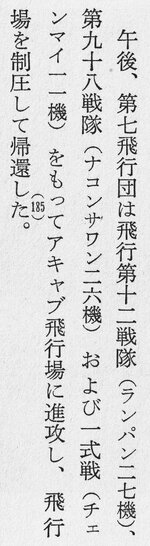
 
Depending on who was writing/transcribing the report the "ー一" (ie one horizontal character shorter the the other) might be a typo and should be "一一" (ie two longer horizontal characters, so "チエンマイー一機" would be "チエンマイ 一一機" (note the extra space between "チエンマイ" and " 一一機" which changes the meaning to 'Chiang Mai' and '11 aircraft'.

Thus

午後、第七飛行団は飛行第十二戦隊(ランパン二七機)、第九十八戦隊(ナコンサヮンニ六機)および一式戦(チエンマイー一機)をもつてアキャブ飛行場に進攻し、飛行場を制圧して帰還した

with the 2 longer horizontal characters and a space in front of them, becomes

午後、第七飛行団は飛行第十二戦隊(ランパン二七機)、第九十八戦隊(ナコンサヮンニ六機)および一式戦(チエンマイ 一一機)をもつてアキャブ飛行場に進攻し、飛行場を制圧して帰還した.

which translates as

In the afternoon, the 7th Air Brigade advanced upon Akyab Airfield with the 12th Air Regiment (27 aircraft from Lampang), the 98th Air Regiment (26 aircraft from Nakhon Sawan), and Type 1 Fighters (11 aircraft from Chiang Mai); having secured control of the airfield, they returned to base.
 
Depending on who was writing/transcribing the report the "ー一" (ie one horizontal character shorter the the other) might be a typo and should be "一一" (ie two longer horizontal characters, so "チエンマイー一機" would be "チエンマイ 一一機" (note the extra space between "チエンマイ" and " 一一機" which changes the meaning to 'Chiang Mai' and '11 aircraft'.
Thank you for your quick response.

You are correct: the OCR was in error in transcribing two different dash lengths: both should have been long (copy attached). With that change, Google translates as "11".

There was no space in Senshi Sosho's text,イ一一機. But it seems to have not been necessary for Google translate.

So --- my ignorance: "11" can be written as either "一一" or "十一"?
 

Attachments

  • 703pt.jpg
    703pt.jpg
    57.4 KB · Views: 27
Yes. It seems to be a matter of who was writing/transcribing the numbers. and in what context.

In Chinese and Japanese formal(?) writing, "ten" was written as "十" ( a single character for 10 ) and "twenty" would be "二十" ( the character for 2 followed by the character for 10).

But Chinese and Japanese did not use a character for "zero" as a place holder in their number system(s). So while the formal character(s) for "eleven" or "twenty-one" would be "十一" or "二十一", over time the "十" symbol for "ten" began to be treated similarly to how "zero" is treated in the Hindu-Arabic numbering system used by most of the Modern world today.

So in the same way, when "eleven" or "十一" and "twenty-one" or "二十一" is written in more common usage, the "ten" or "十" character is dropped and the numbers are written as "一一" and "二一". This same way of dropping the "十" character is evident in the number "twenty-seven" in the text you are translating - instead of the formal "二十七" it appears as "二七" with the "ten" being dropped.

I suggested using a "space" before characters that may be numbers (such as "一一" or "ー一") as I have found that the various translation systems seem to have problems differentiating between formal and common writing, and where similar characters might be used for different purposes.
 
From Senshi Sosho vol 34 p 703, dealing with events in Burma on the afternoon of 24 May 1942, I have this paragraph:

午後、第七飛行団は飛行第十二戦隊(ランパン二七機)、第九十八戦隊(ナコンサヮンニ六機)および一式戦(チエンマイー一機)をもつてアキャブ飛行場に進攻し、飛行場を制圧して帰還した。

Google translates it as:
In the afternoon, the 7th Air Group, with the 12th Air Squadron (27 aircraft from Lampang), the 98th Air Squadron (6 aircraft from Nakhon Sawan), and a Type 1 fighter (1 aircraft from Chiang Mai), advanced on Akyab Airfield, seized control of the airfield, and returned.

I'm curious about the last aircraft mentioned, the "Type 1 fighter (1 aircraft from Chiang Mai)". I believe that the OCR of the text is correct, at least for this item; however, English sources (Ford and Shores) write about 11 fighters, not 1, going to Akyab. This fighter or these fighters was/were 64th Sentai flying out of Chiang Mai, acting as escorts for the Ki-21 bombers. Just one fighter as escort for 33 bombers isn't realistic.

Is there a better translation of チエンマイー一機 different from that offered by Google?
According to dictionary.com, Chiengmai is "a town in NW Thailand: teak, silver, silk industries: university (1964). Pop: 182 000 (2005 est)."
Best,
Mike Wenger
 
Last edited by a moderator:

Users who are viewing this thread

Back