
Who was Lamplugh?

Ad: This forum contains affiliate links to products on Amazon and eBay. More information in Terms and rules

WATU

Airman 1st Class
239
148
Sep 1, 2019
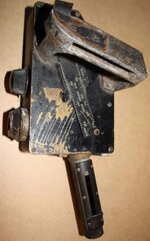
In 1940 a hand held low level bombsight was being issued to the RAF. It became known as the Low Level Bombsight Mk I. In August 1940 Portal, then CinC of Bomber Command, issued a review of bombsights currently in use and under development. This lists a hand held sight which is labelled as a Low Level Bombsight and it seems extremely likely that this was the Mark I. However Portal badges it as the "Lamplugh" bombsight.
I am curious about who Lamplugh was, where he worked and what his role was with the sight. Google has thrown up nothing of obvious value. There was a chap called Captain Alfred Gilmer Lamplugh who was an RFC pilot in WW1 and active in aviation circles for many years thereafter. He also had a family connection with a radio business so might have had some manufacturing/engineering background. But I have not found any actual link and he might be a red herring. Anyone able to shed light on Lamplugh and why the sight bears his name, at least briefly before it gets corporate as the Mk I? Edit - it does seem to have been developed at the RAE which seems likely given its moderate complexity.
 

Attachments

  • Mk 1 1.JPG
    Mk 1 1.JPG
    117.3 KB · Views: 56
Last edited:
I suspect that the man you are looking for information about is the A G 'Lamps' Lamplugh you mention above. The following link does not mention a bombsight but I think I remember reading about the connection in some other source (a long time ago). I could be wrong.

"Captain Alfred Gilmer Lamplugh, CBE, FRAeS, MIAeS, MCAI, FRGS (19 October 1895–15 December 1955) | This Day in Aviation."
Agreed. He is the only lead I have but as yet the records do not link him to the sight. Cannot be that many Lamplughs with an aviation connection.
 
Hi. Did you ever find out more about Lamplugh or Lamplough?

Portal signed a report in August 1940 referring to the Lamplough Sight.

TNA file ADM1/13828 has this catalogue entry: "INVENTIONS AND SUGGESTIONS (59): Track recording: drift recorder Mark II by Mr F E Lamplough".
As an ADM file it is Admiralty rather than RAF but drift recorder work of any sort could be done by someone also involved with bombsights.

He cropped up in 1936 "In a paper read to the Illuminating Engineering Society on January 14, Mr. F. E. Lamplough pointed out some useful applications of fluorescence."

Today I found this site. I have not followed up on his university records yet but the author of the piece below did not get far.


I have been able to find surprisingly little about Lamplough. Educated at Oundle and Cambridge he was awarded a First in Natural Sciences in 1904. Elected a Fellow of Trinity College in 1906, he also served as Additional Demonstrator in Chemistry between 1914 and 1917. He married Augusta Gertrude Stewart in 1907. At the start of the Second World War, he was working at the Royal Aircraft Establishment, Farnborough. He died in 1975 at Woodchester, Stroud, Gloucestershire. During the work on Vita glass he is described as Late Fellow of Trinity College, Cambridge. My impression is that he was working for Chance Brothers, the famous makers of glass and lighthouses (he had patents for a gas valve used in lighthouses in 1920-21), throughout this period though perhaps not as an employee but as an independent inventor or consultant. He was also the inventor (The Times 22 May 1928) of the artificial daylight 'Daylamp' and a glare filter for Chance.

Lamplough's development of a low iron content glass that transmits in the ultraviolet range depended on the findings of Sir William Crookes that oxidised ferric iron absorbs, whereas ferrous iron transmits, ultraviolet. The Chance works would have been highly familiar with Crookes's work since they were responsible for developing and manufacturing special ultraviolet-blocking glass.


Vita+Spectrum.png
Spectrographs showing the transmission through Vita compared with
ordinary window glass. From Lamplough's RSA paper
 
Snippets but nothing of note.

Vita glass was apparently a true glass of high quartz content, which was developed in the 1920s by Francis Edward Everard Lamplough of Cambridge University.

LAMPLOUGH, F. E. E. On the determination of the rate of chemical change by measurement ofthe gases evolved. 14 (1908) 580-608.A simple form of electrical resistance furnace. 16 (1911) 175-6.The depression of the freezing points of sodium and calcium chlorides. 16 (1911) 193-6.
 

Users who are viewing this thread

Back