Why do engines have different shaped horsepower/altitude graphs?

Ad: This forum contains affiliate links to products on Amazon and eBay. More information in Terms and rules

Trexwyoming379

Recruit
1
0
Jul 18, 2025
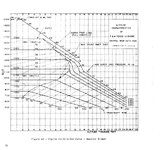
I've noticed that some horsepower/altitude graphs for supercharged engines look like this one for the Spitfire mk 21 (attached below, yes this is a terrible scan of this graph, it is what I could find) where the horsepower increases with altitude and then decreases. Some other horsepower/altitude graphs like the one for the F4U-1A (also attached) are mostly constant with altitude, decreasing before supercharger gear changes. Why is this? What do these engines do differently that causes this?


1758947790778.png

1758947635267.png
 
Engine performance curves are quite a thing. The basic power/altitude plot is simple, with power reducing with altitude. However, there are many variations of supercharger gear arrangements/changes, boost controllers, supercharger characteristics/efficiency, Ram effect etc, that do superimpose on the achieved power. Beyond that, the performance declared by the manufacturer or as tested by other agencies can be simplified or done to different settings.
As regards the "SAW-TOOTH" graph of power changes with supercharger gear changes, that is usually where the supercharger excess output has reached zero, the throttles are wide open and the manifold pressure starts to drop, the gear change point is usually when the power output has fallen to what it will be after the gear change. Usually, Up and Down gear changes are made at different altitudes to minimise hunting between the changes if operating close to the change-over conditions.

Eng
 
I've noticed that some horsepower/altitude graphs for supercharged engines look like this one for the Spitfire mk 21 (attached below, yes this is a terrible scan of this graph, it is what I could find) where the horsepower increases with altitude and then decreases. Some other horsepower/altitude graphs like the one for the F4U-1A (also attached) are mostly constant with altitude, decreasing before supercharger gear changes. Why is this? What do these engines do differently that causes this?
We can note that, where the manifold pressure is constant on the 1st graph (approx between SL and 12500 ft, and again between 19000 and 25500 ft), the engine power slightly rises from the lower altitudes upwards, until the rated altitude is reached. Since the throttle is more and more opened towards the rated altitude, the throttling losses are ever lower, thus the engine makes better power, and the line is slant.
Please note that the engine power curve on that Spitfire graph is for a non-ram condition, while the speed and boost are for the 'full ram' (ie. top speed) condition, hence the mismatch between the power curve and the other two curves.

Some US engines, like the R-2600 (but not the R-1820!) and R-2800 (both 1- and 2-stage), were allowing for a a bit greater boost the lower we get from the rated altitude, so that bit of extra boost countered the increased throttling losses = engine graph is a vertical line under the rated altitude.
 

Attachments

  • chart R-2800-10 ntrl.JPG
    chart R-2800-10 ntrl.JPG
    89.3 KB · Views: 12
To add to what the other posters had said. Power is the result of air burned. Amount of air burned is the total amount of air flowed though the engine and the total amount of air is the result of both pressure and volume. Tomo has said this is pumping loss and it is often referred to as such. But often it is the result of closing off the the throttle part way to prevent over boosting. Yes the engine is less efficient. Takes more power to reach the same boost pressure but boost pressure is not volume/mass of air.
post-13312-0-33829300-1490296715.jpg

P-39 engine could give 1150hp at 12,000ft at 3,000rpm and with 42in of boost. with wide open throttle. Any higher and the supercharger will not give the pressure and volume to give the 1150hp rating (not counting RAM). Any lower and if throttle is opened wider you can get more power but perhaps break the engine. You might be able to get close to 1700hp at sea level but the engine might not last very long ;)
Now what is interesting is that the engine (with different controls) is quite capable of giving me 1200hp at 3,000ft and turning only 2400rpm to do it. BUT the engine controls (throttles and boost control are linked) would need to allow wide open throttle plate and about 45 in of boost. The exiting controls will not allow me to do that.

I will also note that sometimes the graphs are not 100% accurate. The engine in the P-39 was often rated at 1150hp anywhere between sea level and 12,000ft even though we can see that it dips to around 1075hp at a little over 2,000ft but it is back up to 1100hp at just over 5,000ft. Worrying about 50hp on an 1150hp engine was not worth it to pilots. There wasn't anything they could do about it.

Hope this make sense.
 
We can note that, where the manifold pressure is constant on the 1st graph (approx between SL and 12500 ft, and again between 19000 and 25500 ft), the engine power slightly rises from the lower altitudes upwards, until the rated altitude is reached. Since the throttle is more and more opened towards the rated altitude, the throttling losses are ever lower, thus the engine makes better power, and the line is slant.

The reasons for the increasing power between SL and rated altitude are more complex:

1) As mentioned, the gradual opening of the throttle or compressor control flap reduces throttling losses.

OK. But :

2) As altitude increases, ambient temperature decreases, and so does the temperature of the mixture entering the cylinders. This means that at constant pressure (due to regulation), mixture density increases, thus the power grows.
3) Finally, as altitude increases, ambient pressure also decreases (this is the whole problem with the S/C !) and thus the exhaust backpressure also decreases, thus increasing power further more.

It should also be added that at the beginning of the war, "altitude benches," reproducing the exact altitude operating conditions (temperature, pressure) in the workshops, were very rare. Therefore, many engine manufacturers calculate their curves by simply throttling the engine's air intake in order to reproduce the lowest ambient pressure at altitude. The influence of temperature and pressure on points 2 and 3 is interpolated using standardized correction curves, which do not ensure that the actual altitude performances are the ones calculated.

Regarding the issue of exhaust backpressure, there are NACA tests showing that its influence varies greatly from one engine to another, mainly depending on valve crossover. This obviously undermines the relevance of the "standardized" curve I mentioned above.

 

Users who are viewing this thread

Back