Hi ThomasP,
I used Aerodynamics for Naval Aviators. There is a free pdf download at:
https://www.faa.gov/regulations_policies/handbooks_manuals/aviation/media/00-80t-80.pdf .
If you look on page 154, there is a formula for Rate of Climb: RC = 33,000 * [(Pa - Pr) / W], where RC = Rate of Climb (fpm), Pa = power available (hp), Pr = power required for level flight (hp), W = weight (lbs).
Since I had tests and some data, I could plug in a known rate of climb at a known altitude and a known power (hp) and back into the required hp for level flight.
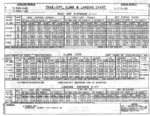
Let's look at the P-39C. At 10,000 feet, the rate of climb is 3,720 fpm. An Allison V-1710-35 makes 1,150 hp at 12,000 feet and the airplane is at a weight of 6,689 lbs. It just so happens we have data for 10,000 feet. Rate of climb is 3,720 fpm. Calculating backwards, the power required for level flight at that altitude is 396 hp. Personally, I'd expect the power required for level flight to go up as the altitude goes up becasue there is less air density, so the wing has to "work harder." By work harder, I mean a slightly higher angle of attack, and that creates more induced drag, requiring more power.
Now, I go to 20,000 feet and I have 1,530 fpm, same weight (for ballpark estimates, anyway). The table says 675 hp from the Allison. The power required for level flight is 365 hp, which is logical to me. Suppose I play P-39 Expert's game and assume the weight dropped by 350 lbs and I'm still at 20,000 feet. Using the same numbers as just above, the expected rate of climb would be 1,614 fpm, a gain of 84 fpm.
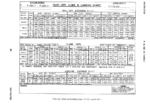
Now, let's look at the P-39D. Same engine. At 10,000 feet, the rate of climb shows 2,720 fpm and the rest of the data is the same except 7,525 lbs. I calculate Pr to be 530 hp. First, that is very strange because the two airplanes are so similar. The P-39D should not require 1/3 more power in level flight. Nevertheless, let's go to 20,000 feet. Same 675 hp available, same 7,525 lbs. I calculate Pr to be 378 hp! Somehow, it takes much less power to fly at 20,000 feet in thin air than it does at 10,000 feet in much thicker air?
No way. Something is very strange.
Now, go back to the 10,000 feet for the P-39D and assume about an equal difference between power required for the P-39D as for the P-39C. For the P-39C, the power required changed by about 30 hp between 10,000 feet and 20,000 fet. So, I take the P-39D power required at 20,000 feet ( 378 hp) and add 30 hp (408 hp) and calculate the expected rate of climb at 1,150 hp to be 3,254 fpm. That is significantly different from 2,720 fpm. If I next plug in the achieved rate of climb (2,720 fpm), I see the power avilable was only 1,028 hp and not 1,150.
Coincidentally, the normal power at 10,000 feet for the V-1710-35 at 2,600 rpm is 1,000 hp.
On the whole, it looks to me as if the P-39D test was likely carried out at Normal power and not military power. Again, if I lose the 350 lbs that P-39 Expert is wanting to lose, the expected rate of climb at 1,150 hp would go from 3,254 fpm to 3,413 fpm, a gain of 159 fpm. The differences between the P-39C and P-39D can be propeller, a sour engine, or any of many factors. But, it should NOT climb at only 2,720 fpm at 10,000 feet with 1,150 hp avaialble.
I am using the formula from Aerodynamics for Naval Aviators because most of the formulas were developed and checked for military-type airplanes with military type horsepower piston engines. There's the right way, the wrong way, and the Navy way. But the Navy doesn't make too many aircraft design calculation mistakes.