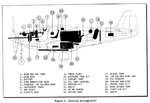
They usually tried to keep the top of the oil tank and the coolant header tank above the top of the engine to help get air bubbles out.
Okay, then we'll rotate it 80 deg upwards, so it's parallel to the prop shaft; it's own CoG mowes forward too. Under it goes the turbocharger. We will locate inter-cooler just aft the front wheel well, while also moving radio forward. The oil-tank armor can loose it's lower half to address CoG issues, too.
They may have tried to space the oil tank from the engine for temperature reasons. You have attached a schematic diagram and not a photograph, it does not show all pipe connections, brackets and small pieces of equipment in the area. I don't have a picture either so I don't know what is in that area.
You can check the schematics in The Book.
Plenty of space between engine oil tank, with couple of pipes to connect the tank engine, plus some parts of starter system.
I do know that in a similar discussion concerning the P-40 somebody had a similar diagram that showed space behind the engine and claimed that something could go there. In the real plane that space was partially occupied by the sidesway brace of the engine mount.
Yep, looking at P-40 diagram the turbo is a non-starter with current set up, aft the engine.
(soon in theaters near you: P-40 with turbo intercooler mounted in chin, with glycol oil coolers relocated in front of wings)
That is probably not the case here but these diagrams should not be take as the last word on available space. You may also want to leave room for the mechanics to work on the back of the engine, carburetor, starter, generator, gun synchronizers and any other accessories are on the back.
Not very maintenace friendly, I agree. But perhaps comparable with P-47, or twice as good as P-38 (maintenace-wise)?
Some planes were more tolerant of CG issues than others, either they weren't flying normally with their CG quite as far aft as the P-39 or they had different stall characteristics or they had different spin recovery characteristics or combinations of the these.
Increasing the likelihood of spin/crashes for extra range calls for a very careful balance. There perhaps were ways to gain a slight performance increase for the P-39 that did not involve making the flight characteristics anymore dangerous. In the early part of the war the P-39 was the second most produced fighter. By the end of 1942 over 2800 had been built. That is a lot of "experienced pilots" to come up with by then and it tends to leave the P-38 and P-40 squadrons with more than a fair share of "green" pilots.
You have a good point there.
Would you check out the sketch of wing for P-39 in thread about hypothetical US fighters for P-39. I've tossed some ideas above, that should've helped to keep CoG at it's place.
It didn't work historically for the P-39 and that is why the P-39 has it's bad reputation. Pilots, group commanders and theater commanders knew it couldn't do the all round fighter job although it could be useful in some roles. I am not saying turn it into a Zero but that extra weight is one reason it can't perform like other fighters using similar powered engines. Over coming a 15-30% weight handicap is going to take more than minor tweaking. Making a fast attack is a little difficult if the enemy is 5,000ft higher than you are.
If we have turbo on board, the P-39 is the one 5000ft above.
Something to consider when using book performance figures to evaluate combat is that book performance charts are established using standard atmospheric conditions. 59 degrees F or 15 degrees C and standard sea level pressure. Planes operating in colder areas got a bit of a boost in performance (denser air) while planes operating in the tropics/desert took a performance hit from the less dense air. It was a double wammy. The engines provided less power while the wing provided less lift. Because of Engine boost and wing loading not all aircraft suffered exactly the same performance loss per degree of temperature.
I'm trying all the time to ram more air in engine, so we can have more power

Well then, the non-turbo won't perform any better, but it might not perform worse at best? not exactly an endorsement.
The non-turbo (main changes are in reduced weight of armament [either 37 + 2x .50 cal, or 5 x .50 cal] to cancel out the weight of new tanks) will have the same weight. If on e wants range, he can cram more fuel in it. Or attach a bomb, and have decent range. So it's better performer.
Just 5% heavier? only a little more drag if you don't use an intercooler. While you may get 50% more power (using WER rating from a P-38 J engine? 1600 vs the 1125hp for a P-39Q engine is 42%) you might be getting only 13% more power 9000ft.
300 lbs for "supercharging with accesories" - half of what is stated for same item(s) of P-38J in The Book. The drag is price to pay, Supermarine paid it when developing Spit IX from Mk.V. The comparison between two V-1710s makes all the point: we want a plane for USAAC that can do hi-alt work as early as mid-42, while being available affordable.
Talk about apples and oranges
P-63, aside from using a 37mm cannon and the Allison extended shaft engine set-up had no interchangeable parts with a P-39. A new fuselage, a new wing of different airfoil (laminar flow with maximum thickness much further back along the cord, which is why the fuel tanks were back there) different area and different construction, it used a main spar and a rear spar instead of the spar arrangement of the P-39. While it had a longer fuselage please note that the wing was further back on the fuselage than on the P-39 which means the engine was further forward in relation to the wing, center of lift. Cockpit was in front of the wing instead of above the leading edge. It's landing gear was wider tracked and it had 10 more inches between the nose gear and the main wheels.
Where they could put fuel on the P-63 has very little to do with where they could put fuel on the P-39.
No apples and oranges.
If it's bad to have plenty of expandable stuff aft the CoG, it doesn't make any difference what plane is subject.
If you point at impossibility to install fuel tanks in front of main spar, because of lack of space, that's not likely. The wing thickness in front of main spar, but inboard, was greater than where fuel tanks were located. The P-38 have had fuel tanks in leading edge - a space much less generous than front half of P-63's wing.
However, with both the P-39E and the P-63 as attempts to improve the concept of the P-39 (37mm gun firing through prop hub) they are indications that more "stuff" could not be crammed into the existing P-39 airframe.
The only 'stuff' P-63 was carrying extra was auxiliary blower (not even intercooler). Despite designing new wing, it was inferior to, older, P-51's (less fuel, no internal HMGs, ammo for only for 1 HMG). P-63 can hardly be used as a proof how some people are good designers/engineers, dismissing a premise that only P-63 is a way to make better P-39.
While we "know" that P-39 was flown with rear fuselage/wing tanks we do not "know" one way or the other that the idea wasn't thought of, sketches made with preliminary calculations and given up. Considering some of the other stuff that shows up on paper sketches (Merlin powered P-63s with massive airscoops in the wing center section) it doesn't seem likily that this was totally over looked.
Well put.
Is the part "with rear fuselage/
wing tanks" referring to drop tanks, among other, or to additional inner wing tanks? I'd like to know more anyway