Currently, I'm working on my upcoming book From Tokyo to Torch: The Story of Five Doolittle Raiders in the USAAF's 319th Bombardment Group.
Every now and then, research takes me deep into archival material, where unexpected and often deeply human stories emerge. Some of these fragments never make it fully into the main narrative, yet they offer a powerful glimpse into the realities behind the records.
Recently, I came across a remarkable account linked to a mission over Sicily in July 1943. A co-pilot, captured after bailing out, was later liberated following the Allied landings. After his return to the United States, he provided a statement based on what he had been told during captivity. It described the fate of his pilot—found in the cockpit, still strapped in—and, strikingly, buried with military honors by the opposing side.
It's a small piece of a much larger story, but one that quietly reflects the complexity of war: loss, respect, and the thin line between enemies.
I thought it was worth sharing.
319th Bombardment Group
4 July 1943
Mission No. 47
During the attack on the airfield at Gerbini, Sicily the B-26 Marauder with serial number 41-31589 was heavily hit by anti-aircraft fire and enemy fighters. The aircraft was piloted by Lt. Robert Praun. At an altitude of approximately 14,000 feet, the aircraft sustained such severe damage that it could no longer remain in formation, and control was rapidly lost.
According to the testimony of co-pilot Richard A. Love, the order to abandon the aircraft was given while it was still airborne. One by one, the crew members left the aircraft. In those brief moments, between control and collapse, their survival depended on timing and chance.
Praun remained on board.
Why he did so cannot be determined with certainty. He may have attempted to stabilize the aircraft long enough to give his crew time to jump. The heavily damaged aircraft continued its descent and crashed in the hills southwest of Licodia Eubea, Sicily.
Later information, obtained through an Italian officer, indicated that Praun was found dead in the cockpit, still strapped into his seat. He had been killed on impact.
What followed diverges from the usual pattern of the air war. Instead of an anonymous grave or an unrecorded burial, Praun was given a military funeral. He was buried at Licodia Eubea, near the site where his aircraft had come down—a rare moment of recognition for an adversary in a conflict that seldom allowed for such gestures.
The crew consisted of navigator/bombardier Paul C. Tomich; engineer and gunner Clarence W. Nelson; radio operator and gunner Roy W. Roberts; gunner Pedro C. Carranco; and co-pilot Richard A. Love.
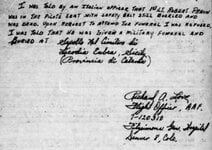
According to a statement by co-pilot Richard A. Love, an Italian officer informed him that Lt. Praun had been found lifeless in the pilot's seat, with his safety belt still fastened. His request to attend the funeral was denied. He was further told that Praun, after being processed through a local hospital, had been buried with military honors at the cemetery of Licodia Eubea, Sicily (Province of Catania).
It is noteworthy that co-pilot Richard A. Love, after parachuting onto Sicily, was taken prisoner by Italian forces and interrogated about the crash of the aircraft. In the aftermath of the Allied landings on Sicily, he was liberated, allowing his unit to obtain valuable information regarding the final phase of the flight and the loss of the aircraft.
In a statement recorded after his repatriation, Love described what he had been told during his captivity:
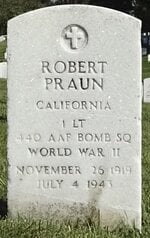
Does anyone happen to have a photograph of Lt. Robert Praun, pilot of B-26 41-31589 shot down near Licodia Eubea on 4 July 1943?
Every now and then, research takes me deep into archival material, where unexpected and often deeply human stories emerge. Some of these fragments never make it fully into the main narrative, yet they offer a powerful glimpse into the realities behind the records.
Recently, I came across a remarkable account linked to a mission over Sicily in July 1943. A co-pilot, captured after bailing out, was later liberated following the Allied landings. After his return to the United States, he provided a statement based on what he had been told during captivity. It described the fate of his pilot—found in the cockpit, still strapped in—and, strikingly, buried with military honors by the opposing side.
It's a small piece of a much larger story, but one that quietly reflects the complexity of war: loss, respect, and the thin line between enemies.
I thought it was worth sharing.
319th Bombardment Group
4 July 1943
Mission No. 47
During the attack on the airfield at Gerbini, Sicily the B-26 Marauder with serial number 41-31589 was heavily hit by anti-aircraft fire and enemy fighters. The aircraft was piloted by Lt. Robert Praun. At an altitude of approximately 14,000 feet, the aircraft sustained such severe damage that it could no longer remain in formation, and control was rapidly lost.
According to the testimony of co-pilot Richard A. Love, the order to abandon the aircraft was given while it was still airborne. One by one, the crew members left the aircraft. In those brief moments, between control and collapse, their survival depended on timing and chance.
Praun remained on board.
Why he did so cannot be determined with certainty. He may have attempted to stabilize the aircraft long enough to give his crew time to jump. The heavily damaged aircraft continued its descent and crashed in the hills southwest of Licodia Eubea, Sicily.
Later information, obtained through an Italian officer, indicated that Praun was found dead in the cockpit, still strapped into his seat. He had been killed on impact.
What followed diverges from the usual pattern of the air war. Instead of an anonymous grave or an unrecorded burial, Praun was given a military funeral. He was buried at Licodia Eubea, near the site where his aircraft had come down—a rare moment of recognition for an adversary in a conflict that seldom allowed for such gestures.
The crew consisted of navigator/bombardier Paul C. Tomich; engineer and gunner Clarence W. Nelson; radio operator and gunner Roy W. Roberts; gunner Pedro C. Carranco; and co-pilot Richard A. Love.
According to a statement by co-pilot Richard A. Love, an Italian officer informed him that Lt. Praun had been found lifeless in the pilot's seat, with his safety belt still fastened. His request to attend the funeral was denied. He was further told that Praun, after being processed through a local hospital, had been buried with military honors at the cemetery of Licodia Eubea, Sicily (Province of Catania).
It is noteworthy that co-pilot Richard A. Love, after parachuting onto Sicily, was taken prisoner by Italian forces and interrogated about the crash of the aircraft. In the aftermath of the Allied landings on Sicily, he was liberated, allowing his unit to obtain valuable information regarding the final phase of the flight and the loss of the aircraft.
In a statement recorded after his repatriation, Love described what he had been told during his captivity:
I was told by an Italian officer that 1st Lt. Robert Praun was in the pilot's seat with safety belt still buckled and was dead. Upon request to attend the funeral I was refused. I was told that he was given a military funeral and buried at Cimitero di Licodia Eubea, Sicily (Provincia di Catania).
Richard A. Love
Flight Officer, AAF
T-120310
Fitzsimons Gen. Hosp.
Denver 8, Colo.
Does anyone happen to have a photograph of Lt. Robert Praun, pilot of B-26 41-31589 shot down near Licodia Eubea on 4 July 1943?