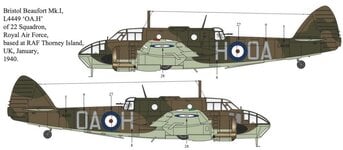
Hello, today I bought Bristol Beaufighter from Airfix and i want to buy the Xtradecal sheet of decals.
To the point, I would like to build the aircraft L4449 OAoH. My question is, do somebody have a photo of this aircraft when it had no yellow outer ring of the fuselage roundel. Also is it possible, that this aircraft (as shown in the instructions) participated in the battle of france ( without yellow ring) and if so, what it carried above the france? bombs or torpedo?
Thank you guys.
While 22 squadron began to receive its Beaufort I on 15th Nov 1939, while at Thorney Island on the south coast of England, the type was not cleared by A&AEE for operational use until some months later. As a result 22 squadron did not fly its first operational sorties until 15th April 1940. By then it had moved to North Coates near the North Sea coast in Lincolnshire to be nearer its operational area over German North Sea waters and coastline.
No.22 Squadron began the Second World War as a torpedo bomber of Coastal Command, before moving to the Far East in March-April 1942. After spending the next two years flying anti-submarine patrols and convoy escort missions, it converted to the Beaufighter and spent 1945 as a ground attack...
www.historyofwar.org
Initial sorties were to lay mines with Gneisenau an early victim on 5th May off the Elbe estuary. (The RAF aerial minelaying campaign had begun the night before, 13/14th April, by Hampdens of Bomber Command).
On 7th May, 22 squadron dropped the first 2,000lb armour piercing bombs in an unsuccessful attack on shipping off Norderney on the German coast. The first Beaufort torpedo dropping sorties were not flown until 11th Sept 1940, again by 22 squadron. Until then it was either bombs or mines that were carried.
While two more squadrons began to receive Beauforts from April 1940, 42 squadron didn't become operational until 5th June at Thorney Island, followed by 217 squadron at St Eval. But following losses due to engine problems all Beauforts were grounded from late June. Beaufort operations only began again on 31st Aug with 22 squadron.
You will find more information about the operations In the various squadron Operational Record Books downloadable from The National Archives.
"The Beaufort File" published by Air Britain has a poor quality photo of a line up of three 22 squadron aircraft taken in early 1940 that includes L4449 as the second aircraft in the row (the others are L4458 / I-OA and an unidentified third aircraft). And this is where the problems start with the illustration you posted. The underside colour is noted as Silver with no fin flash and Type A roundels in 6 positions.
On the following link you will find details of Coastal Command camouflage & markings as they progressed through WW2. Points relevant to your query are-
Aug 1939 - camouflage would be Dark Green / Dark Earth / Aluminium paint
7th Dec 1939 - orders to make fuselage & upper wing markings Type A (lower wing were already Type A)
1st May 1940 - yellow ring to be added to the fuselage roundel
June / July - upper wing roundels to be Type B (red / blue)
July 1940 - undersides to be Sky or Black as determined by individual Commands. CC(As CC were operating both day and night both could be appropriate to the Beaufort).
Here is a very early photo of L4449. Note Type B fuselage & upper wing roundels and no fin flash, dating it to no later than early Dec 1939 (allowing for time to repaint the markings) and Aluminium finish undersides.
Beaufort L4449

www.worldwarphotos.info
Here is a photo of L4449 and others taken at North Coates, later in 1940, when it had black undersides, fin flash and Type A1 (with the yellow ring) roundels on the fuselage sides. Note how the outer yellow ring has been painted around the squadron codes.
Beauforts L4449 OA-H, L9891 OA-F and L4461 OA-J, of No. 22 Squadron RAF, at North Coates
www.worldwarphotos.info