
Effectiveness of the P-38 (6 Viewers)

Ad: This forum contains affiliate links to products on Amazon and eBay. More information in Terms and rules

Neel Kearby, allegedly with a high angle deflection shot. March 1943.

March 5 1944. Claimed 26 kills (?). 21 credited. Definitely one of the top P-47 aces of them all. I was not familiar because of the somewhat unusual theater for a top P-47 ace...
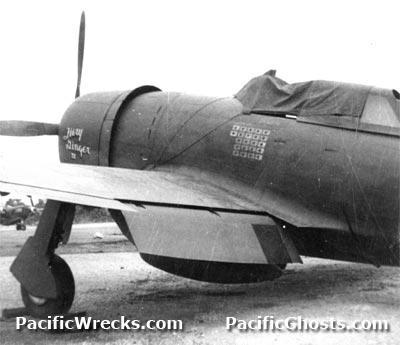

One of the more unusual thing I heard about P-47s in the Pacific is that with heavy bombloads, combined with short island runways, they tried to take off very early in the day or very late in the day, as in full sunlight the air was too dilated (not dense enough) to let them take off(!)... I don't now if this applied to Ns, but I am almost sure the source of this tidbit flew the shorter span Ds.
 
March 5 1944. Claimed 26 kills (?). 21 credited. Definitely one of the top P-47 aces of them all. I was not familiar because of the somewhat unusual theater for a top P-47 ace...


One of the more unusual thing I heard about P-47s in the Pacific is that with heavy bombloads, combined with short island runways, they tried to take off very early in the day or very late in the day, as in full sunlight the air was too dilated (not dense enough) to let them take off(!)... I don't now if this applied to Ns, but I am almost sure the source of this tidbit flew the shorter span Ds.
He was actually credited with 22, including one on the day he was shot down. I have not seen the '26 claim' list.
 
So by 1944 the Ki43 improved into an aircraft that was equivalent to a 1940 Mk I Spitfire or low dash Me109E?

I don't think you quite realise how off you are...:

RAE minimum turn radius tests (turn times are my estimation): Spitfire I: 1025 feet (360 about 22-23 seconds, 20-21 seconds if at a higher than minimal speed) Hurricane I : 800 feet (about 18 seconds) Me-109E: 880 feet (about 19-20 seconds to left at a lower speed)

Ki-43-II 1944 TAIC pilot manual translation: 360: 11 seconds both ways...

TAIC added note in the translation of a captured Ki-43-II pilot manual; "There is reason to believe that the Ki-43 is greatly preferred to the higher performing Tony and Tojo types."


-From Osprey; "Ki-43 Oscar aces of World War 2": P.50: (Sgt Toshimi Ikezawa, Ki-43 ace): "I heard Major Eto had refused delivery of the Ki-84. I think we owe our survival to the Ki-43,
as the Ki-84 would have left you in a mighty tight spot if you were attacked from above by
P-51s. ---Skilled (Spitfire Mk VIII) enemy pilots such as flight leaders would pull out of their
dives
when they realized they could not catch us [unaware]. New pilots would dive straight
down on us
, leaving them vulnerable in a turning fight."


-Iseo Mochizuki (Ki-61 pilot ace, 2009 interview); "In the case of the Hien, you would make
a high-speed attack [makes dive and zoom hand gesture]. But then, because [of the speed]
the turn radius became wide
, and the enemy pilot [target] could turn inside you. Because of
that [speed] the chances of being shot down was high
."

-Notes by QAZ, "Aviation Decisive Battle Weapons" P. 164-165, "Unknown Sword" P. 86-89 (Me-109E-7 vs
Ki-27): Oblt. Losigkeit: "I think the Bf-109 can shoot when the Ki-27 tries [begins] to turn. [However] the Ki-27 often
turns, so I cannot dive on it.
"

Concerning the Zero it was quite another matter, given the irrational (and extreme) Japanese Navy hostility to low speed prolonged turns:

-Drachinifeld, YT, "Zero or Hero?" (Interview with Justin Pyke, UCalgary MA in Military and Intelligence
History, @CBI_PTO_History) 59:07 "Intelligence reports assumed that these tactics (hit and run) indicated the
Zero lacked maneuverability
." 59:22 "Judging from their apparently long fuselage, these planes do not have a
small turning circle, and are not very maneuverable." 59:33 "The Chinese report in question noted the
reluctance of the Japanese Navy pilots to dogfight
." 1:00:05 "Chinese pilots report that the Japanese will not
engage in a turning duel
." 1:01:42 USN pilot comment (1942): "In my opinion, they [Zero pilots] had generally
poor fighter tactics: Zeros could not be shaken by us if they would chop their throttles and sit on our
tails
." [Meaning turning with them]


View: https://youtu.be/ApOfbxpL4Dg?si=Sv7JdNB9Za3biXVN

"On October 21, 1943, the Group launched eight aircraft along with four Mustangs from the 530th on a big Japanese supply dump at Kamaing in Burma. The 530th squadron's P-51As met numerous Mitsubishi Zeros when they accompanied B-24s and B-25s on bombing missions. On the way down, I came up behind Lt. Geoffrey Neal, who was chasing a Zero [Mitsubishi A6M] down to the deck! I latched on to their formation and watched as he drove the enemy fighter right into the ground. The pilot of the Zero had tried everything to get rid of Lt. Neal except to circle fight. At this point, Lt. Arasmith had two confirmed kills, but the fight wasn't over…"-311th Fighter Group Unit history
 
March 5 1944. Claimed 26 kills (?). 21 credited. Definitely one of the top P-47 aces of them all. I was not familiar because of the somewhat unusual theater for a top P-47 ace...


One of the more unusual thing I heard about P-47s in the Pacific is that with heavy bombloads, combined with short island runways, they tried to take off very early in the day or very late in the day, as in full sunlight the air was too dilated (not dense enough) to let them take off(!)... I don't now if this applied to Ns, but I am almost sure the source of this tidbit flew the shorter span Ds.
Col Neal Kirby's loss was tragic, loss of all the pilots was tragic. The more I read about the South West Pacific, I think Gen Kenney turned a blind eye to crew fatigue.
 
One of the more unusual thing I heard about P-47s in the Pacific is that with heavy bombloads, combined with short island runways, they tried to take off very early in the day or very late in the day, as in full sunlight the air was too dilated (not dense enough) to let them take off(!)... I don't now if this applied to Ns, but I am almost sure the source of this tidbit flew the shorter span Ds.

It was quite a common practice in the Far East if aircraft were heavily loaded.
 
Way back, about 1959, the first F-86D for the new 159 FS LA ANG landed at the New Orleans Lakefront airport. This was before the longest runway was lengthened. The F-86D fighters were to replace the Douglas B-26s of the 122nd Light Bombardment Sq then stationed at the Airport. An always exciting event was to watch B-26 takeoffs. They would taxi to the runway, turn towards the overrun, move to the edge of the concrete, turn 180, run up the engines full similar to a carrier takeoff, release brakes and it always seemed they retracted the L/G to miss the seawall. I missed the F-86D takeoff three days after delivery because they made the run in the early morning, first light, to use the dense cool air. He landed at the new facility in Belle Chasse La. where the LAANG still lives.
 
It was quite a common practice in the Far East if aircraft were heavily loaded.
Most US manuals include a take-off chart like this one

For some reason the US used 0 degrees C as the standard for this chart while all the engine charts used 15 degrees C standard (59 degrees F).
Please note the 10% longer take off distances for every 10 degrees above 0 degrees.
So on a 35 C (95F) day you need 35% more runway than a 0 degree day and more importantly here about 10% more runway at 40 C compared to 30 C.
and since our 15,00lb P-47 already needs about 3150ft on a zero wind day at 30 C and extra 300+ft may be hard to find at mid day.

Wings don't make as much lift at higher temperatures and engines don't make as much power at the same manifold pressure.
 
Last edited:
I don't think you quite realise how off you are...:

RAE minimum turn radius tests (turn times are my estimation): Spitfire I: 1025 feet (360 about 22-23 seconds, 20-21 seconds if at a higher than minimal speed) Hurricane I : 800 feet (about 18 seconds) Me-109E: 880 feet (about 19-20 seconds to left at a lower speed)

Ki-43-II 1944 TAIC pilot manual translation: 360: 11 seconds both ways...

TAIC added note in the translation of a captured Ki-43-II pilot manual; "There is reason to believe that the Ki-43 is greatly preferred to the higher performing Tony and Tojo types."
Something does not seem right.
The Spitfire turn is too high according to some sources. It is often given as 885ft radius.
estimated speed ( double radius times 3.14 for feet circumference then divide by seconds needed to get fps and then convert to mph) is about 191mph for the Spit (885 radius), 190mph for the Hurricane and 188mph for the 109. Not going to argue with those as even 1-2 seconds can make a difference.
Problem comes with the Ki-43 and the fact that no radius is given.
I am not saying that the Ki-43 could not turn better. Question is how much better?
just plugging in numbers I get.
450ft radius=174mph
500ft radius=194mph
600ft radius=233mph.
all using 11 seconds for a 360 degree turn.
Can a Ki-43 really do 2 full 360 degree turns for 1 turn by the Spitfire?
In order to do a 11 second 360 degree turn the Ki-43 needs to doing a very small circle or going very, very fast. Are we looking at a misprint/typo?
I have not tried to do the G force needed.

Many Japanese pilots that had experience with the Ki-43 did not like the faster, higher wing loading fighters because they just flew so different to what they were used to.
I have read that some Luftwaffe pilots did not want to give up their 109s to change over to the Fw 190s because of the difference in handling/cockpit layout/reaction time.
US 56th fighter group did not change over to Mustangs from their P-47s.
 
OK, I am getting old and maybe I am not thinking clear.
Manual says flying at 205mph which is 300fps.
Turn takes 11 seconds which is the plane flying 3300ft distance.
Radius is given at 301.5 ft which I double to 603ft and multiply by 3.14 to get the circumference of the circle which is 1893.4 ft.
What am I doing wrong????

Or is the plane flying at 115mph?
 
I don't think you quite realise how off you are...:

RAE minimum turn radius tests (turn times are my estimation): Spitfire I: 1025 feet (360 about 22-23 seconds, 20-21 seconds if at a higher than minimal speed) Hurricane I : 800 feet (about 18 seconds) Me-109E: 880 feet (about 19-20 seconds to left at a lower speed)

1770795032392.png


Report B.A.1640, November 1940.
 
Hey Shortround6,

You are thinking clearly. The numbers as presented in the translation do not work. Either the time is wrong or the speed is wrong or the radius is wrong.

At 205 mph IAS a 360° turn in 11 sec works out to a radius of 543 ft at a sustained 5.6 G, which was not possible for any aircraft in the WWII or Korean era.

At 205 mph IAS a 360° turn in 11 sec with a radius of 305 ft would be a sustained 9.5 G, which was not possible for any service aircraft until the F-15 Eagle(?).
 
Last edited:
Hey Shortround6,

You are thinking clearly. The numbers as presented in the translation do not work. Either the time is wrong or the speed is wrong or the radius is wrong.

At 205 mph IAS a 360° turn in 11 sec works out to a radius of 543 ft at a sustained 5.6 G, which was not possible for any aircraft in the WWII or Korean era.

At 205 mph IAS a 360° turn in 11 sec with a radius of 305 ft would generate a sustained 9.5 G, which was not possible for any service aircraft until the F-15 Eagle(?).

An Oscar II would never make sustained speed turns at such a high speed, so yes the value is wrong, but is maybe it is a starting value, allowing for a high rate of speed decay. 11 seconds is very low for sustained speed... Truly sustained speed was probably 13-14 seconds at 120-140 mph. It also would not normally sustain turns at full power (like most WWII types except the maybe the Spitfires and Yaks, due to their peculiar wings and leading edges not dog-legging the prop spiral enough), sustained turning radiuses were always at their best when making circles at massively reduced power, as much as 40-50% below WEP, and the effect on turn rate of that seemed to have been small, since the turn radius was so much smaller.

The turn times were probably not much reduced by power cutting, but reducing power did massively cut the radius, and the radius was king to get aiming lead... (By contrast the turn time hardly mattered: Even if you gained in the circle in rate, you could not get aiming lead at a smaller radius and so you inevitably wound up in front, and then the smaller radius did get the aiming lead on you... So the better rate was actually bad in this case... All WWII pilots ever obsess about is radius and cutting power to get it, never speed or energy in turns... The only apparent exception to this was the Spitfire, which could do a controllable stall with 3-axis control and "shoot across the circle" towards smaller German radiuses, with wings rumbling. Spitfire pilots do mention doing this, but it was likely not a stable target picture for obvious reasons. This was the crutch to the Spitfire's poor radius...)

Cutting power continuously 40% below WEP during multiple circles was virtually routine by 1945: Here Erich Brunotte mentions using only 0.9 ATA (Absolute Technical Atmosphere, a measure of manifold pressure) to 1.2 ATA, when his fw-190D-9 had available 1.9 ATA (!!). "We almost never used it."

This was so routine that he says, quite extraordinarily, that he hardly ever got out of that 50%-60% power range during combat(!!!!), except to get away. This means that to him combat in 1945, in a D-9, is synonymous with circles at half power...


-Erich Brunotte (YT interview, "The Fighter Collection/Eagle Dynamics": "Luftwaffe fighter
pilot Erich Brunotte meets the Digital Combat Simulator FW-190D-9": 12:15: "Engine
Power Management": "We almost never used full throttle – We had it on normal power but
we pulled back even from that, as you did not need that much in a fight – You used WEP to
get away or get close [straight lines] but it happened rarely – The manifold pressure [in
combat] was usually 0.9 to 1.2 ATA.
" [The FW-190D-9 maximum was 1.7/1.9 ATA.]


View: https://youtu.be/kOuVqP89058?si=Z586Oup91Od5O2dk


A combat between 16 P-38Ls and one Ki-43-II went on for 30 minutes with no hits scored, and all 16 P-38s went home out of gas or ammo... One pilot described it such: "He just made constant circles loafing at low throttle with his canopy open, going extremely slow, and we never managed a single hit." It is too bad I cannot source that one...

A Fieseler Storch obtained a similar result when the Germans made tests to determine how the Me-109G could attack the Soviet Po-2s. The problem of a slow target was in this case so extreme that despite repeated tests, the Me-109 never managed to even get a single frame of the Fi-156 ON FILM... I can source that one...

Because boomers historians have made such a mess of thinking that reality conveniently lines up with their expectations (the Zero avoiding low speed turns, per Navy doctrine, being probably the most shocking example), we now have not the slightest understanding of how extreme the problem is of hitting a slow target making circles at minimum speed.

An N1K2 pilot described surviving 15 minutes of passes by 8 P-51Ds without suffering a single hit. The method? You guessed it: "I was making circles at such an extremely slow speed that they could not understand what they were seeing." They just continued to approach and then were unable to correct, swinging by at useless speed... He was doing this over a lake near his home. I can source it.

And now for the king of slow turners, despite being extremely mushy and clumsy, with a uniquely extreme speed loss during the initial phase of the turn, the Razorback P-47D... (Not to be confused in this with the Bubbletop...) No late war design was more obsessed with turning at extreme slow speed than the P-47D (at least in left turns...) Dive and then zoom? I can't recall a single clear cut case in nearly one thousand Encounter Reports I read through (twice)...:


-William M McDermott, 25 May 1944 [P-47D Razorback, needle-tip prop (superior prop for
low speed turns if using full power)]: "The enemy aircraft [Me-109G-6] and I both banked
to the left at the same time. After 3 or 4 climbing turns I managed to get into a position to
fire a deflection shot, using about two rings and observing no hits. [5000 ft.] We continued in
a climbing Lufberry using full power and indicating 140 mph. I used two and half rings and
observed a few hits on his tail surfaces. We continued circling for approximately another full
turn when he suddenly snapped and spun in.
"

1770842690595.png


Note that here the needle-tip prop would be equivalent to using partial power. In May it very likely was.

And now our good old Rechlin and KG 200 Luftwaffe test pilots, like most WWII test pilots with little front-line experience, with their usual test pilot propensity to use full power in turns, against an underpowered (!!!) P-47D Razorback (!!!!), with needle-tip prop (!!!!!), they of course cannot help but come across as Captain Obvious:

On Special Missions: The Luftwaffe's Research and Experimental Squadrons 1923-1945.
Classic, 2003: Luftwaffe KG 200 evaluation: "The P-47D out-turns our Bf-109G."

Well duh you know...

Another random example of the period obsession with lowered power:

-Kyosti Karhila, 32 victory ace (Finland):
"I learned to fly with the "Cannon-Mersu" (Me-109G-6). I found that when fighter pilots got
in a battle, they usually applied full power and then began to turn. In the same situation I
used to decrease power, and with lower speed was able to turn equally well.
With lower
speed you got the smaller radius, then you got the deflection.--When the enemy decreased power,
I used to throttle back even more
.
"

It was literally a contest of lowering power... Does this fit well with your conception of how this worked?
 
Last edited:
View attachment 867104

Report B.A.1640, November 1940.


Yes, the angle of bank is the dead giveaway on these figures...

696 feet comes from these charts below: Don't they look cute? I just love these things....

1770843569857.png


Note no airframe number, pilot name, or flight date... This is how they were arrived at, in case you are wondering:

The RAE determined in Report No. B.A.1640 that "The minimum radius of turn without height loss at 12,000 ft., full throttle, is calculated as 885 ft. on the Me 109 compared with 696 ft. on the Spitfire." and that the corresponding time to turn through 360 deg is 25 seconds for the Me 109 and 19 seconds for the Spitfire. 73​ (See also Me 109 and Spitfire. Comparison of Turning Circles and Spitfire and Me 109 Diagrams of Turning). 60 years later Dr. John Ackroyd, PhD, C.Eng, FRAeS of the Aerospace Division, Manchester School of Engineering, University of Manchester, and Fellow of The Royal Aeronautical Society, took a fresh look at this subject in his paper "Comparison of turning radii for four Battle of Britain fighter aircraft". He calculated the minimum turn radii to be 686 feet for the Spitfire IA versus 853 feet for the BF 109 E-3 - which is in very good agreement with te RAE's findings. 7"​

CALCULATED. Gosh! What else is there to say?

But then reality intrudes...:


Reports and Memoranda No. ​2361​

September 1940*​

"When the Me.109 was following the Hurricane or Spitfire, it was found that our aircraft turned inside the Me.109 without difficulty when flown by determined pilots who were not afraid to pull their aircraft round hard in a tight turn. In a surprisingly large number of cases, however, the Me. 109 succeeded in keeping on the tail of the Spitfire or Hurricane during these turning tests, merely because our Pilots would not tighten up the turn sufficiently from fear of stalling and spinning."​

Its the MATH guys... The MATH says the diameter of two "somethings" is falling short... ​

Anyone cares to be reminded of the opinion of the RAF mission record holder?​

"So there are the legends about the Spitfire. Aaaah the legends... Legends are hard to kill. (You don't say!) One of those legends is that the Spitfire turned better than the Messerschmitt 109 or the FW-190. Well that is a good joke ["C'est une bonne blague"]. In fact, all those who found themselves with a 109 or a 190 turning inside them, at low speeds, well those in general did not come back to complain about the legend... Why? Above 280 to 300 knots, the Spitfire turned better than the Me-109. But, first and foremost, in a turning fight, the speed goes down and down and down and down, and at one point there comes a time, when the speed has gone down below 200 knots, that the Me-109 turns inside the Spitfire."


View: https://youtu.be/c2zdA9TcIYo?si=DV031ggNCvw0prf8
​


Oh but wait, I just read on these forum that he is the only pilot that you can't trust: "an exception". Well that's unfortunate!​

So how about the top Spitfire ace of all times? (top FW-190A killer as well, with 20) Oh, I forgot about about the "memoranda 2361": Clearly there is a twin diameter issue here as well... Because the math you know...:​

-Johnny Johnson (top Spitfire ace, 32 kills) "My duel with the Focke-Wulf": "With wide-open throttles I held the Spitfire [V] in the tightest of vertical turns [Period slang for vertical bank]. I could not see him, and little wonder, for he was gaining on me: In another couple of turns he would have me in his sights.---I asked the Spitfire for all she had in the turn, but the enemy pilot hung behind like a leech. It could only be a question of time..." ​


Definitely a diameter issue...​


1770845066196.jpeg
​


Last edited:
Depends.
Feb 1944 10 x P-38Js vs 20 P-51Bs is a very bad idea.
However, in late summer and early fall of 1942 10 x P-38Gs might very well be a better deal than 20 x P-40Ks or 20 x P-39 K/L. Or Spitfires without two stage Merlins. When did Spitfire V production stop?

Based on actual operational history and combat outcomes, I'd say 10 P-38Gs were worth 40 P-39 K/L, but probably not much better than 10 P-40K and more like maybe 6 or 8 P-40F.

P-38G gives you the extra range (but keeping in mind, range isn't optimized for P-38s yet in 1942) which added additional combat options, and altitude (particularly compared to P-40K, but P-38G also has some altitude limitations), so that also opens up some windows for certain kinds of missions for example escorting Allied heavy bombers or intercepting Japanese bombers in the Pacific, but in terms of shooting down enemy aircraft, escorting bombers on realistic strike missions, due in part to conditions (not so great for high altitude bombing, in most cases) P-40s were at least as useful in 1942 or pretty much any time in 1943.

In terms of surviving combat in the Mediterranean against Bf 109, Fw 190 and MC 202 and 205, you are better off with P-40F / L.

They were also pulling a lot less in terms of logistics chain.

By the time you get to 1944 then yeah 10 P-38J is probably worth 20 or maybe 30 P-40N.
 
Things didn't really work that way.

If someone was limping home, he was generally escorted. If they were already on the way home, then his escort was the entire group.

Disagree with that one - pilots often got isolated in combat, and routinely ended up flying home alone; however it is also true that they often made it back to base (or to a secondary base, or somewhere they could crash land relatively safely) if they survived the first few minutes of flying out of the combat area. You could only see enemy aircraft at a certain distance. This was true for all types of planes but the P-38 did have the extra engine for additional safety.
 
How effective were the 1942 era P38's?, from what I have read not really, it wasn't until the second half of '43 that it got hydraulic controls and the J model two years later in 1944 that the definitive model was produced. I'm no expert on the P38 but a quick read up has all the models made before that in need of factory or field modifications as one problem after another was experienced.

You have a point but there were some outlier pilots, like Bong, who learned to make the most of the advantages of the type and achieved outstanding results even quite early, which outshone other Allied types in the Pacific.
 
For the Corsair and Hellcat maybe, but the early-war P-38 pilots in the Pacific flew against the same highly trained IJN pilots or the same somewhat less highly selective IJA pilots.

It needs to be kept in mind that when the P-38s in 1942-43 encountered aircraft during the island hopping campaign, any A6Ms they ran into were flown by the same quality IJN pilots as the USN Wildcat pilots fought against. This is true for the IJA pilots in their Ki-43s.

The more recent research into the actual kill:loss ratios (as opposed to the post-WWII origin rah-rah USA numbers) is evidence of this.

I would agree with this but extend it to the Corsairs too. All through 1943 the fight was still very difficult and early P-38s and Corsairs were faced with slightly improved A6M and Ki-43, (compared to 1942) as well as some of the rarer Army types (Ki-61, Ki-44) in typically well-led units with experienced pilots and routinely concentrated in equivalent or greater numbers. As you say the combat outcomes reflect this.

Hellcat came only toward the end of the year, by which time cracks were certainly appearing in the Japanese air forces.
 
I personally don't rate the A6M or Ki 43 after 1942, yes they could be dangerous at low speeds but neither were air superiority aircraft.

I don't know where you are getting that but I'd say, compared to what?
 

Users who are viewing this thread

Back