cvairwerks
Staff Sergeant
CATIA V5 was publicly released in 1998. Because we were early adopters, we got an initial version in 1997. We probably had between 10 and 20,000 users in the company.- CATIA V5 25 years ago

Follow along with the video below to see how to install our site as a web app on your home screen.
Note: This feature may not be available in some browsers.
CATIA V5 was publicly released in 1998. Because we were early adopters, we got an initial version in 1997. We probably had between 10 and 20,000 users in the company.
thanks for information - i thought with 15 years of experience i'm old userCATIA V5 was publicly released in 1998. Because we were early adopters, we got an initial version in 1997. We probably had between 10 and 20,000 users in the company.


I know WHAT the part itself is. The issue is how would you get TO it? The boresight mount is buried inside the aircraft and couldn't be reached easily, unless there's an access panel for it I haven't gotten to yet.With a little digging....The 17579 is the 186 bulkhead bore sighting tool mount. Look at 17569, as it's the fabrication drawings for the bore sight "T" that fits that socket. The cotter key is used to orient the "T" in the correct position and the entire "T" is locked into place for gun firing by the nut that screws into the bottom of the 17579 fitting. Had to run thru the maintenance manual to find the bore sight procedure and it gave the drawing number for the bore sight tool installations.
Sometimes you have to follow a breadcrumb trail to find the info or data you need...
I'm only modeling holes that would in some way actually be visible because they're not covered by bolts, washers, etc.Was going to mention that you could do yourself a favor and not even bother with holes in parts if you don't plan on showing pins and bolts removing. Save on polys that aren't necessary. You could add a temp Empty just to point where the pin goes for later.
We seem to be having a problem communicating.The maintenance manual section for the bore sight set up, says to unscrew the rubber plug from the fitting. The plug covers the hole in the belly skin.
The mount is attached to the 186 bulkhead at butt line 0 and is flushed to the bulkhead face, which in turn makes it flush to the IML of the fuselage skin at that location. Go to either 10256 or 19380 and look at the main view. It's looking aft at the bulkhead and if you look right above that, there is a view of the bulkhead, looking from the right. The fitting is at the right edge of the view, and various reference lines are carried up from the view looking aft. Vought didn't use water line/butt line on all of their drawings, so it makes it a little harder to give you a 3D location.
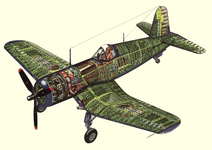
Depending on your desired precision and accuracy, the attached cutaway may be of help. It is of a later mark, but I doubt the locations of bulkheads, etc, changed very much.I'm looking for good cross-section/blueprints of the F4U-1's structural framework for a 3D modeling project. There was a previous thread here a while back about it, but all the sources provided there are now defunct.
I've got good elevation drawings for the exterior shape, but nothing for the internal skeleton. Does anyone have scans/copies of the material cited in the old thread, or anything that would be of use?
Is there a way you can illustrate what you're talking about? It might help me see it better.The tape is wrapped around the spacer and between it and the bracket. The rivet goes thru all three parts. It's purpose is to allow the spacer to slide slightly on the structure as the tank strap is tensioned or released. It also provides some chafe protection, as the strap will move ever so slightly during flight.