
Full name of airman from RAF 613 Squadron.

Noppie

Airman
15
10
Joined
Dec 19, 2022
Hello to all,

I am currently writing an article about a bomb that was intended for a railway bridge in Leeuwarden during the Second World War.

On November 29, 1944, a de Havilland Mosquito departed from RAF Blackbushe. Its mission was to bomb waterways stretching from Groningen toward Leeuwarden, and further on toward Sneek. The primary target in Leeuwarden was a railway bridge spanning the small river known as the Potmarge.

The bomb missed the bridge, landing about 50 meters further south in a small open field. Despite missing its target, the immense blast caused severe destruction. While the warehouse at Schrans 35 and the uninhabited building at Schrans 37 were damaged, the house at Schrans 39 was hit the hardest. This was the home of the Van der Meer family. Tragically, Johannes van der Meer's 8-year-old son and a woman named Pietje Brouwer were killed on the spot.

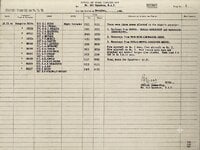
According to the Operations Record Book (ORB) for November 29, 1944, approximately 14 Mosquitoes were assigned to three different missions that day. The ORB does not explicitly state which aircraft was assigned to which specific route. However, after a careful study of the recorded flight times, I have reached the following conclusion:

The direct distance from RAF Blackbushe to Leeuwarden is 270 nautical miles (Nm). In reality, the flight path would not have been a straight line, as the Mosquito likely started its operations over Groningen first. Given that the cruising speed of a Mosquito is roughly 270 knots (nautical miles per hour), and the bomb impacted Leeuwarden around 23:30 Dutch time, we can calculate a likely window. The aircraft responsible must have been airborne at least an hour before 23:30 and landed roughly an hour or more after the attack.

Based on these flight timelines, two specific aircraft come into consideration:

  • LR354, crewed by F/L Morris and Sgt Parfitt. Actual Time of Departure (ATD) 21.51 hours. Actual Time of Arrival (ATA) 00.50 hours
  • RR199, crewed by S/L Duncan and F/O Strudwick. ATD 19.21 hours. ATA 02.55 hours.
Which of these two crews dropped the bomb remains a mystery for now. I would love to hear your thoughts on this reasoning—does this timeline hold up to your scrutiny? Furthermore, if anyone has more information, I am highly interested in finding the full names of the four airmen mentioned above.

Lastly, I want to emphasize that this research is absolutely not intended to point fingers or assign blame. It is purely an effort to accurately document the historical facts of that tragic night.

The attached file below is upgraded by Gemini AI.

Cheers,

Noppie
 

Attachments

  • RAF 613 Sq waterway Leeuwarden #2.jpg
    RAF 613 Sq waterway Leeuwarden #2.jpg
    181.5 KB · Views: 35
Hello to all,

I am currently writing an article about a bomb that was intended for a railway bridge in Leeuwarden during the Second World War.

On November 29, 1944, a de Havilland Mosquito departed from RAF Blackbushe. Its mission was to bomb waterways stretching from Groningen toward Leeuwarden, and further on toward Sneek. The primary target in Leeuwarden was a railway bridge spanning the small river known as the Potmarge.

The bomb missed the bridge, landing about 50 meters further south in a small open field. Despite missing its target, the immense blast caused severe destruction. While the warehouse at Schrans 35 and the uninhabited building at Schrans 37 were damaged, the house at Schrans 39 was hit the hardest. This was the home of the Van der Meer family. Tragically, Johannes van der Meer's 8-year-old son and a woman named Pietje Brouwer were killed on the spot.

According to the Operations Record Book (ORB) for November 29, 1944, approximately 14 Mosquitoes were assigned to three different missions that day. The ORB does not explicitly state which aircraft was assigned to which specific route. However, after a careful study of the recorded flight times, I have reached the following conclusion:

The direct distance from RAF Blackbushe to Leeuwarden is 270 nautical miles (Nm). In reality, the flight path would not have been a straight line, as the Mosquito likely started its operations over Groningen first. Given that the cruising speed of a Mosquito is roughly 270 knots (nautical miles per hour), and the bomb impacted Leeuwarden around 23:30 Dutch time, we can calculate a likely window. The aircraft responsible must have been airborne at least an hour before 23:30 and landed roughly an hour or more after the attack.

Based on these flight timelines, two specific aircraft come into consideration:

  • LR354, crewed by F/L Morris and Sgt Parfitt. Actual Time of Departure (ATD) 21.51 hours. Actual Time of Arrival (ATA) 00.50 hours
  • RR199, crewed by S/L Duncan and F/O Strudwick. ATD 19.21 hours. ATA 02.55 hours.
Which of these two crews dropped the bomb remains a mystery for now. I would love to hear your thoughts on this reasoning—does this timeline hold up to your scrutiny? Furthermore, if anyone has more information, I am highly interested in finding the full names of the four airmen mentioned above.

Lastly, I want to emphasize that this research is absolutely not intended to point fingers or assign blame. It is purely an effort to accurately document the historical facts of that tragic night.

The attached file below is upgraded by Gemini AI.

Cheers,

Noppie

I'm pretty sure Sqn 613 were in France in late November 1944 (and RR199 is a typo - it's HR199)

Therefore, there is a 95% mathematical and operational probability that Mosquito LR354, flown by Morris and Parfitt, dropped the bomb on the Potmarge bridge.

In November 1944, Great Britain (and consequently the RAF logbooks) remained on British Summer Time (GMT+1) through the winter. Occupied Holland had been forced onto Central European Time (also GMT+1) by the Germans. RAF time and local Dutch time were therefore 100% synchronized. 23:30 in Leeuwarden was precisely 23:30 in Morris's cockpit.

At this point in time, 613 Squadron was stationed at Base A.75 (Cambrai/Epinoy) in northern France. The distance to Leeuwarden is approximately 320 km. At standard Mosquito cruising speed, this is a 40–45 minute flight each way.
  • HR199 took off at 19:21. Their operational window over Holland was between 20:00 and 22:00. (There's a typo - 0255 in this aircraft's "Down" time I think must be 2255).
  • LR354 took off at 21:51. They arrived over Leeuwarden around 22:30–22:35, leaving the area again at roughly 00:05 to land in France at 00:50.
23:30 sits dead center in LR354's operational window over the target ;)

The Pilot I can find in other notes but not fullname at the moment so P.D. Morris but the Navigator should be Ronald Arthur Parfitt "Lofty".
I have seen a note that both crewmembers was flying PZ289 the night of 3/3 1945 on Raids in Rees - Hamborn - Koesfeld - Haltern area.
 
Last edited:
I'm pretty sure Sqn 613 were in France in late November 1944 (and RR199 is a typo - it's HR199)

Therefore, there is a 95% mathematical and operational probability that Mosquito LR354, flown by Morris and Parfitt, dropped the bomb on the Potmarge bridge.

In November 1944, Great Britain (and consequently the RAF logbooks) remained on British Summer Time (GMT+1) through the winter. Occupied Holland had been forced onto Central European Time (also GMT+1) by the Germans. RAF time and local Dutch time were therefore 100% synchronized. 23:30 in Leeuwarden was precisely 23:30 in Morris's cockpit.

At this point in time, 613 Squadron was stationed at Base A.75 (Cambrai/Epinoy) in northern France. The distance to Leeuwarden is approximately 320 km. At standard Mosquito cruising speed, this is a 40–45 minute flight each way.
  • HR199 took off at 19:21. Their operational window over Holland was between 20:00 and 22:00. (There's a typo - 0255 in this aircraft's "Down" time I think must be 2255).
  • LR354 took off at 21:51. They arrived over Leeuwarden around 22:30–22:35, leaving the area again at roughly 00:05 to land in France at 00:50.
23:30 sits dead center in LR354's operational window over the target ;)

The Pilot I can find in other notes but not fullname at the moment so P.D. Morris but the Navigator should be Ronald Arthur Parfitt "Lofty".
I have seen a note that both crewmembers was flying PZ289 the night of 3/3 1945 on Raids in Rees - Hamborn - Koesfeld - Haltern area.
The summery of november 1944 was clear about it. 10 Mosquito's departed from Epinoy in France for 3 different missions. I see that now. Did not downloaded at first. But now I did.
Thank you for your conclusion Nogo99. It helped me a lot.
Cheers,
Noppie.
 
The Pilot I can find in other notes but not fullname at the moment so P.D. Morris but the Navigator should be Ronald Arthur Parfitt "Lofty".
Full name was Peter Duncan Morris 43551. Received from an other forum.
 
At this point in time, 613 Squadron was stationed at Base A.75 (Cambrai/Epinoy) in northern France.
Now doing reseach regarding air base Epinoy. On a lot of intersites it is mentioned as A.103. Wich one is correct. Probably your A.75.
Cheers,
Noppie.
 
Now doing reseach regarding air base Epinoy. On a lot of intersites it is mentioned as A.103. Wich one is correct. Probably your A.75.
Cheers,
Noppie.
I think the mistake is because you're actually looking at two different eras.

A-75 should be the correct WWII Allied code (1944–45). The '103' you are seeing online I think is from after the war, when the French Air Force took over the airfield in 1953 and designated it Base aérienne 103. So for a WWII context, I'm pretty sure A-75 is the one. Or someone must correct me?
 
I think the mistake is because you're actually looking at two different eras.

A-75 should be the correct WWII Allied code (1944–45). The '103' you are seeing online I think is from after the war, when the French Air Force took over the airfield in 1953 and designated it Base aérienne 103. So for a WWII context, I'm pretty sure A-75 is the one. Or someone must correct me?
That make sense. I googled it again and you are wright. Tank you.
 

Users who are viewing this thread

Back