Hello to all,
I am currently writing an article about a bomb that was intended for a railway bridge in Leeuwarden during the Second World War.
On November 29, 1944, a de Havilland Mosquito departed from RAF Blackbushe. Its mission was to bomb waterways stretching from Groningen toward Leeuwarden, and further on toward Sneek. The primary target in Leeuwarden was a railway bridge spanning the small river known as the Potmarge.
The bomb missed the bridge, landing about 50 meters further south in a small open field. Despite missing its target, the immense blast caused severe destruction. While the warehouse at Schrans 35 and the uninhabited building at Schrans 37 were damaged, the house at Schrans 39 was hit the hardest. This was the home of the Van der Meer family. Tragically, Johannes van der Meer's 8-year-old son and a woman named Pietje Brouwer were killed on the spot.
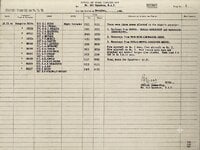
According to the Operations Record Book (ORB) for November 29, 1944, approximately 14 Mosquitoes were assigned to three different missions that day. The ORB does not explicitly state which aircraft was assigned to which specific route. However, after a careful study of the recorded flight times, I have reached the following conclusion:
The direct distance from RAF Blackbushe to Leeuwarden is 270 nautical miles (Nm). In reality, the flight path would not have been a straight line, as the Mosquito likely started its operations over Groningen first. Given that the cruising speed of a Mosquito is roughly 270 knots (nautical miles per hour), and the bomb impacted Leeuwarden around 23:30 Dutch time, we can calculate a likely window. The aircraft responsible must have been airborne at least an hour before 23:30 and landed roughly an hour or more after the attack.
Based on these flight timelines, two specific aircraft come into consideration:
Lastly, I want to emphasize that this research is absolutely not intended to point fingers or assign blame. It is purely an effort to accurately document the historical facts of that tragic night.
The attached file below is upgraded by Gemini AI.
Cheers,
Noppie
I am currently writing an article about a bomb that was intended for a railway bridge in Leeuwarden during the Second World War.
On November 29, 1944, a de Havilland Mosquito departed from RAF Blackbushe. Its mission was to bomb waterways stretching from Groningen toward Leeuwarden, and further on toward Sneek. The primary target in Leeuwarden was a railway bridge spanning the small river known as the Potmarge.
The bomb missed the bridge, landing about 50 meters further south in a small open field. Despite missing its target, the immense blast caused severe destruction. While the warehouse at Schrans 35 and the uninhabited building at Schrans 37 were damaged, the house at Schrans 39 was hit the hardest. This was the home of the Van der Meer family. Tragically, Johannes van der Meer's 8-year-old son and a woman named Pietje Brouwer were killed on the spot.
According to the Operations Record Book (ORB) for November 29, 1944, approximately 14 Mosquitoes were assigned to three different missions that day. The ORB does not explicitly state which aircraft was assigned to which specific route. However, after a careful study of the recorded flight times, I have reached the following conclusion:
The direct distance from RAF Blackbushe to Leeuwarden is 270 nautical miles (Nm). In reality, the flight path would not have been a straight line, as the Mosquito likely started its operations over Groningen first. Given that the cruising speed of a Mosquito is roughly 270 knots (nautical miles per hour), and the bomb impacted Leeuwarden around 23:30 Dutch time, we can calculate a likely window. The aircraft responsible must have been airborne at least an hour before 23:30 and landed roughly an hour or more after the attack.
Based on these flight timelines, two specific aircraft come into consideration:
- LR354, crewed by F/L Morris and Sgt Parfitt. Actual Time of Departure (ATD) 21.51 hours. Actual Time of Arrival (ATA) 00.50 hours
- RR199, crewed by S/L Duncan and F/O Strudwick. ATD 19.21 hours. ATA 02.55 hours.
Lastly, I want to emphasize that this research is absolutely not intended to point fingers or assign blame. It is purely an effort to accurately document the historical facts of that tragic night.
The attached file below is upgraded by Gemini AI.
Cheers,
Noppie