How many rounds of ammunition could the various F2A types carry? (1 Viewer)

FulmenTheFinn

Airman 1st Class
155
418
Joined
Dec 9, 2023
Location
Finland
I've tried e-mailing, DM'ing, or otherwise messaging a number of people acquainted with the aircraft, as well as the Cradle of Aviation Museum about this, but none have replied to me, so I'm asking here now:

How many rounds of ammunition could the various F2A "Brewster Buffalo" type aircraft carry, including export models? I'm not confident in the figures typically found online. See below.

First it's important to include what I've discovered thus far. This is from my message to the Cradle of Aviation Museum, quote begins:

1) For the F2A-1-based Model 239 the Brewster Aeronautical Corporation (henceforth shall be abbreviated "BAC") Report No. 350 "Detail Specification for Model 239 Airplane Class VF" mentions the .50 cals, one in the fuselage and one on each side of the wing, carried 200 rounds each and the .30 cal in the fuselage 600 rounds, so 600 x .50 and 600 x .30 in total per aircraft.

2) The part and equipment lists for the Brewster Model 239 in the Finnish National Archives from 23 May 1940 and 30 May 1942 list the following:

"2 pcs cartridge belt boxes in the wings for 220 cartridges
[...]
1 pc cartridge belt box in the fuselage for 220 cartridges
[...]
1 pc cartridge belt box in the fuselage for 600 cartridges"

So a total of 660 x .50 and 600 x .30 cal rounds per aircraft.

The above differs from the figures in BAC report no. 350 by 20 rounds per .50 cal. Presumably there was spare room the Finns used up by squeezing a few more rounds in. All good so far. However now it starts getting trickier:

3) According to Finnish aviation historian Jukka Raunio the boxes for the wing .50 cals could hold 400 rounds each. [...] I suspect his figure may be a result of misreading pp. 28-29 in BAC report no. 350, but let's move on.

4) Kari Stenman in his book "Brewster Model 239 Suomen Ilmavoimissa [Brewster Model 239 in the Finnish Air Force]" mentions that the ammo belts on the wing .50s could carry a whopping 800 rounds, in other words a total of 1,600 x .50 cal rounds in the two wing machine guns alone!

Then according to Kari Stenman's and Andrew Thomas's "Brewster F2A Buffalo Aces of World War 2", pp. 23-24, on 4 March 1942 Finnish ace pilot Lauri Nissinen reported to have expended 1,500 x .50 cal and 1,000 x .30 cal rounds in a single attack with the Brewster Model 239. This amount of ammunition carried far exceeds the figures given above.

I recently found a 1967 drawing of an F2A-3 which is "based on VF-2 average operational figures" (VF-2 flew both the F2A-2 and F2A-3 - I don't know if they flew the F2A-1, but that's neither here nor there) and was drawn by the assistance of F2A pilots from said unit. The drawing mentions the two fuselage .50 cals in the F2A-3 as having 500 rounds each, and the two wing .50 cals as having 800 rounds each, so 2,600 rounds .50 cal in total. This drawing can be found on Google in a file called "Buffalo-Modellistica-2023.pdf".

Also, the book "America's Hundred Thousand" mentions that the F2A-3 could carry more ammunition than its predecessor types, but doesn't elaborate on this claim in any way.


Quote ends.

To clarify, I'm interested in the maximum amount of .50 cal, and when present, .30 cal ammunition the aircraft's various types could carry.

Any input with all of the above in mind is appreciated, thank you.
 
A thorough examination of W.8133 (339E) by the A&AEE gives 250 rounds for each fuselage .5-inch and 450 rounds for each wing .5-inch.

This is for the ammunition tanks only, and doesn't count any extra belt leading from the tank to the gun.

MAP data sheet for the 339E gives 250 rounds per gun for the fuselage .5s and 500 rounds per gun for the wing .5s (perhaps indicating the extra belt I alluded to?)
MAP data sheet for the 339B gives 160 rounds per gun for the fuselage .5s and 300 rounds per gun for the wing .303s

This is very interesting, thank you. I don't know if you saw, but I sent you a DM about these documents.
 
Here's an update on where my research into this topic is currently at:

1753466028117.png


Additionally one can calculate from the loadout weights mentioned in America's Hundred-Thousand, p. 440, that the F2A-2 and -3 were capable of carrying at least 900 and 1,300 rounds .50 cal respectively. One .50 cal round with its link weighed about 0.3 lb, while a .30 cal equivalent weighed about 0.065 lb.

EDIT: Updated 25 July 2025.
 
Last edited:
I tried to make sense of the F2A ammo loads also a while back. The trouble like you I found is some data seems too large. The F2A is a small plane with a fairly narrow wing.
But it looks like the wing gun ammo boxes were at the wing/fuselage junction extending into the fuselage body, so perhaps could be increased to hold 800 rounds, but it is still suspicious as the original F2A only had 200-220. Were the 220-450-800 rd gun wing ammo boxes completely different boxes?
The F2A-3 having more nose gun ammo is plausible as it moved the engine forward.

My thought is the space was always there, but from the 220rd of the prototype F2A-1, they went with F2A-2 the "new normal standard" 400rd of US fighters, but for the F2A-3 they were competing vs F4F and had to increase firepower so got 800 rd ammo boxes.
 
I think (without actually measuring the boxes/feedways) that people are somehow doubling the ammo in the wings at the very least. Turning 800 rounds in the "wing" to 800 rounds per gun for the wing guns.
AHT says 390lbs for the F2A-3 in overloaded bomber condition. That is about 1300 rounds of .50 cal ammo.
2600 rounds is 780lbs.
F4F-3s carried a max of 1720 rounds (430 rpg) 516lbs
and the F4F-4s carried 1440 rounds max (432lbs) for their 6 guns. They swapped ammo for gun weight.

800 rounds per wing gun means about 1 minute of firing time if the guns were the faster firing versions.

As a weight check, the Manual for the P-40D & E shows 300lbs for the design load of 1000 rounds for the 4 gun P-40D and max load of 738lbs for 2460 rounds.
The P-40E had a design load of 423lbs for 1410 rounds for the six guns and a max load of 561lbs for 1870 rounds.

I can understand being able to squeeze in another 20 rounds in a feed way leading from the ammo box to the gun, maybe. But 800 rounds of .50 cal ammo per gun is really going to cripple performance.
 
The USN F2A-2 PD (Performance Data) sheets from May 1943 list a maximum of 250 rpg for the nose guns and 200 rpg for the wing guns.

The USN F2A-3 PD sheets from December 1942[edit - changed 1943 to 1942] list a total of 1300 rounds.

If either the F2A-2 or F2A-3 as operated in US service could have carried more ammunition (possibly barring a few additional rounds in the feed chutes) the PD sheets would list it.

NOTE that the standard .50 cal ammunition box contained 100-110 rounds belted. Perhaps there was/is a misunderstanding as to how many rounds the "additional" ammunition box held?

??
 

Attachments

Last edited:
The US did a lot strange stuff listing ammo capacities. Sometimes to make weight (many performance figures were done at less than max clean weight) and it wasn't just fuel that was not carried. Even the specs for the F4U were done with just 200rpg with the extra 200rpg (?) listed as overload.

Any F2A-2 or F2A-3s still flying in the Spring of 1943 (USMC had none in Dec 1942) were either at training bases or being used as squadron hacks.

Some of the USN PD sheets have occasionally doubtful information. Like listing 1600lb AP bombs for early versions of the SBD.
Pilot's manual for the SBD-3 has a gross weight of 9019lbs and with armor and protected tanks and a 1000lb bomb it can hold 100 US gallons (600lbs of fuel)
So either they retroactively significantly increased the gross weight or carriage of the 1600lb bomb meant leaving the rear crewman and some of the armor behind and a very short flight ;)
I don't care if any SBD ever carried the 1600lb bomb in a combat area. What I care about is that every USN PD sheet from 1942 on lists the 1600lb bomb for every SBD ever built. And just about every SBD data sheet lists the insane 2250lb bomb load. (one 1600lb AP bomb and two 325lb depth charges).
 
Addition to the above:

I had forgotten that I had the armament section of the Detail Specification for the F2A-1. For the nose guns it lists the ammunition load as 600 rounds of .30 cal and 200 rounds of .50 cal, with 200 rounds per .50 cal for each of the 2 wing guns. So 600x .30 cal + 600x .50 cal total.

Additionally, mention is made of substituting a .30 cal for the .50 cal nose gun, giving 2x .30 cal in the nose and 2x .50 cal in the wings (1x .50 cal per wing). Presumably, it would have carried 600 rounds of .30 cal for each nose gun in this arrangement. So 1200x .30 cal + 400x .50 cal total.

F2A-1 detail specification-armament copy.png


:study: Incidentally, the Brewster Model 239 Detail Specification lists the same armament combinations and ammunition load as for the F2A-1. The Model 239 Detail Specification can be found here "Brewster B-239 Buffalo Manuals" courtesy of Baball.
 
Last edited:
Thank you for the Data Sheets.
They really do show the weight increase and the performance loss between the -2 and the -3.
Trying to carry another 390lbs of ammo would have been useless and the navy knew it as shown by the reduced weight (less ammo and fuel) in the first column of fighter and the greater load in the 2nd column.
 
The US did a lot strange stuff listing ammo capacities. Sometimes to make weight (many performance figures were done at less than max clean weight) and it wasn't just fuel that was not carried. Even the specs for the F4U were done with just 200rpg with the extra 200rpg (?) listed as overload.

Any F2A-2 or F2A-3s still flying in the Spring of 1943 (USMC had none in Dec 1942) were either at training bases or being used as squadron hacks.

Some of the USN PD sheets have occasionally doubtful information.

In my previous two posts I tried to allude to the fact that there is reason to doubt listed useful ammo loads as being the same thing as maximum ammo capacity. The detailed spec manual brought up by @ThomasP is the BAC report #350 I mentioned in 1) of the OP.

I'm particularly perplexed by MSgt Lauri Nissinen's combat report from 4 March 1942. 1,000 x .30 cal rounds and 1,500 x .50 cal rounds on an F2A-1-based Model 239? On an aircraft whose parts lists only talk about ammo boxes with a capacity of 600 rounds per .30 cal box and 220 rounds per .50 cal box? I've tried to find the report in Finnish to see if it's an improper translation and is in fact talking about the total ammo expenditure of the entire flight of Brewsters, but thus far I've only found it in English in Stenman's and Thomas' book. I might have to go digging for it in the Finnish archives. However in my experience these kinds of reports talk about personal ammo expenditure only.

Also, I'd missed this in America's Hundred-Thousand, which I'll add to my list of sources:

"The armament on the US Navy F2A-2 and F2A-3 was similar to that of the 239 except that both synchronized fuselage guns were 50 caliber M-2 models with a total round capacity of 500. The F2A-2 .50 caliber gun installation with 200 rounds in each wing was the same as the 239; however, the F2A-3 installation doubled the ammunition capacity to 400 rounds per gun."
 
Then according to Kari Stenman's and Andrew Thomas's "Brewster F2A Buffalo Aces of World War 2", pp. 23-24, on 4 March 1942 Finnish ace pilot Lauri Nissinen reported to have expended 1,500 x .50 cal and 1,000 x .30 cal rounds in a single attack with the Brewster Model 239. This amount of ammunition carried far exceeds the figures given above.

[...]

I'm particularly perplexed by MSgt Lauri Nissinen's combat report from 4 March 1942. 1,000 x .30 cal rounds and 1,500 x .50 cal rounds on an F2A-1-based Model 239? On an aircraft whose parts lists only talk about ammo boxes with a capacity of 600 rounds per .30 cal box and 220 rounds per .50 cal box? I've tried to find the report in Finnish to see if it's an improper translation and is in fact talking about the total ammo expenditure of the entire flight of Brewsters, but thus far I've only found it in English in Stenman's and Thomas' book. I might have to go digging for it in the Finnish archives. However in my experience these kinds of reports talk about personal ammo expenditure only.

I've now gotten to the bottom of this mystery by going through the actual combat reports in the National Archives. As I suspected the original report was improperly translated into English. Stenman's version also appears to contain some errors. The report is dated 3 March, not 4 March, 1942, and the report isn't MSgt. L. Nissinen's, but Sgt. U. Lehto's, with handwritten text on the backside by Cpt. L. Ahola. The report specifically says that the flight in total fired 1,500 large-calibre (.50 cal) and 1,000 small-calibre (.30 cal) rounds into two DB 2 [sic] and one I-16 aircraft on the ground, which Ahola concludes means that the hit enemy aircraft had to have thus been destroyed. We're talking of the expended ammunition of at least four Brewsters here.

I also checked another Squadron 24 Brewster Model 239 combat report, this time by Cpt. E. Luukkanen, where he describes expending all his own ammo on a sortie on 22 October 1942, amounting to 700 x .30 cal and 660 x .50 cal rounds. Thus far it's the only mention I've found of the fuselage .30 cal being able to carry 700 rounds. I did wonder if this was a typo meant to say 600, and going through the original report in the archives did not dissuade my ponderings as the report is typewritten, not handwritten. Although these things are usually checked for typos and corrected, and there were no correction markings here. I also found one report mentioning 650 x .30 cal rounds spent by a single Model 239 on a single sortie, and that one was handwritten, so I'm quite sure the .30 cal could hold at least 650 rounds, and I'm leaning towards 700.

So far everything I've found indicates that the .50 cals carried 220 rounds each, as seen in the Finnish Model 239 parts lists I mentioned in the OP, with no indication that they could carry higher amounts. It is worth noting that the same parts lists mention the .30 cal's ammo box as a 600 round box, exactly as in the original Brewster Aeronautical Corporation technical manual (as the reader may remember, said manual specified the .50 cal ammo boxes as 200 round boxes, sharp, i.e. the Finns look to have managed to squeeze in at least another 20 extra .50 cal rounds per box). Because I've seen some Allied figures for F2A-2s with 4 x .50 cals implying a total of 900 rounds of ammo, I still think the Model 239's .50 cals may have gone up to 225 rounds per gun, with a few rounds on the belts going into the MGs outside of the boxes. It could also be though that the implication of 900 rounds is just 880 rounded up.

Based on empirical evidence I am firmly of the opinion that large language model chatbots are completely untrustworthy as historical research tools, but I do occasionally use ChatGPT for calculations. ChatGPT is of the opinion that if the 200 round .50 cal boxes had the same extra space as the 600 round .30 cal box that could cram in apparently an extra 100 rounds, then the .50 cal boxes could hold 233-234 rounds. Realistically this includes rounds on the belts outside of the boxes, in the case of both ammo types. I'd still take ChatGPT's numbers with a massive grain of salt here.
 
Last edited:
My reading of the Model 239 and F2A-2 specs listed above is 250 rounds 0.50 calibre in the fuselage box or alternative 600 rounds 0.30 calibre fuselage box. For the wing guns it is listed as 200 rounds 0.50 calibre. With two fuselage and two wing 0.50 calibre guns it is going to be 900 rounds, but not 225 per gun.
Best regards,
Yavor

All the .50 cal boxes on the 239 were rated for 200 rounds by the Brewster Aeronautical Corporation. The .30 cal box was rated for 600 rounds (Brewster Report #350: Detail Specification for Model 239 Airplane, Class VF). While I don't have such primary source documentation on the F2A-1, everything suggests Brewster's ratings for it were identical to the 239's on this matter. The Finns rated the boxes at 220 and 600 or 700 rounds respectively, depending on the document. Although one document puts the wing .50s at 215 and the fuselage .50 at 225 rounds per gun. Regardless, all the .50s could carry 220 rounds and the single .30 could carry 700 rounds. According to Finnish documents from 1939-41, one serving of ammo per Brewster Model 239 aircraft was rated at 220/.50 and 600/.30 (660 x .50 and 600 x .30 in total), but in practice the .30 was also loaded with 650 or 700 rounds. Thus far I've found no indication that 239s actually flew with more than 220 rounds per .50, even if up to 225 rounds per nose .50 may theoretically have been possible.

The fuselage and wing .50s on the F2A-2 were rated at 250 and 200 rounds respectively, for a total of 900 x .50 cal rounds (Brewster Report #383: Erection & Maintenance Instructions, Model F2A-2).

On the F2A-3 the fuselage boxes remained rated for a capacity of 250 rounds like on the A-2, but the wing boxes were enlarged and rated at 400 rounds each, for a total of 1,300 x .50 cal rounds (Brewster Report #512: Erection & Maintenance Instructions for Model F2A-3 Airplane, also America's Hundred-Thousand).

So I've established that the .50 cal boxes on the 239 could take 220 rounds, possibly 225 rounds in the fuselage, and the .30 cal box in the fuselage 700 rounds. What I don't know is whether these boxes were identical on the F2A-1, as well as on the A-2's wings. I suspect they were, particularly on the A-1. If so, the A-1 could carry 660 (possibly 665) x .50 + 700 x .30 like the 239, and the A-2 940 x .50 instead of 900. The part number for the wing boxes on the 239 was 5-61313 (Brewster Report #352: Erection & Maintenance Instructions for Model 239 Airplane), so if that part number shows up on the A-1 and -2, I should have my answer regarding the wing guns at least. As I understand from this post, and the various Brewster documents I've seen seem to reinforce this, the prefix 5 in the part number itself refers to a part designed for the A-1, further reinforcing my impression that the wing .50 cal boxes on the 239 were the exact same type found on the A-1. Unfortunately I don't know the part numbers for the other ammo boxes.
 
Last edited:
One can see the wing box, actually, near Tikkakoski. Not the best way to confirm the box capacity but the double-size wing box for the F2A-3 looks possible.

53408964523_71da68e388_o.jpg
 
One can see the wing box, actually, near Tikkakoski. Not the best way to confirm the box capacity but the double-size wing box for the F2A-3 looks possible.

What's more, on the 339C, D and E the wing boxes each took 500 rounds of .50 cal ammo. The fuselage boxes were rated at 650 x .303 (339C & D) and 250 x .50 (339E) respectively. I've not seen relevant documentation for the 339B and 339-23, but it wouldn't surprise me if the former had the same .50 cal boxes found on the 239, while the latter probably had 250 rounds per box in the nose and 500 rounds per box in the wings. Later the Brits replaced the nose .50s on the 339B with .303 cals, which probably had a capacity similar or identical to the .303s on the 339C & D.

This may be of some interest. Thomas E. Horncastle filled a patent application on behalf of Brewster Aeronautical Corporation on August 1, 1940.

Thanks. This gave me the idea to go look on Google Patents. There's a few pages worth of patents relating to Brewster there.

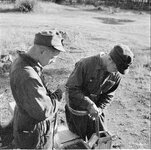
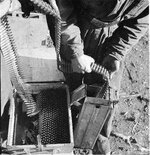
Incidentally, here's a couple of shots of Finnish mechanics filling what the photo descriptions call the wing ammo boxes for the Brewster 239. Posted as clickable thumbnails for usability.

46751_63402.jpg 46752_63403.jpg
Ammo is being loaded into the BW's wing machine gun's cartridge container.

9 October 1941, Lappeenranta, Finland. Photos by L. Johnsson via SA-Kuva. SA-Kuva #46751 & 46752.
 
Thank You for the pictures! It looks like 0.30 calibre ammo belt?
Yavor

Zoom in on the left side of the second photo. That's definitely .50 cal. Which it also has to be if the photo description is accurate.
 

Users who are viewing this thread

Back