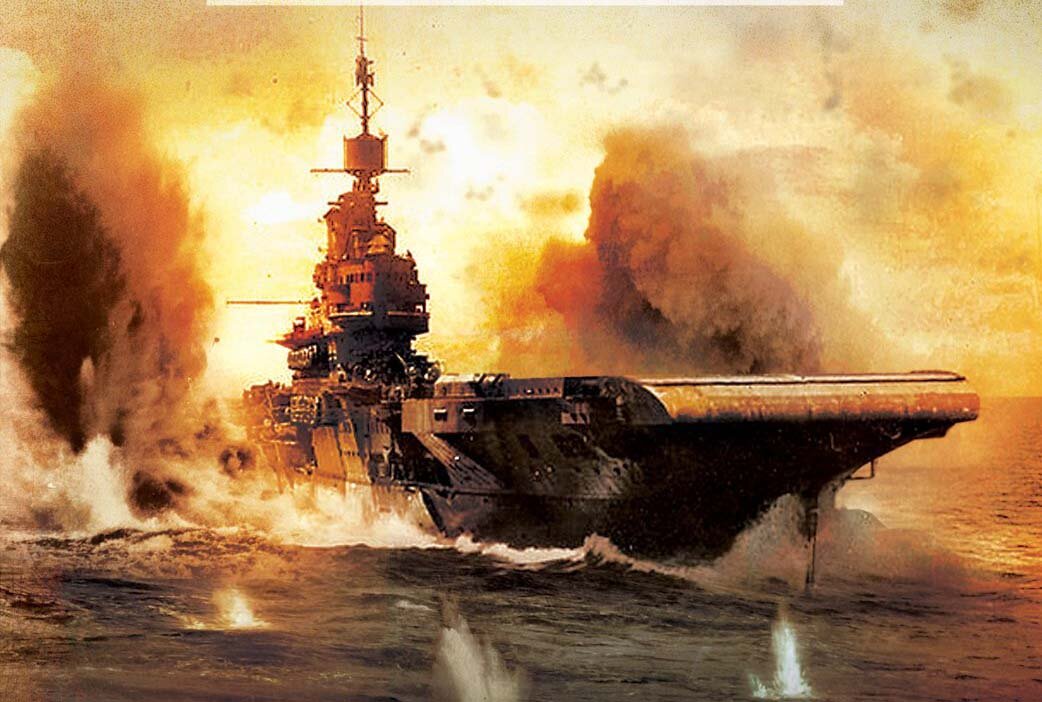
Earlier I mentioned the change in AA.
Extreme examples are things like the USS North Carolina class. They went to the Pacific with 6 quadruple 1.1 guns (upgraded from 4) in late 1942 with an assortment of of .50 cal MG and 20mm. By late spring or summer of 1943 both ships had the 1.1s landed and 10 quadruple 40mm Bofors guns replacing them and by August of 1943 both ships (?) had 15 quad mounts. The .50 cal MGs had pretty much disappeared and the number of 20mm guns were around 50+ to 64. A lot of the ships newer than the North Carolinas got pretty heavy AA batteries to begin with and a number of the older ships saw extensive changes.
The 5in guns were getting an increasing supply of proximity fused projectiles.
The Japanese never saw such extensive upgrades. They tried to do what they could but they didn't have the manufacturing base.
Well here I would distinguish between calibres and numbers of weapons.
The US recognised early on that the 0.5" and 1.1" were inadequate. US production of the 20mm Oerlikon had begun in mid-1941 and the first twin Bofors was produced in Jan 1942 and the first quad in April with the first ship fittings in June/July.
Britain began with 0.5" and 2pdr Pom-Pom (40mm). It had placed orders with Oerlikon in Switzerland for large numbers of 20mm in 1939 but the German advance in May/June 1940 cut off supplies with few delivered. Licence production here took some time to set up and it was late in 1941 before they began to become available in quantity. Licensed production of air cooled Bofors began in Britain pre-war but most went to the Army and only a few to the RN (see PoW late 1941 with a single mount for example). Britain adopted and produced the complex but stabilised and radar equipped Dutch Hazemeyer twin water cooled 40mm from late 1942.
Only Japan did not increase the calibre of its A.A. weapons. It went to war with the 25mm based on a Hotchkiss design and end the same way.
But all navies, including the Japanese increased the numbers of weapons carried. You have mentioned the US but here is the British equivalent
King George V -1940 4xoctuple Pom-pom & 4xUP projectors (rocket batteries)
Anson & Howe - 1942 6xoctuple Pom-Pom & 18 single 20mm
Howe - Sept 1945 8xoctuple & 6xquad Pom Pom, 2xquad & 18 single 40mm Bofors & 4 twin 20mm
And for Japan
Yamato - 1941 on completion 6 twin 5" plus 24x25mm in 8 triple mounts and 2 twin 13.2mm
Yamato - 1945 12 twin 5" plus 162x25mm mostly in triple and single mounts and 2 twin 13.2mm (but after sacrificing 2 of her triple 6.1" turrets)
As well as many more 25mm barrels, Japanese carriers that survived to the latter part of 1944 had their AA armament augmented by 6x28 barrelled AA rocket launchers

www.navweaps.com
But to carry the heavier A.A. armament there were choices and sacrifices to be made.
USA - in larger ships the sacrifice was reduced stability margins not acceptable to the RN. From 1942 destroyers sacrificed sets of torpedo tubes to get 2 twin 40mm. In 1945 the anti-kamikaze AA refits saw the sacrifice of yet more torpedo mounts in early destroyers and even one mount in Fletcher & Sumner classes. Even cruisers up to the Cleveland class were losing one of their two catapults in 1945 to save weight for more AA and radar.
RN - in 1944/45 many cruisers lost a turret to gain additional Pom-Poms and other light AA and aircraft facilities had been removed earlier. As the war went on 0.5" was replaced by single 20mm was replaced by twin 20mm was ultimately replaced by single 40mm
Japan - Yamato I noted above. But even their fleet destroyers were losing a turret to gain more light A.A.
And it was not only light AA but weight for radars and other electronics high up in the ship.
The US proximity fuse programme was inspired by British work begun in 1939 and passed to the US by the Tizard Mission in 1940. Testing took place from early 1942 and it was first used in action by the cruiser Helena on 5 Jan 1943 with her 5"/38 guns. By mid-1944 they were available for a variety of both British & US guns from 3"/50 through to 6"/47. Initial teething problems were largely overcome by 1945. For example, the RN found the batteries in early versions apt to deteriorate quickly in tropical conditions.
Shortround6 said
"The British got a bit "lucky" in that they developed airborne radar before anybody else did and this allowed them to attack under the cover of darkness better than some other countries. Certainly not fool proof in the early years and needing skill and training but it did allow tactics that other nations could only use with much more difficulty."
Getting "lucky" had nothing to do with it. Night flying from carriers had been practiced by the FAA from the mid-1920s, long before radar had even been thought of. It was part of the standard training for FAA pilots. The first radar sets were fitted to Swordfish in early 1941. Too late for Taranto and just in time for the Bismarck. All the Swordfish on Victorious were equipped with ASV.II in May 1941 but only some of those on Ark Royal. Due to technical problems Albacores weren't fitted with it until late in 1941 and only a few had it on Formidable and none on Indomitable in April 1942 in the Indian Ocean during Operation C. That was the reason for the Indomitable borrowing a couple of Swordfish for her air group.
From Wiki so who knows.
"Before the Indian Ocean raid, the established doctrine regarding attack against ships was to arm all D3A1 dive bombers with semi-AP bombs. On 5 April 1942, an IJN carrier force attacked
Colombo on
Ceylon with half of its complement, while the other half was kept in reserve for strikes against ships. Since a second strike against Colombo was deemed necessary, the dive bombers of reserve force were rearmed from semi-AP bombs to land bombs. When British heavy cruisers were spotted soon afterwards, the reserve force was sent with a portion of D3A1 dive bombers armed with land bombs. In the subsequent attack, land bombs unintentionally proved very effective in suppressing the
anti-aircraft fire from the ships. As a result, the doctrine was modified in order to intentionally equip the first few D3A1 dive bombers with land bombs. This new method was already implemented for the attack that sank
HMS Hermes just four days later, and continued to be used from then on.
[7]"
I recommend reading Rob Stuart's 6 articles on the Japanese activities in the Indian Ocean in 1942. He is currently the foremost researcher on this, from both British and Japanese sources, and his articles do cover the Japanese bomb loads. I have noted previously that only 6 of the 85 aircraft dispatched to sink Hermes got land attack bombs. That piece of information came from one of Rob's articles.
Might very well be wrong. I don't know what the Germans and Italians were using in the Med but it may have been an assortment. The damage assessment of the Illustrious tends to say that 3 different sizes of bombs were used from 250kg to 500kg with one 1000kg bomb. The types may also have been mixed.
The Germans were using a mix of bombs and when they went after Illustrious & Formidable they did use some 1,000kg bombs on the Stukas. Illustrious suffered one such hit and Formidable 2. You will find details of these and the various damage reports over on the Armoured Carriers website.
Armoured aircraft carrier design balanced treaty limits, survivability and air power, using an innovative armoured box hangar and flight deck to keep carriers fighting under air and kamikaze attack. Illustrious, Formidable, Victorious, Indomitable, Indefatigable and Implacable in World War II, 194
www.armouredcarriers.com
But to carry a 1,000kg bomb a Ju87 Stuka had to leave the gunner behind and I believe operate at lighter fuel loads and had a much longer take off run. So they were not an everyday weapon.
Edit:- AIUI the first USN Carrier borne aircraft to go to sea with radar were the TBF-1 Avengers of VT-10 when the parent air group arrived on the Enterprise in Oct 1942. That was with the ASB-1 set roughly equivalent to the British ASV.II.