La-5 / La-5F / La-5FN / La-7 / La-7B-20

Ad: This forum contains affiliate links to products on Amazon and eBay. More information in Terms and rules

These are approximate data for the La-7 of the head series, tested in July 1944. The prototype La-5FN ("dooblyor") had a ground speed of 562 km/h in nominal mode and 595 km/h in emergency mode, with a maximum speed of 648 km/h.

La-5FN produced in May 1943 (#39210104) had a ground speed of 530 km/h in nominal mode and a maximum speed of 610 km/h, in October 1943 La-5FN (#39210495) had a ground speed of 542 km/h in nominal mode and a maximum speed of 620 km/h. The graphs in this book are very rough, they cannot be used to accurately determine the maximum speed of Soviet airplanes, which varied greatly during production.
La-5F No.99391160: June 1943: M-82F: 3,202 kg.
561 / S. L.
619 / 5,790 m.

with 1700 horsepower, already achieved 561 at SL
 
La-5F No.99391160: June 1943: M-82F: 3,202 kg.
May I know the source of this information?
561 / S. L.
619 / 5,790 m.

with 1700 horsepower, already achieved 561 at SL
I provided control test results that were obtained for production airplanes. The difference between M-82F and FN(V) by power at the beginning of the FNV production was rather insignificant.
 
May I know the source of this information?

I provided control test results that were obtained for production airplanes. The difference between M-82F and FN(V) by power at the beginning of the FNV production was rather insignificant.
542 at nominal 1570hp translates to 572km/h with 1850hp
 
542 at nominal 1570hp translates to 572km/h with 1850hp
And what? The FN prototype had 562 at nominal and 595 at TO.
The maximum speed of serial La-5FNs according to control tests of the Air Force Research Institute did not exceed 626 km/h, and the ground speed at nominal was 546 km/h (tests in January 1944).
The maximum speed of serial La-7s never exceeded 658 km/h during control tests.

In addition: La-5FN production amounted to about 3% of the total fighter production in the USSR in 1943.
 
Last edited:
And what? The FN prototype had 562 at nominal and 595 at TO.
The maximum speed of serial La-5FNs according to control tests of the Air Force Research Institute did not exceed 626 km/h, and the ground speed at nominal was 546 km/h (tests in January 1944).
The maximum speed of serial La-7s never exceeded 658 km/h during control tests.

In addition: La-5FN production amounted to about 3% of the total fighter production in the USSR in 1943.
546 nomial translates to 576 with 1850hp at the deck
the graph shows
574-577 at SL
635-638 at 6250m
 
546 nomial translates to 576 with 1850hp at the deck
the graph shows
574-577 at SL
635-638 at 6250m
1747755697242.png

The graph overestimates the speed by 8-17 km/h (at least).
 
theres the other graph which has lower deck speed
You can simply shift this graph to the left by ~17-20 kph and you obtain very realistic values for serial La-5FNs in 1943.
According to the recollections of many Soviet pilots, a difference in _maximum_ speed of 10-15 km/h was not considered to be significant in air combat.
 
La-5FN produced in May 1943 (#39210104) had a ground speed of 530 km/h in nominal mode and a maximum speed of 610 km/h, in October 1943 La-5FN (#39210495) had a ground speed of 542 km/h in nominal mode and a maximum speed of 620 km/h.
Hi bf109, do you have a link to these flight test reports? I'm working on some flight models for Il-2 1946 and I try to collect as much original documentation as I can to get perfs as close to reality as possible.
 
Hi bf109, do you have a link to these flight test reports? I'm working on some flight models for Il-2 1946 and I try to collect as much original documentation as I can to get perfs as close to reality as possible.
Unfortunately, I do not have copies of the reports. A table containing the results of tests of both prototypes and production airplanes with serial numbers was published in the magazine "Aviation and Cosmonautics" 2000/05-06 (in Russian). A scanned copy of the magazine is available on the Web.
 
So i just found out something interesting...
Ash-82-111 and Ash-82-112 are both written as 'M-82A' engines and usually distinction between them isnt made.


M-82-111 appears to be the one that was rated 1330 Horsepower at Military Power, 1570 horsepower with Take Off Power
M-82-112 was the optimised more reliable upgraded version with 1400 Horsepower at Military Power and 1700 with Take Off Power

I-185 M-82A prototype for example used the M-82-111 limited to 1570 Horsepower
La-5's introduced in July 1942 used M-82-111 engines but by Late 1942 they were already switching to M-82-112's
As '112' were still replacing the '111' in serial produced La-5's in Early 1943, thats when further upgraded M-82F engine was also approved which was basically the afterburning M-82-112 engine that could maintain the 1700 horsepower regime at long periods of time.

I-185 M-82A is rated
549km/h at Sea Level -- 1570hp
615km/h at 6450m

I-185 M-71 is rated
600km/h at Sea Level -- 2000hp
680km/h at 6100m

2000 / 1570 = 1.274
∛1.274 = 1.084
549 x 1.084 = 595km/h

Seems like I-185 M-71 was eighter tiny bit more aerodynamically refined or I-185 M-82-111 didn't achieve even that full 1570 horsepower output.


Last edited:
Average Quality Lavochkin Max Speed:

La-5 / early

509km/h at Sea Level - 1330hp
580km/h at 6250m

La-5 / late
518km/h at Sea Level - 1400hp
590km/h at 6250m

La-5F
552km/h at Sea Level - 1700hp
590km/h at 6250m

La-5FN
568km/h at Sea Level - 1850hp
620km/h at 6250m

La-7
613km/h at Sea Level - 1850hp
663km/h at 6250m

La-9
640km/h at Sea Level - 1850hp
690km/h at 6250m
 
Last edited:
So i just found out something interesting...
Ash-82-111 and Ash-82-112 are both written as 'M-82A' engines and usually distinction between them isnt made.


M-82-111 appears to be the one that was rated 1330 Horsepower at Military Power, 1570 horsepower with Take Off Power
M-82-112 was the optimised more reliable upgraded version with 1400 Horsepower at Military Power and 1700 with Take Off Power
The "112" differed from the "111" only by the presence of a pneumatic starter instead of an electric one. The first two digits meant the reduction (11:16), and the last one - the starter type.
The unreliable operation of the AK-82BP carburetor (based on the Holley carburetor) was the main reason for the reduction of the engine's maximum power, finally the Soviets failed to improve the carburetor.
I-185 M-82A prototype for example used the M-82-111 limited to 1570 Horsepower
IIRC, the I-185 was equipped with pneumatic starter. The three-digit production designations were introduced after I-185 testing began.
La-5's introduced in July 1942 used M-82-111 engines but by Late 1942 they were already switching to M-82-112's
IIRC, only the first production batch of the LaGG(LaG)-5 was equipped with electric starter ("111").
As '112' were still replacing the '111' in serial produced La-5's in Early 1943, thats when further upgraded M-82F engine was also approved
3-digit designations were used for the M-82F/FN as well.
which was basically the afterburning M-82-112 engine
It was a piston engine, what afterburning? The M-82F had certain differences from the M-82A (usually the letter "A" was not specified in the official instructions) - intake pipe diameter was changed, cylinder cooling fins were increased, valve timing was changed.
that could maintain the 1700 horsepower regime at long periods of time.
... due to the improvements mentioned above.
Seems like I-185 M-71 was eighter tiny bit more aerodynamically refined or I-185 M-82-111 didn't achieve even that full 1570 horsepower output.
There were two different I-185s with M-82 engines. The first was a redesign of the M-71 version, whereas the second version had a redesigned fuselage corresponding to the smaller frontal area of the M-82 - the performance of this variant was better. But the major problem was unreliable engine performance, which did not allow to achieve maximum power. The M-82 was intensively improved during the I-185 trials, and Lavochkin received a slightly more refined engine (although the fundamental problem with the carburetor remained).
 
Last edited:
The first digit represents the engine reduction (1=11:16, 2=9:16, 3=0.56)
The second digit represents the compression ratio (1= CR of 7, 2=CR of 6.4)
The third digit represents the presence or absence of a pneumatic self-starter (1=no pneumatic self starter, 2=yes pneumatic self starter)
If the 3-digit modification code end in 'И', this means the engine has a single speed transmission. If it lacks the 'И', then it has a two-speed transmission.

Ash-82FN-312 would be an engine with a gear reduction of 0.56, CR of 7, has a pneumatic self-starter and a two-speed transmission. Such examples were built at Zavod 29 in Omsk. By mid-1944 Zavod 29 mainly made M-82 engines for the Tu-2.

Such technical data likely only made its ways around organization working in close proximity with the engines. Other organizations simply recorded their reduction ratios in the accounting docs.
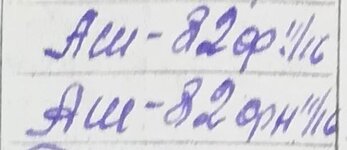
Attached in a sample of what such a doc looks like:
 

Attachments

  • F and FN.JPG
    F and FN.JPG
    16.8 KB · Views: 26
Last edited:
The first digit represents the engine reduction (1=11:16, 2=9:16, 3=0.56)
The second digit represents the compression ratio (1= CR of 7, 2=CR of 6.4)
The third digit represents the presence or absence of a pneumatic self-starter (1=no pneumatic self starter, 2=yes pneumatic self starter)
If the 3-digit modification code end in 'И', this means the engine has a single speed transmission. If it lacks the 'И', then it has a two-speed transmission.
Thanks. I was too lazy to check G.Serov's statement in his article on the development of the M-82, though I could well have.
1749023068662.png

1749023290876.png

I have never come across any mention of M-82 modifications with compression ratio other than 7. Apparently, this was the reason for Serov's my omission to explain the meaning of the second digit in the designation.

I apologize in absentia to G. Serov - his article describes everything correctly, it is, apparently, I myself decided to simplify the interpretation of the designation. I also apologize to the forum participants.
 
Last edited:

Users who are viewing this thread

Back