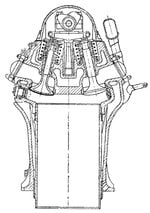
Looking to understand the rationale behind the unique induction+exhaust arrangement of the M-107/VK-107.

Ad: This forum contains affiliate links to products on Amazon and eBay. More information in Terms and rules

There a lot of things going on in a cylinder and sometimes going one way affects several things at once.

You need really good instruments to really figure out what was happening.
Extra scavenging is good. The more old "used" air you can get out the more fresh air you can get in. That means more power. Getting old hot air out and getting more cooler (relative) air in also helps cooling. With carbs you get a bit of extra cooling because of the evaporation of the fuel and/or the weight of the mixture compared to pure air. However the more boost that is used, assuming superchargers of equal efficiency (which they are not) the hotter the intake air/mixture and now people have to start doing a lot calculations. Compare XX degree intake mixture at YY grams weight per cylinder full vs XXH (higher temp) intake mixture but with more mass to absorb the heat in the piston and cylinder/head/walls.

All valves are not created equal. That is to say even valves of the same size/shape do not flow the same amount air/gasses depending on shape of the ports and/or manifolding. Total lift (valve opening distance) and rate of opening/closing can make a difference. A lot of this is small but sometimes several small differences can add up.
On the Allisons there was a measurable change taking out the backfire filters and that assumed the filters were in good shape to begin with, they were often clogged in even a few dozen hours.

I have no idea if the M-107 could get enough rich mixture in the single intake valve to mix with clean air to get the desired overall mixture. I assume they were at least close.
But comparing it to a normal 4 valve head maybe it was better and maybe it wasn't.
Either 4 valve head should be way better than the 2 valve heads and should have been better than the 3 valve head. The question is by how much?
The scavenging can provide a bit more cooling, in theory. It can provide a bit better fuel economy. But getting peak power might impact both of those..........so what were they trying for and what did they achieve?
The HS engines with the 2 valve heads used a poor port layout. Jumo heads with 3 valves used 1 large intake valve on the inside and two smaller exhaust valves on the outside. Smaller valves tended to run cooler than large valves and were less prone to warping, burning.
on the Klimov 3 valve head things get a bit twisted with both the inlet ports and exhaust ports being on the same side. Ports may not be as large as desired. The M-107 has a lot ports going down the side, are they as large as they should be? What is the size/shape of these ports?
Normal V-12s use 6 siamesed ports on the outside of the head, not 13 ports.

The theory may have been fine. So was the theory behind the sleeve valve, it was the execution that was a problem.
 
AFAIU the benefits of a "hot vee" layout is seen on modern engine with modern compact and high heat resistant turbochargers. The hot vee allows short exhaust manifolds with minimal heat and velocity loss before entering the turbocharger.

None of that applies to WWII aero engines. Turbos at the time were bulky, and often required cooling to not melt. And needless to say, most engines were not turbocharged to begin with.

Also, without a turbo on your WWII aircraft you'd want individual exhaust stubs as short as possible, with no manifold, to maximize jet thrust, a non trivial fraction of the total thrust at high speed.

All this would speak strongly in favor of the traditional approach of exhaust on the outside of the V and intakes on the inside. Mixing intake and exhaust on the same side like the engine being discussed here sounds like a recipe for heating up the intake air, not what you want.

I suppose you could make a hot vee work with an inverted engine. But maybe there are practical details making that troublesome, particularly on the ground. Like kicking up dust? Or hot exhaust rising upwards along the fuselage, scorching the paint and in the worst case maybe even starting a fire if the aircraft has a fuselage fuel tank, and some small amount spilled during fueling? And preventing a belly mounted radiator, as you obviously don't want the exhaust to feed straight into the radiator. So in the end maybe not worth it?
Wow. Not only informative but I even understood it!
 
There a lot of things going on in a cylinder and sometimes going one way affects several things at once.

You need really good instruments to really figure out what was happening.
Extra scavenging is good. The more old "used" air you can get out the more fresh air you can get in. That means more power. Getting old hot air out and getting more cooler (relative) air in also helps cooling. With carbs you get a bit of extra cooling because of the evaporation of the fuel and/or the weight of the mixture compared to pure air. However the more boost that is used, assuming superchargers of equal efficiency (which they are not) the hotter the intake air/mixture and now people have to start doing a lot calculations. Compare XX degree intake mixture at YY grams weight per cylinder full vs XXH (higher temp) intake mixture but with more mass to absorb the heat in the piston and cylinder/head/walls.

All valves are not created equal. That is to say even valves of the same size/shape do not flow the same amount air/gasses depending on shape of the ports and/or manifolding. Total lift (valve opening distance) and rate of opening/closing can make a difference. A lot of this is small but sometimes several small differences can add up.
On the Allisons there was a measurable change taking out the backfire filters and that assumed the filters were in good shape to begin with, they were often clogged in even a few dozen hours.

I have no idea if the M-107 could get enough rich mixture in the single intake valve to mix with clean air to get the desired overall mixture. I assume they were at least close.
But comparing it to a normal 4 valve head maybe it was better and maybe it wasn't.
Either 4 valve head should be way better than the 2 valve heads and should have been better than the 3 valve head. The question is by how much?
The scavenging can provide a bit more cooling, in theory. It can provide a bit better fuel economy. But getting peak power might impact both of those..........so what were they trying for and what did they achieve?
The HS engines with the 2 valve heads used a poor port layout. Jumo heads with 3 valves used 1 large intake valve on the inside and two smaller exhaust valves on the outside. Smaller valves tended to run cooler than large valves and were less prone to warping, burning.
on the Klimov 3 valve head things get a bit twisted with both the inlet ports and exhaust ports being on the same side. Ports may not be as large as desired. The M-107 has a lot ports going down the side, are they as large as they should be? What is the size/shape of these ports?
Normal V-12s use 6 siamesed ports on the outside of the head, not 13 ports.

The theory may have been fine. So was the theory behind the sleeve valve, it was the execution that was a problem.
Getting back to the VK-107, which is the subject of this thread...

I think there's no need to worry about the size of the ports. With four independent ports, the VK-107's cylinders likely had a very good breathing.

Similarly, mixing a quantity of fuel-air mixture with fresh air inside the cylinder must have caused some carburetor tuning issues, but not to the point of reducing performance.

I think there's another difficulty with this engine that hasn't been mentioned yet: the very unusual valve train design obviously saved on a camshaft, but at the cost of central exhaust ports and a very complex combustion chambers shape.

Indeed, while the intake valves were parallel, the exhaust valves were V-shaped, but an INVERTED V, which gave the cylinder heads a totally unique appearance.

As a reminder, the engine that the VK-107 copied, the Hispano-Suiza 12-Z, retained a cylinder head with four parallel valves, exactly like the Rolls-Royce Merlin one. This "pancake" configuration did not preclude the presence of squish zones in the form of four lunules between the valves, squish zones that are nowhere to be found in the VK-107.

Another problem, very well pointed out by Shortround, is that the twin intake chambers, which are clearly represented by our various drawings, must have generated pulsating phenomena that were difficult to control. Indeed, the two adjacent cylinders that aspirate from this common chamber are not offset by 360°, but by 240° or 540° of cycle (except for the central chamber !). Hence, a very erratic induction rhythm.

The conclusion from all this is that the VK-107, despite its significant power increase, was not very successful due to numerous mechanical difficulties and a clear lack of reliability. In this respect, it was completely similar to its Western counterpart, the Hispano-Suiza 12-Z, which never really performed well. It seems to me that the only 4-valve derivative of the old Hispano 12Y was the Saurer YS-2 (with twin camshafts !) – see this thread :


Below is a cross-section of the VK-107 cylinder, which clearly shows its most unusual appearance !
 

Attachments

  • VK 107.jpg
    VK 107.jpg
    517.1 KB · Views: 31
AFAIU the benefits of a "hot vee" layout is seen on modern engine with modern compact and high heat resistant turbochargers. The hot vee allows short exhaust manifolds with minimal heat and velocity loss before entering the turbocharger.

None of that applies to WWII aero engines. Turbos at the time were bulky, and often required cooling to not melt. And needless to say, most engines were not turbocharged to begin with.

Also, without a turbo on your WWII aircraft you'd want individual exhaust stubs as short as possible, with no manifold, to maximize jet thrust, a non trivial fraction of the total thrust at high speed.

All this would speak strongly in favor of the traditional approach of exhaust on the outside of the V and intakes on the inside. Mixing intake and exhaust on the same side like the engine being discussed here sounds like a recipe for heating up the intake air, not what you want.

I suppose you could make a hot vee work with an inverted engine. But maybe there are practical details making that troublesome, particularly on the ground. Like kicking up dust? Or hot exhaust rising upwards along the fuselage, scorching the paint and in the worst case maybe even starting a fire if the aircraft has a fuselage fuel tank, and some small amount spilled during fueling? And preventing a belly mounted radiator, as you obviously don't want the exhaust to feed straight into the radiator. So in the end maybe not worth it?
All good points, and I would add that many modern turbo's need cooling arrangements , although I guess you are pointing towards the basic integrity of the Turbine, which was very problematic in the WW2 period, particularly for the Germans with very limited high-temp alloys who cleverly resorted to turbines with only hot gas in some sections of the gas path so that a turbine blade experienced -hot gas-cool air-hot gas-cool air- etc as it span around. For more detail see Calum Douglas TSCT ( Turbo/Supercharger Compressors and Turbines for Aircraft Propulsion in WWII ) see image below, a great book!

Hot exhaust systems in close confines and particularly in oily areas can be problematic, witness the German difficulties with the DB 606/610/613 double engines that actually operated with considerable problems of the adjoining exhaust systems in the small space between the lower centre cylinder banks. However, other engines, such as the JUMO 222 versions, did have adjoining and lower-cowling area exhaust systems that may have also seen problems if they had reached full production.

Exhaust stubs and manifolds became somewhat more isolated in some installations. Earlier aircraft often had simple bare stubs that poked out of holes in the cowl. Later, in some like the
Bf 109 E-onwards, the exhaust stubs became enclosed within a sealed metal "trough" open to the airflow that kept the exhaust gasses from recirculating inside the cowling and kept the red-hot stubs from being exposed to any normal oil or fuel leaks from the engine.

The Jet-thrust from ejector exhausts was a factor, Hooker quotes 150 lb for the Merlin when they were considering Turbo or Mechanical 2-Stage Supercharging.

Eng


tsct1_IMG_3426.jpg
 
Last edited:

Users who are viewing this thread

Back