Shortround6
Lieutenant General
There a lot of things going on in a cylinder and sometimes going one way affects several things at once.
You need really good instruments to really figure out what was happening.
Extra scavenging is good. The more old "used" air you can get out the more fresh air you can get in. That means more power. Getting old hot air out and getting more cooler (relative) air in also helps cooling. With carbs you get a bit of extra cooling because of the evaporation of the fuel and/or the weight of the mixture compared to pure air. However the more boost that is used, assuming superchargers of equal efficiency (which they are not) the hotter the intake air/mixture and now people have to start doing a lot calculations. Compare XX degree intake mixture at YY grams weight per cylinder full vs XXH (higher temp) intake mixture but with more mass to absorb the heat in the piston and cylinder/head/walls.
All valves are not created equal. That is to say even valves of the same size/shape do not flow the same amount air/gasses depending on shape of the ports and/or manifolding. Total lift (valve opening distance) and rate of opening/closing can make a difference. A lot of this is small but sometimes several small differences can add up.
On the Allisons there was a measurable change taking out the backfire filters and that assumed the filters were in good shape to begin with, they were often clogged in even a few dozen hours.
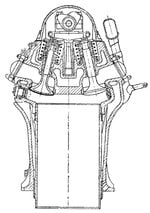
I have no idea if the M-107 could get enough rich mixture in the single intake valve to mix with clean air to get the desired overall mixture. I assume they were at least close.
But comparing it to a normal 4 valve head maybe it was better and maybe it wasn't.
Either 4 valve head should be way better than the 2 valve heads and should have been better than the 3 valve head. The question is by how much?
The scavenging can provide a bit more cooling, in theory. It can provide a bit better fuel economy. But getting peak power might impact both of those..........so what were they trying for and what did they achieve?
The HS engines with the 2 valve heads used a poor port layout. Jumo heads with 3 valves used 1 large intake valve on the inside and two smaller exhaust valves on the outside. Smaller valves tended to run cooler than large valves and were less prone to warping, burning.
on the Klimov 3 valve head things get a bit twisted with both the inlet ports and exhaust ports being on the same side. Ports may not be as large as desired. The M-107 has a lot ports going down the side, are they as large as they should be? What is the size/shape of these ports?
Normal V-12s use 6 siamesed ports on the outside of the head, not 13 ports.
The theory may have been fine. So was the theory behind the sleeve valve, it was the execution that was a problem.
You need really good instruments to really figure out what was happening.
Extra scavenging is good. The more old "used" air you can get out the more fresh air you can get in. That means more power. Getting old hot air out and getting more cooler (relative) air in also helps cooling. With carbs you get a bit of extra cooling because of the evaporation of the fuel and/or the weight of the mixture compared to pure air. However the more boost that is used, assuming superchargers of equal efficiency (which they are not) the hotter the intake air/mixture and now people have to start doing a lot calculations. Compare XX degree intake mixture at YY grams weight per cylinder full vs XXH (higher temp) intake mixture but with more mass to absorb the heat in the piston and cylinder/head/walls.
All valves are not created equal. That is to say even valves of the same size/shape do not flow the same amount air/gasses depending on shape of the ports and/or manifolding. Total lift (valve opening distance) and rate of opening/closing can make a difference. A lot of this is small but sometimes several small differences can add up.
On the Allisons there was a measurable change taking out the backfire filters and that assumed the filters were in good shape to begin with, they were often clogged in even a few dozen hours.
I have no idea if the M-107 could get enough rich mixture in the single intake valve to mix with clean air to get the desired overall mixture. I assume they were at least close.
But comparing it to a normal 4 valve head maybe it was better and maybe it wasn't.
Either 4 valve head should be way better than the 2 valve heads and should have been better than the 3 valve head. The question is by how much?
The scavenging can provide a bit more cooling, in theory. It can provide a bit better fuel economy. But getting peak power might impact both of those..........so what were they trying for and what did they achieve?
The HS engines with the 2 valve heads used a poor port layout. Jumo heads with 3 valves used 1 large intake valve on the inside and two smaller exhaust valves on the outside. Smaller valves tended to run cooler than large valves and were less prone to warping, burning.
on the Klimov 3 valve head things get a bit twisted with both the inlet ports and exhaust ports being on the same side. Ports may not be as large as desired. The M-107 has a lot ports going down the side, are they as large as they should be? What is the size/shape of these ports?
Normal V-12s use 6 siamesed ports on the outside of the head, not 13 ports.
The theory may have been fine. So was the theory behind the sleeve valve, it was the execution that was a problem.