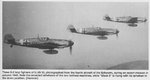
I see no evidence that the Messerschmitt 109F-K's cooling drag was 'relatively high'. What was the cooling drag % on comparable fighters for example?
For example RAE gives the following figures for 'drag as the % of total profile drag - Powerplant' (no seperate cooling system referenced) :
Hurricane I: 11.8 %
Hurricane II: 16%
Spit Vc: 18.2 %
Spit IX: 19.1 %
Typhoon: 27.1 %
Tempest V: 24.3 %
Mustang X: 22.9 %
FW 190A : 21.5 %
In comparison, Hoerner estimates the Me 109G's 'engine and radiator installation' being 23.3% of the drag. That appears to be a pretty average figure, quite close to the Mustang X's.
It was very much higher than the FW 190Ds, already explained why (Junkers style radiator, which fundamental difference in installation you appear to completely ignore), but it is extremely doubtful that the installation was much different in this aspect than other more commonly used, conventional cooling systems (ie. on Spitfire, Mustang, Yakovlev etc. fighters).
The percentage of the total drag is of course is also dependent on the design. Assuming two entirely identical cooling system designs, the percentage will be higher on the aircraft with the smaller wing area, as in the aircraft with a larger wing/fuselage area, other components will contribute more heavily to drag, even if in absolute terms the drag of the radiator installations are identical.
If you would increase the wing size on the 109 by 25%, and leave everything else alone, the % of drag of the engine/coolant system will very likely be a smaller percentage of the total drag. Anyway, what matters is the actual drag generated by the cooling system installation, relative drag to total drag is a pretty meaningless figure, unless you are comparing different models of the same aircraft.
For example the
Spitfire IX, with 19.1 % of powerplant-related drag to the total drag, had a Cd0 of 0.0229 with 242 sq. feet wing area, ie. 5.58 sq. feet total drag.
19.1% of that, or 1,058 sq. feet, was powerplant-related drag.
The
Mustang X, with 22.9 % of powerplant-related drag to the total drag, had a Cd0 of 0.0227 with 233 sq. feet wing area, ie. 5.28 sq. feet total drag.
22.9 % of that, or 1,211 sq. feet, was powerplant-related drag (RAE figures). (Which I find odd, but that is what RAE gives).
For example the
Bf 109G, assuming Hoerner's value of 23.3 % of powerplant-related drag to the total drag, a Cd0 of 0.0230 with 174 sq. feet wing area, ie. 4.02 sq. feet total drag. 23.3 % of that, or 0,93 sq. feet, was powerplant-related drag.
"...especially since the relatively high cooling drag was a problem acknowledged even by Messerschmitt themselves in the reports that Hoerner refers to. ..."
Hoerner does not refer to any Messerschmitt reports in my copy... so I have some doubts about this 'acknowledgement'. In particular the testing of Bf 109F in ealry 1942 as a G testbed considered the cooling system entirely satisfactory.
Moreover Hoerner does not state in Chaper XIV that the Messerschmitt 109 radiator had leakage, but that a radiator
generally similiar to the one used on the Me 109 (subtype unspecied)
may have had such leakage, because that radiator installation had high coefficients of drag.
Of further interest to the subject of the Mustang's ducted radiator, is the testing of a protounding belly cooper scoop on Me 109 V31 in October 1941. So - little surprise here - the solution was not unknown in Germany or elsewhere, but for some reason they opted against it.
Hell even the Hurricane used such!