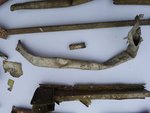
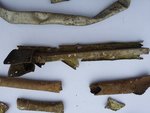
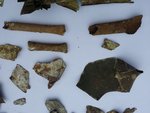
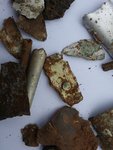
There is no need to apologize.
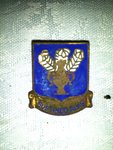
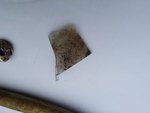
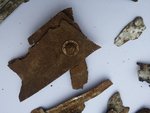
That is the logo of the US Army Air Forces Training Command. The pin would have been worn on the cap of US Army Air Corps cadets still in training. I am doubtful that any combat crew would have worn this insignia BUT by definition all of them would have had one from their training. Maybe one of them kept it as a good luck symbol?
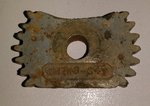
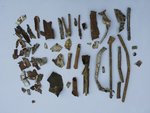
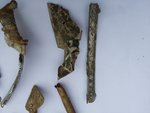
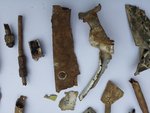
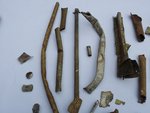
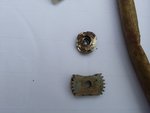
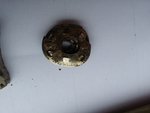
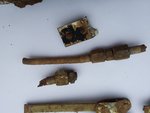
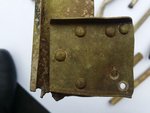
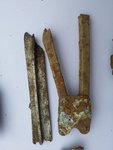
Also, GM may or may not have anything to do with General Motors; however, the Allison Engine Company WAS a division of GM during WW2. In addition, General Electric turbo-superchargers were a component of the Allison engines on, let's say, a P-38 Lightning. Superchargers and turbos are "gear rich" environments, you could say - which would explain the GM part # on the gear but a seemingly different part numbering scheme on the other parts.... perhaps Allison part numbers?
The photo-recon version of the P-38 were known as the F-4 and F-5, which were standard P-38s which then had their noses modified to remove their armament to allow room for photography equipment. These aircraft, in addition to the Spitfires and Mosquitoes which were commonly used, had to fly deep into German territory to accomplish their missions.
A close-up of a turbo-supercharger on a P-38.
View attachment 506273
Source:
www.kbvp.com
Some speculation - aerial photography was of course one of the technical skills taught by USAAF Training Command - an additional technical skill which MAY have caused its wearer to have a strong connection to the symbol.
Fortunately, we also have a veteran B-17 Bombardier here on the forums.
 billrunnels
Bill, perhaps you might have some context as to when and why Training Command pins might have been worn by crews over Germany? Thanks in advance for any insights.
 JohnP
Keep in mind that B-17s also were turbo-supercharged - if you look closely at B-17 engine nacelles you'll be able to spot a similar structure to that shown above on the P-38. So I don't think we have any answers yet, but we at least have a few hypotheses to begin narrowing the possible range of answers.
I know there are some Allison engine gurus on the forums as well. Perhaps one of them can chime in if any of these part numbers ring a bell and/or are consistent with Allison part numbers?
EDIT: one more thing - do you have any more information regarding where these parts were found in Germany?