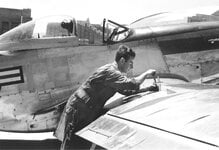
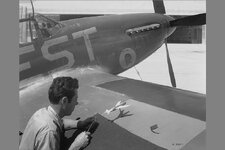
P-51 Being Outfitted For NACA Testing

Ad: This forum contains affiliate links to products on Amazon and eBay. More information in Terms and rules

MIflyer

Captain
8,950
20,233
May 30, 2011
Cape Canaveral
January 1946. That little model they have there looks a lot like a Bell X-1.
Screenshot 2025-02-19 at 18-43-23 Semispan airplane model NASA_Langley Research Center (NASA-L...png
 
This was a scheme being used at the time for high speed, transonic flow testing as no wind tunnels were capable of trans/supersonic flow speeds at the time.

With the P-51 laminar flow wing, stable air was accelerated to those speeds in that area of the airfoil.
 
I'm not sure if it's to illustrate your point about the exhaust shrouding, but the bottom two images are of actual P-51Hs. The fairing of the radiator scoop into the rear fuselage and especially the lack of a kink in the wings leading edges for the landing gear wheels next to the fuselage are giveaways.

Also on the P-51D pictured, it does look like a normal (or maybe slightly modified) standard P-51B/C/D/K exhaust shroud. The fact that the aluminum around and aft the exhaust and the shroud (be it aluminum or steel) is polished does play tricks maybe on one's eyes (it did mine at first, hence editing to add this comment).

A lot of the NACA P-51Ds were fitted with the P-51H taller tail unit (or at least the extension on the vertical stabilizer) as, on the H, it improved handling/directional stability under certain circumstances (an annoying issue on the Mustang dating back to the P-51B due to the switch from the Allison to the Merlin, and use of a 4 bladed prop instead of 3).
 
Well, on the H models and possibly that restored ex-NACA D model the fairing around the exhaust pipes seems to be bent around the pipes rather than just having the pipes sticking out of it. And I think the material on the H and the restored D is Stainless Steel, not AL.
 
Remember that the actual P-51H vertical tail was very different from the P-51D tail with cap as seen here.
 
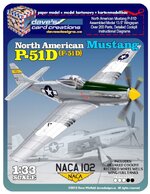
I published a model of NACA 102.
This is from some of the research I have:
The most significant use of these aircraft by the NACA, was in acquiring data on the Bell X-1 design.
The Mustang was chosen for this role, due to its stability, even while exposed to compressibility at high speeds.
NACA Mustangs were the first to be modified with extended vertical stabilizers to increase the aircraft's stability at speed.
The aircraft were used for wing flow pressure distribution tests, with scale models of various airfoils and X-1 designs
mounted on top of the wings for test purposes. Contained within each gun bay were optical balances and strain gauges,
which were wired directly to the models. Flown to 30,000 ft, and then put into a 30-degree dive, the top speeds usually
would reach around 475-mph in the dive, during the 4G pullout, the supersonic air traveling over the wing would provide
the opportunity to gather desired data.
 

Attachments

  • adw-NACA 102 cover.jpg
    adw-NACA 102 cover.jpg
    103 KB · Views: 23
They said that the X-1 fuselage was based on the .50 caliber bullet, which was known to go supersonic with no problems. Of course they still had to figure out the airfoil to use and wing placement.
 
re
I've no idea what shape they were testing with the second one.
In 1946 there were several forward-swept wing aerodynamic and design studies underway.

One used the P-51 as a start point.
One used the P-80/F-90 as a start point.
One used the P-84 as a start point.
One used what became the D-558 high speed design as a start point.

I could be wrong, but that looks like either the one of aerodynamic shapes based on the P-80 or one of the early pre-D-558 shapes.
 

Users who are viewing this thread

Back