Blind fire tail guns such as "Village Inn" tail radar used on the Lancaster would I think have not been a success. Likewise for the tail gun radars the US had for the B-24,B17 and B-29.
This is because the same technology possible also made a bigger, more accurate longer range radar in the fighter possible and the fighter is better armed.
Little known is that the Germans deployed a small number of FuG 211 and FuG 215 blind fire radars in combat in 1942. These were known as "Pauke A" and about 10 were produced and trialed in combat. These had an accuracy of 0.5 degrees within +/-10 degrees of forward. The reason they were not deployed in greater numbers is likely because of the IFF (Identification Friend or Foe) problem which confounded everyone and that they get caught up in the frequency changes needed in 1943 to overcome windows. You had to fly up close and get a visual. For the Nachtjagdt the rules were if it had 4 engines its not ours so shoot it down. Proper airborne IFF didn't reach the Luftwaffe but for a few "Neuling" equipped Me 262.
Above is a picture of the early FuG 202C1 Lichtenstein radar mounted in a Ju 88C. It operated at 490Mhz (60cm)
The small aerial in front of the 16 part (4 by 4) array is the dipole from which the signal radiates, the rear antenna is the 'reflector' which is placed 1/4 wavelength away. it reflects the signal forward and is spaced such a way that the reflection constructively interferes with the dipole to increase directionality. Further forward directionality is promoted by the array interference pattern.
By using a rotating switch wave delays were switched in to the dipoles steer the beam alternately left/right then up/down. By comparing the relative strengths of the returns the position could be determined quite well.
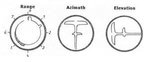
This is what the radar operator saw; Below are the radar traces.
The scope on the left is a j scope and shows the range of the target aircraft around its circumference. It is somewhat superfluous in that the other scopes also contain range information. The scope in the middle shows whether the target is to the left or right (in this case the right return is heaviest so the target is to the right) and the scope in the right shows if the target is high or low, in this case high. The big pulse at the end is the ground return.
By evaluating the deviation electronically, rather than visually, the Luftwaffe was able to obtain 0.5 degrees within +/-10 degrees of center. This is a 0.87m error every 100m and probably good for attacks up to 200m away. 200m was certainly the attack range they envisioned.
This was all updated 25 times/second. It was in many ways superior to allied mechanically scanned radar which took many seconds to scan and had equally abstract displays.. The narrow beam of allied microwave radar however made it less susceptible of receiving jamming energy.
The Germans (Telefunken) could have switched in a wider range of delays but left/right/up/down was sufficient.
If the Germans had of replaced their 60cm 1.5kW transmitter with a 15cm 5kw transmitter (which they had by way of the Telefunken LD7 disk triode) and used a more complicated switch pattern 4 left.right and 4 up down) they would have had a phased array radar that could have fitted in a dome.
Somewhat astonishingly the Germans placed their 490MHz 60cm Pauke A radar in a 70cm dish to produce a 57 degree wide beam that could be scanned to track a blind fire solution as an alternative to the array.
FuG 222 "Pauke SD" was a project using 9cm radar, I think using non magnetron sources. Three were built. In addition the FuG 247, a 3cm radar in the lab stage was to be blind fire capable. The FuG 240N3 radar (9cm) deployed on 25 Ju 88G7 aircraft was not blind fire capable but the FuG 244 and FuG 245 (3cm fire control radars from different manufacturers) certainly had some. These radars incidentally found themselves integrated into quad 20mm FLAK and were called "Rettin"
These latter radars injected the firing directions into either the EZ42 or EZ45 gyro 'reflector sight' which had been modified to take inputs from Toss bombing computers or the blind fire computer (Elfe) to deflect the cross hairs appropriately. It was hope to put the signals straight to the auto pilot.
Apart from guns the intention was to use the R100 rocket, a 250mm 10 inch rocket with a proximity fuse to be fired from 1.2km. About 25 were test launched before the end of the war.
Hence tail gun blind fire radar would be outperformed the night fighters radar and weapons.