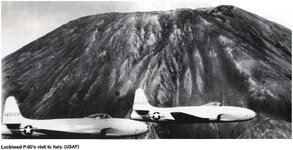
Hi! I'm new to this website, and what surprised me was when I read that the early YP-80 actually served in a sortie.
[.....]
I dunno if you guys know anymore information, but I'm hoping to find more information about the entire P-80 series, especially the beginnings.
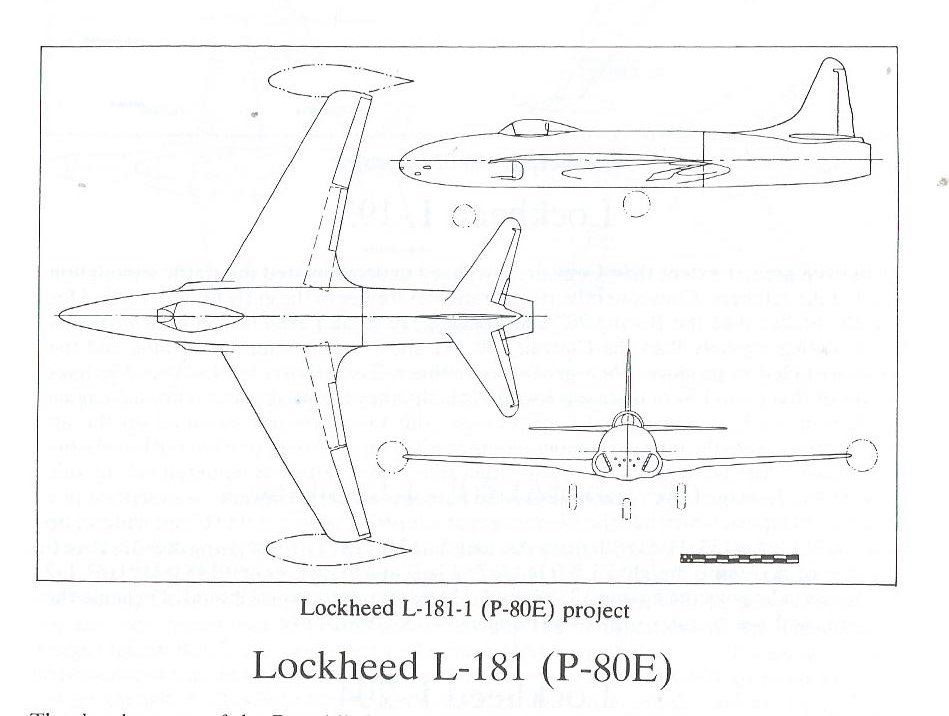
Lockheed F-80E : Link to the page
I dunno if you guys know anymore information, but I'm hoping to find more information about the entire P-80 series, especially the beginnings.
Lockheed F-80E : Link to the page
I believe that the following 12 page article might be a useful addition to this thread:
I have not seen it before.
Please forgive me if it has been posted/discussed here before.
Contrary to popular belief, the article tends to suggest that the early P80 engines were not as reliable as has been rammed home over and over again when they are compared to the equivalent German jets.
[.....]
pp4/12
Bob(Hoover) recalls the struggles with those early Lockheed P-80s: "They put me into the jets right off. When I first flew it, the engine life was exceedingly short. After each flight, you had to wait until the engine cooled down so you could crawl up the tailpipe. We learned to do that ourselves, to crawl up and take a device that could measure the clearance between the blades on the turbine wheel against the shroud that surrounded it. It had to be within a paper-thin tolerance between each blade. I can't recall how many there were, but it took a considerable time to go through this procedure, which was commonplace with the earlier jet engines. That happens with a lot of the new engines when they are first developed." Pisanos: "The engineers would have to look at them and if necessary, replace the engine to continue the flight. We also had problems at Muroc with blades coming off, one time I had to put a YP-80 on the lake bed dead stick because of that. Tony LeVier and ol' Kelly Johnson were really living at Muroc with us during the service tests. Of course, every time we had a major catastrophe, they would take the airplane back to Burbank and try to repair it." Fuel control was one of the biggest problems with the early Shooting Star. Bob: "We didn't have fuel controls as nowadays, and we didn't have adequate controls with the P-59 before it. So, what we had to do… the pilot was responsible as the fuel controller. It was a manual procedure on those early engines. You had to meter it so delicately to avoid it getting excessive temperature and exceeding the limits on the engine.
pp5/12
"When you would go to start the engine, the engine would be cranked up with an external power source to where the rpm of the engine was high enough to accomplish throttle movement. But we always had problems with the power unit getting it up to enough speed before ignition. Then when you hit the ignition, you barely broke the throttle out of its stop-cock, or closed position. "In that position there was no fuel coming out at all, and then you'd have to come around a little horn on the throttle quadrant, to get out of that stop-cock position. If you came around that horn and moved it just a fraction of an inch too fast, you'd be to the limits of temperature and you'd have to stop it. So, you had to be very careful because the metering of the fuel was the most important thing in the world to jet engines before we got automatic fuel controls." It was the opposite of what you'd expect with a piston engine, where the richer mixture would run cooler. With the jets, more fuel had the opposite result. Bob: "Correct, if you let the pressure build up too much, with too much of a squirt of fuel, then the turbine wheel couldn't accept it quick enough and all that fuel that it didn't need at low rpm would exceed the temperature needed for engine start. We eventually got fuel controllers on the P-80 and then it became a reasonable airplane, but even to the end, you had to be careful coming out of the stop-cock position. After the Shooting Star, the F-84 was the next one to come along and they had a fuel controller." But with the early P-80, the problems continued. Almost a year after the loss of Milo Burcham, fuel pump failure also led to the loss of Richard Bong, America's top ace of the Second World War, on August 6, 1945. The Lockheed test pilot had a primary fuel pump failure on takeoff with an early production P80, and was lost when he bailed out at insufficient altitude for the chute to deploy.
pp6/12
Pump failure had been a well documented issue with the planes, and they had recently been upgraded with an auxiliary I-16 fuel pump which needed to be engaged by the pilot. In the post-crash investigation it was determined that the auxiliary pump was not engaged. Flight testing of the P-80s was the very definition of hazardous duty.
[.....]
I went looking for such evidence after re reading Chuck Yeagers book.
He clearly states at pp116/117 Chapter 9 The Right Place of his autobiography that early(mid/late1945) P80 engines only lasted 3-4 hours:
"The life of an engine in those early jets was practically nothing; after only three or four hours an engine would burn out, and we had so many fire-warning lights in the cockpit that I finally unscrewed the bulb. But since the Shooting Star was always being repaired, I logged more jet time than anyone else: the airplane couldn't go back into service until the maintenance officer checked it out on the sky(
CY was the designated maintenance officer - my emphasis). So, right from the start, I was probably the most experienced jet pilot in the Air Corps.
Flying these primitive jets was tricky. You had to be cautious opening the throttle because the engine temperature would climb enormously, So, you'd ease up on the throttle slowly, making sure you didn't go over the red line on the temperature gauge. The landings were even trickier. Flying faster than ever before, you had to line up your approach faster and more accurately than with props. The Shooting Star didn't decelerate very quickly, and its rate of acceleration was even worse, so if you came in too slow, you couldn't get your power back for nearly twenty seconds, and by then you might be heading into the ground. We lost several jets and pilots that way. Like somebody said, it was like trying to learn how to ride a race horse after riding only on elephants."
THIS 3/4 HOUR ENGINE LIFE IS, OF COURSE, LESS THAN THE COMMONLY ACCEPTED LIFE OF 10 HOURS OR SO LIFE OF A JUMO 004 as in the Me262.
The Me262 is roundly pilloried for this short engine life and how bad it is, yet here is significant evidence that the P80 was actually worse.