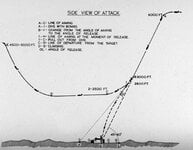
Spitfire Dive Bombing schematic (2 Viewers)

Shortways

Airman
58
43
Joined
Dec 4, 2023
Does anyone have a sharper version of this picture please?
 

Attachments

  • IMG_8701.jpeg
    IMG_8701.jpeg
    33.2 KB · Views: 17
I would just lob the bomb a 6000ft (A) and head back for a beer
Works for me. Likely just as accurate as whatever that release is called.
 
Works for me. Likely just as accurate as whatever that release is called.
Unfortunately for attackers, the closer you get, the more accurate the result.
You can tell the real 90 degree screamers, like the Ju87, they have dive brakes and a folding bomb crutch that swings out as the free-falling bomb accelerates away from the braked aircraft and the bomb is carried out far enough to miss the prop.
Dive bombing is tricky, even 5 degrees feels steep and 45 degrees almost feels vertical! The Spitfire would have trouble sighting the target under the nose, they would have to approach in a turn or, offset and judge the relative angles by the height and the position of the target relative to the wing leading edge or similar.
The inherent greater accuracy with dive-bombing did make-up for the often wildly flown aiming, the variables of speed, dive angle, release height and pre-calculated sight settings were
considerable.
Is the whole document available to see please?

Cheers

Eng

 
Unfortunately for attackers, the closer you get, the more accurate the result.
You can tell the real 90 degree screamers, like the Ju87, they have dive brakes and a folding bomb crutch that swings out as the free-falling bomb accelerates away from the braked aircraft and the bomb is carried out far enough to miss the prop.
Dive bombing is tricky, even 5 degrees feels steep and 45 degrees almost feels vertical! The Spitfire would have trouble sighting the target under the nose, they would have to approach in a turn or, offset and judge the relative angles by the height and the position of the target relative to the wing leading edge or similar.
The inherent greater accuracy with dive-bombing did make-up for the often wildly flown aiming, the variables of speed, dive angle, release height and pre-calculated sight settings were
considerable.
Is the whole document available to see please?

Cheers

Eng
I got the pictures from the Internet.
 
Unfortunately for attackers, the closer you get, the more accurate the result.
You can tell the real 90 degree screamers, like the Ju87, they have dive brakes and a folding bomb crutch that swings out as the free-falling bomb accelerates away from the braked aircraft and the bomb is carried out far enough to miss the prop.
Dive bombing is tricky, even 5 degrees feels steep and 45 degrees almost feels vertical! The Spitfire would have trouble sighting the target under the nose, they would have to approach in a turn or, offset and judge the relative angles by the height and the position of the target relative to the wing leading edge or similar.
The inherent greater accuracy with dive-bombing did make-up for the often wildly flown aiming, the variables of speed, dive angle, release height and pre-calculated sight settings were
considerable.
Is the whole document available to see please?

Cheers

Eng
My experience in actual bombing is all in jets, but 45 degrees was generally considered standard, and is quite comfortable once you get used to it. And while I'm sure you can get closer to the target in a prop (mainly because of speed effect on pullout radius), the error sensitivities for dive angle, airspeed, and release altitude are significant, and hitting the parameters associated with your sight setting is critical. Here's a diagram from Navy weapons training (beginners' course, introduced in advanced jet syllabus):
Figure 19: Curvilinear/Straight-Path Tracking

Note the lead angle to begin straight path tracking, initial pipper placement, and steepening dive angle compensated by a slightly shallow initial roll-in. The goal is to arrive at desired dive angle before starting the straight-path portion, and relaxing to achieve proper sight picture at release altitude on airspeed (and if you miss on any of the parameters, you adjust aim point to compensate).

Contrast with the Spitfire diagram where the pilot changes dive angle at the last 200' of the dive, to something in a 15 degree range, pulling to a preselected depression angle. It looks like a fighter guy's estimate of what a dive bomber is doing by watching it from the side.
 

Users who are viewing this thread

Back