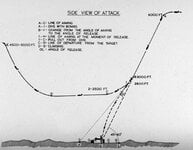
My experience in actual bombing is all in jets, but 45 degrees was generally considered standard, and is quite comfortable once you get used to it. And while I'm sure you can get closer to the target in a prop (mainly because of speed effect on pullout radius), the error sensitivities for dive angle, airspeed, and release altitude are significant, and hitting the parameters associated with your sight setting is critical. Here's a diagram from Navy weapons training (beginners' course, introduced in advanced jet syllabus):
Figure 19: Curvilinear/Straight-Path Tracking
Note the lead angle to begin straight path tracking, initial pipper placement, and steepening dive angle compensated by a slightly shallow initial roll-in. The goal is to arrive at desired dive angle before starting the straight-path portion, and relaxing to achieve proper sight picture at release altitude on airspeed (and if you miss on any of the parameters, you adjust aim point to compensate).
Contrast with the Spitfire diagram where the pilot changes dive angle at the last 200' of the dive, to something in a 15 degree range, pulling to a preselected depression angle. It looks like a fighter guy's estimate of what a dive bomber is doing by watching it from the side.