US "Amazon" variant of the British "Grand Slam" earthquake bomb dropped by B-29s on reinforced U-boat pens in Germany during post-war trials

Ad: This forum contains affiliate links to products on Amazon and eBay. More information in Terms and rules

hw97karbine

Airman 1st Class
265
911
Mar 23, 2025


The Valentin submarine pens are a reinforced concrete facility on the Weser River at the Bremen suburb of Rekum, built to protect German U-boats during World War II. The factory was under construction from 1943 to March 1945 using forced labor, but was damaged by air-raids and unfinished by the end of the war. The Valentin factory was the largest fortified U-boat facility in Germany, and was second only to those built at Brest in France.

After the war, the facility was used as a target for Project Ruby, a series of joint British and American tests to determine the viability of various munitions against reinforced concrete targets. It had been hit by British "Tallboy" and "Grand Slam" earthquake bombs during a raid on March 27th 1945 and one of the weapons tested in 1947 was "Amazon", the US variant of the 22,000 lb "Grand Slam" that weighed in at 25,000 lbs and was dropped by B-29 Superfortress bombers flying from RAF Marham in England. Fifteen such inert bombs were dropped from 17,000 feet and of these two hits were obtained on the thinner roof section that was approximately 15 feet thick.

extended footage
 
There were two separate series of trials and several different US developments of the 22,000lb Grand Slam were tested.

Project Ruby 1946
Included tests of the US 22,000lb SAP T28 "Amazon" alongside the 12,000lb "Tallboy" (US designation 12,000lb GP T10) and 22,000lb "Grand Slam" (US designation 22,000lb GP T14). The T28 design did not prove satisfactory as the weapons tended to break up during penetration. That led to a redesign and more trials In 1947.

Project Harken 1947
Included tests of the US 25,000lb T28E1 "Amazon II" and the 25,200lb T28E2 "Samson" bombs. The latter was longer and narrower. The impact in the film looks more like a "Samson" to me.

Note the change of designation from "GP" on the T10 & T14 to "SAP" with the T28 series.

The official report on the Harken trials can be found here. Unfortunately not all the pages have been captured.
 
View attachment 827295

The Valentin submarine pens are a reinforced concrete facility on the Weser River at the Bremen suburb of Rekum, built to protect German U-boats during World War II. The factory was under construction from 1943 to March 1945 using forced labor, but was damaged by air-raids and unfinished by the end of the war. The Valentin factory was the largest fortified U-boat facility in Germany, and was second only to those built at Brest in France.

After the war, the facility was used as a target for Project Ruby, a series of joint British and American tests to determine the viability of various munitions against reinforced concrete targets. It had been hit by British "Tallboy" and "Grand Slam" earthquake bombs during a raid on March 27th 1945 and one of the weapons tested in 1947 was "Amazon", the US variant of the 22,000 lb "Grand Slam" that weighed in at 25,000 lbs and was dropped by B-29 Superfortress bombers flying from RAF Marham in England. Fifteen such inert bombs were dropped from 17,000 feet and of these two hits were obtained on the thinner roof section that was approximately 15 feet thick.

extended footage

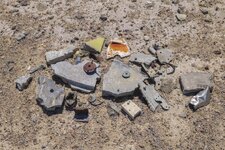
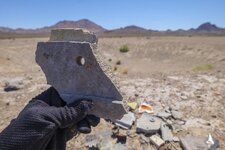
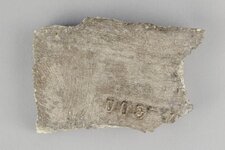
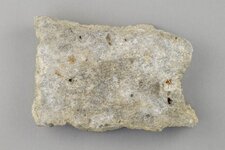
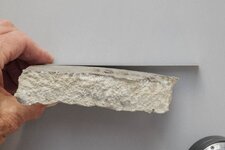
I had the pleasure of exploring two old bombing targets north of Wendover Field, Utah. One target has a single large crater, about 30-feet in diameter. There was a variety of 1-inch thick solid bomb casing fragments and thin aluminum strips that appear to be from a crashed aircraft. Therefore my first thought was that the target had been hit by a cruise missile, but what would cruise missile wreckage be doing at a World War Two bombing target? I brought a single fragment of casing home and photographed it. The piece, shown below, is 5-inches long, exactly one-inch thick, weighs 608 grams, does not respond to a magnet, and is not radioactive. I don't know the formule for determining the bomb's radius, but the 5-inch long piece curves 8mm across its horizontal length. It curves about half as much vertically. A site administrator at Wreckchasing . com suggested that this fragment might've come from an Amazon test bomb, dropped during Project Ruby in 1945. THANKS for any feedback! Robert
000A.jpeg
 

Attachments

  • 003.jpg
    003.jpg
    225.9 KB · Views: 15
  • 008.jpg
    008.jpg
    230.6 KB · Views: 19
  • 001.jpg
    001.jpg
    133.6 KB · Views: 14
  • 002.jpg
    002.jpg
    134.9 KB · Views: 13
  • 003.jpg
    003.jpg
    65.9 KB · Views: 13

Users who are viewing this thread

Back