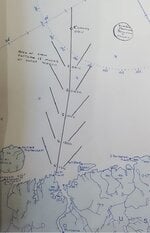
I was browsing through the ORBs from UK National Archives for 304 (Polish) Squadron for May 1945. I was surprised to read that as the war in Europe ended they were receiving Wellingtons equipped with sono-buoys (High Tea). I knew they were fitted in late mark Liberators and used on operations but that was the first time I had seen sono-buoys linked to Wellingtons.. Anyone have information on the fitting in Wellingtons and if other squadrons were equipped earlier and used it on operations?

Navigation
Install the app
How to install the app on iOS
Follow along with the video below to see how to install our site as a web app on your home screen.
Note: This feature may not be available in some browsers.
More options
You are using an out of date browser. It may not display this or other websites correctly.
You should upgrade or use an alternative browser.
You should upgrade or use an alternative browser.
Wellingtons and sono-buoys (High Tea) (3 Viewers)
- Thread starter WATU
- Start date
Ad: This forum contains affiliate links to products on Amazon and eBay. More information in Terms and rules
More options
Who Replied?
Jadera
Airman 1st Class
- Thread starter
- #3
Hi Thanks 306 was a single-seat fighter squadron so not really suitable for High Tea. 53 was fitted with High Tea but was a Liberator unit. Did you find evidence that either flew Wellintons late war?
Jadera
Airman 1st Class
I couldn't find anything, only squadrons that I found were 172, 179, 304 and possibly 612
- Thread starter
- #5
Hi. 612 and 172 Wellington squadrons, probably, had ASV Mk VIA radar bombsights. 524 and 304 definitely did. That is what I was looking at. As yet I have not seen mention of 179 but will look into it. Where did you see 179 named? It was in the 304 ORBs that High Tea was mentioned. ThanksI couldn't find anything, only squadrons that I found were 172, 179, 304 and possibly 612
Appendices in the RAF Narratives give CC Group orders of battle with squadrons, aircraft type (incl those fitted with LL but not High Tea), radar type, UE, strength & available aircraft monthly from Sept 1944. It might be worth a trawl through. High Tea does get mentioned on Liberators.Hi. 612 and 172 Wellington squadrons, probably, had ASV Mk VIA radar bombsights. 524 and 304 definitely did. That is what I was looking at. As yet I have not seen mention of 179 but will look into it. Where did you see 179 named? It was in the 304 ORBs that High Tea was mentioned. Thanks
179 squadron converted from Wellington XIV to Warwick GR.V in Nov 1944 and moved to St Eval. Narrative says ASV.IIIB and LL on its aircraft on 1 May 1945.
304 moved down from Benbecula to St Eval on 6th March with LL Wellington XIV.
Their are differences in radar fits from what you note, but not sure which would be correct.
RAF in the Maritime War Vol 5

306 was only ever a single engined fighter squadron throughout its existence. 53 only flew Liberators from May1943 to June 1946 when it disbanded.
Note that by May 1945 per the Narrative the role of 524 (ASV.IIIA) and 612 (ASV.VIA) squadrons was anti-shipping in the North Sea and not anti-submarine which may have had an effect on equipment fits. Note also no LL
- Thread starter
- #7
Hi Ewen
524 and 304 definitely had the Mk VIA radar bombing equipment but not in all aircraft initially. New aircraft fitted with it were fed in piecemeal so reports could easily mention other radar types. For example 304 started to receive ASV VIA aircraft on 20 April. The Mk VIA could be used against ships and U-boats and the aircraft would carry the Leigh Light for identification of targets at night. Final attack could be by radar or visual bombsight. The only sight mentioned in the ORBs was the Mk XIV used in attacks above 1,000' which indicates an anti-shipping role rather than ASW although the Mk XIV could be used against U-boats with the 600lb bomb. Only one or two U-boats were seen monthly and targets were overwhelmingly ships. There is no evidence in the ORBs of blind bombing being undertaken. Mk III low level bombsights would have been held at the station.
I will look at 172 and 612 squadrons later. My expectation is that they will mirror 524 and 304. 179 is not relevant, as you say.
Still no more on High Tea in Wellingtons but the 304 ORB clearly mentions it.
524 and 304 definitely had the Mk VIA radar bombing equipment but not in all aircraft initially. New aircraft fitted with it were fed in piecemeal so reports could easily mention other radar types. For example 304 started to receive ASV VIA aircraft on 20 April. The Mk VIA could be used against ships and U-boats and the aircraft would carry the Leigh Light for identification of targets at night. Final attack could be by radar or visual bombsight. The only sight mentioned in the ORBs was the Mk XIV used in attacks above 1,000' which indicates an anti-shipping role rather than ASW although the Mk XIV could be used against U-boats with the 600lb bomb. Only one or two U-boats were seen monthly and targets were overwhelmingly ships. There is no evidence in the ORBs of blind bombing being undertaken. Mk III low level bombsights would have been held at the station.
I will look at 172 and 612 squadrons later. My expectation is that they will mirror 524 and 304. 179 is not relevant, as you say.
Still no more on High Tea in Wellingtons but the 304 ORB clearly mentions it.
- Thread starter
- #8
Jadera
Airman 1st Class
maybe buoy utlity?
- Thread starter
- #10
A surprising use of High Tea by a Wellington XIV of 172 Squadron. It carried out a depth charge attack on a submerged U-boat. It subsequently dropped a High Tea pattern. The odd thing is that this was on 11 May, three days after the end of the war in Europe. And the fact that Wimpys had High Tea still surprises me!
The term SBU is used in the RAF narrative in the context of " E-boats and Small Battle Units". So ASBU I would suggest refers to Anti- Small Battle Unit patrols.A related query. 612 ORBs talk of mainly three missions. Armed recce, anti-shipping and ASBU. Any thoughts on what ASBU stood for? Obvious guess for the AS bit is anti-submarine. But BU leaves me puzzled?
It is a reference to the various craft used to target Allied shipping between the Thames estuary and the Scheldt in 1945. Craft like Biber, Molch & Seehund midget subs and Linsen explosive motorboats. These were being targeted by RN patrols as well as 524 & 612 squadrons RAF with Wellingtons as well as 119 with Albacores then Swordfish as well as 819 FAA with Swordfish mostly by night as well as Beaufighters of 236 & 254 squadrons by day.
The Linsen operated in groups of three - two carrying explosives and the third radio gear to control the other two remotely.
See p249 and following pages of the RAF Narrative I referred to earlier.
- Thread starter
- #12
ThomasP
Chief Master Sergeant
Does anyone have size and wight specs on the war-time British 'High Tea'. sonobuoys, particularly the early variants as used in 1942-43?
If my information is correct, the size of the original variant was Ø24" x 72"L. I have no weight info.
Any information would be appreciated
If my information is correct, the size of the original variant was Ø24" x 72"L. I have no weight info.
Any information would be appreciated
- Thread starter
- #14
Hi I looked into High Tea a few years back but did not major on the buoy dimensions. I wrote the following:
"The AN/CRT-1A was made up of a hydrophone and an amplifier connected to an FM radio transmitter. The
sonic hydrophone, amplifier, and transmitter, together with a battery power supply, were incorporated in a
waterproofed cardboard tube about 30 inches in length and 4 inches in diameter and weighing about 12
pounds. The transmitter and batteries were housed in the upper compartment, which was separated by a
watertight bulkhead from the release mechanism, hydrophone, and cable in the lower compartment. The
brief included the requirement to minimise use of materials in short supply – hence the cardboard tube.
Source I noted as "NDRC, Div 6, Vol 14 Listening Systems". Probably on Hyperwar or a similar site. I'll see if I have a copy.
I do have a copy and it is the source of the dimensions. It tweaks the diameter to 4.25" later on.
"The AN/CRT-1A was made up of a hydrophone and an amplifier connected to an FM radio transmitter. The
sonic hydrophone, amplifier, and transmitter, together with a battery power supply, were incorporated in a
waterproofed cardboard tube about 30 inches in length and 4 inches in diameter and weighing about 12
pounds. The transmitter and batteries were housed in the upper compartment, which was separated by a
watertight bulkhead from the release mechanism, hydrophone, and cable in the lower compartment. The
brief included the requirement to minimise use of materials in short supply – hence the cardboard tube.
Source I noted as "NDRC, Div 6, Vol 14 Listening Systems". Probably on Hyperwar or a similar site. I'll see if I have a copy.
I do have a copy and it is the source of the dimensions. It tweaks the diameter to 4.25" later on.
Last edited:
- Thread starter
- #15
As to models only the AN/CRT-1A and AN/CRT-1B were used. Largely identical.
"In addition to the AN/CRT-1A a 1B version was used - the 1A operated on 67.7 to 71.7 Mc/s, the 1B on 62.9 to 66.9 Mc/s; the visible
designator on the 1A was a black band with a white band on the 1B"
"In addition to the AN/CRT-1A a 1B version was used - the 1A operated on 67.7 to 71.7 Mc/s, the 1B on 62.9 to 66.9 Mc/s; the visible
designator on the 1A was a black band with a white band on the 1B"
- Thread starter
- #16
The US produced, and AIUI supplied to Britain and used under codename High Tea, was the AN/CRT-1 / 1A / 1B.Does anyone have size and wight specs on the war-time British 'High Tea'. sonobuoys, particularly the early variants as used in 1942-43?
If my information is correct, the size of the original variant was Ø24" x 72"L. I have no weight info.
Any information would be appreciated
Dimensions per manual 5.25-5.5in x 40.5-41in weight 16lbs (other sources say 12.5-14lbs)
From this site (which notes the hydrophone cable at 24ft)
Also this giving the hydrophone cable at 20ft
Reading through the RAF Narrative I highlighted before, following a CC Group Commanders Conference on 31st Jan 1945, there were two attempts in 1945 to create sonobuoy barriers across likely U-boat transit routes. The first on 8/9 March 1945 was laid from the air west of Ireland and was constantly patrolled by aircraft. It didn't prove very successful due to battery life of the sonobuoys.This line was backed up by an escort group ready to prosecute any contacts.
A second attempt in May saw a string laid from ships between Rockall and the Hebrides. These were of a different type with longer battery life and the exercise lasted 3 days from 2-5 May. The lines were constantly patrolled by Liberator GR.VIII of 59 & 120 squadrons based out of Ballykelly, Northern Ireland.
The first RAF operational use of sonobuoys is supposed to have been on the Sunderlands of 210 squadron in July 1942. That appears not only on Wiki but in various sonobuoy articles.UK saw limited roll-out from August 1943 but it only built up supply volumes towards the end of that year. It was not used by Coastal Command in 1942. I think the US only used it operationally from early summer 1943.
As for early US use see this article
The 12th Nov 1943 instructions from CC HQ about the equipment fit on Liberators notes "Radio Sono Buoy to be fitted when available to all aircraft". That suggests it was not then available.
Oddly High Tea rarely rates a mention amongst Liberator equipment fits whereas ASV.X and LAB does.
The use of High Tea on Liberators AFAICT is associated with the introduction of the GR.VIII into service. Compared to the earlier GR.VI they had a different internal layout for the navigator, radio & radar operators as well as the 3cm ASV.X (AN/APS-15) These only began to arrive in Britain in Aug 1944 with the first squadron allocations in Nov 1944. Squadrons converted in the following order:-
224 - Nov 1944
120 - Dec 1944
53 - Jan 1945
86 - Feb 1945
206 - Feb 1945
59 - March 1945 noted as equipped with ASV.X, LAB, LL and High Tea. First operational sortie on GR.VIII was 23 March.
547 - March 1945.
220 & 311 never received the GR.VIII before 'VE Day. In some cases the switch from earlier models extended over a few months. There is no mention of the GR.VI taken over by 311 from 206 in March 1945 having High Tea.
I'm interested to hear about earlier CC use on Liberators and other aircraft.
- Thread starter
- #19
Hi Ewen
Looking at the NDRC dimensions there is no mention of the parachute which is the pointy bit at the top. I think the NDRC length is for the core buoy tube which entered the water. Although I cannot see why the diameter differs.
I am surprised at the early use of sonobuoys. Any primary sources you can point me at? My information is that AN/CRT-1A was only finalised as the mass production model in the spring of 1943 with bulk deliveries due to come off from June. I expect any AN/CRT-1's (essentially a prototype) received in the UK were just for trials. Operational models were the 1A and 1B. Supplies to the UK were only a trickle even by March 1944. If you PM me an email I will send you my article which has some examples of use and more on timelines.
HMS Vindex, a CVE, escorting a convoy leaving Murmansk used an innovative sonobuoy fence pattern. Buoys were laid along the sloping lines following the planned route of the convoy. 85 were dropped in total, rather less than the ideal number. It was felt that saving just one merchantman would justify substantial sonobuoy use.
Looking at the NDRC dimensions there is no mention of the parachute which is the pointy bit at the top. I think the NDRC length is for the core buoy tube which entered the water. Although I cannot see why the diameter differs.
I am surprised at the early use of sonobuoys. Any primary sources you can point me at? My information is that AN/CRT-1A was only finalised as the mass production model in the spring of 1943 with bulk deliveries due to come off from June. I expect any AN/CRT-1's (essentially a prototype) received in the UK were just for trials. Operational models were the 1A and 1B. Supplies to the UK were only a trickle even by March 1944. If you PM me an email I will send you my article which has some examples of use and more on timelines.
HMS Vindex, a CVE, escorting a convoy leaving Murmansk used an innovative sonobuoy fence pattern. Buoys were laid along the sloping lines following the planned route of the convoy. 85 were dropped in total, rather less than the ideal number. It was felt that saving just one merchantman would justify substantial sonobuoy use.