In my opinion an important part of any duel would be to start on the same airstrip and have both pilots race for their planes in a "scramble":
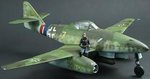
Me 262 Scrambling
"...Always accelerate the engines slowly. The gas temperature must never rise above the permitted value and the engine must not "roar" (bullern)... In view of this, only take corners by using the brakes, never by using the engines. Always taxi gently and never make sharp turns, otherwise control of the aircraft will be lost..."
"...After releasing the brakes, push the throttle lever right forward and check over the engine... the check is done by eye and ear, the engines must not "roar" and the instruments must show the same values as they did during running up or during previous take-offs. The gas pressure must be especially watched, and if it is more than 5% lower than previously, do not take off. in such a case, it is most likely that cavitation has taken place within one of the compressor stages...
Pilot Notes on Me262 by Flug Kapitan Wendell
http://forum.axishistory.com/viewtop...2d38f&start=15
"...Another Me-262 story from Hans Busch, original Me-262 pilot:
As with most all WWII tricycle landing gear aircraft, the nose wheel on the Me-262 was not at all steerable, but rather was just castoring...
If the nose wheel on the Me-262 got cocked too much during ground maneuvering, the nose wheel had to be straightened out first or damage could occur from further taxiing.
This apparently occurred frequently in the Me-262. Hans related that he occasionally encountered this problem and had to climb out of the cockpit, engines running, and manually pull and pry the nose wheel back into alignment himself before proceeding!.."
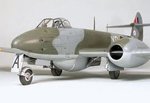
Meteor Scrambling:
From
http://www.wwiiaircraftperformance.o...Meteor-CFE.pdf
56. The starting up is extremely easy and can be completed in approximately 56 secs. This, coupled with the fact that no warming up is necessary is of considerable advantage for a rapid "scramble", and a formation of Meteors could get off the ground nearly as quickly as a formation of any conventional single engine fighters, and more rapidly than a formation of twin-engined fighters.
57. A number of test scrambles have been carried out, with the pilot strapped in the cockpit, helmet on, R/T plugged in, starter control plugged in, and one airman standing by, brakes on, and no chocks. The time was taken from the moment the high pressure c_o_c_k was turned on, till the aircraft became airborne, and included starting up both motors, taxiing 75 yards, turning on to the runway, and taking off.
58. Two types of scrambles were used. First, the jet engine procedure of turning on to the runway and opening up the throttles fully on the brakes to check the max rpm and jet pipe temperatures. This type of scramble takes 2 min 40 sec. Secondly, the conventional take-off was done, which can be used for an emergency where no checks of rpm or jet pipe temperatures were done on the runway, and this takes 2 min 5 sec.
After take-off, the Meteor would have time to come around to attack the Me 262 on lift-off. That's if an engine surge hadn't occurred, or the pilot wasn't still straightening out his nose wheel. Would the rules allow the Meteor to strafe the Me 262 on the gound?
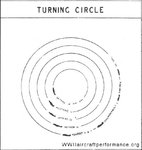
The diagrams attached give an indication that the Me 262 nosewheel was relatively weakly castoring.