Yak-9P with VK-105PF-2 engine

Ad: This forum contains affiliate links to products on Amazon and eBay. More information in Terms and rules

Hoggardhigh

Airman 1st Class
223
33
Jan 6, 2014
United States
Hi all,

So apparently many Yak-9Ps (essentially all-metal Yak-9Us) had their VK-107A engines swapped out for the VK-105PF-2.

According to this article, when Polish Yak-9Ps were refitted with the -105 engine, the original top cowling panels had to be replaced with those of the Yak-9U, with the front intake just behind the propeller and the rear outlet between the gun bulges; however, the illustration on page 27 of Robert Panek's Yakovlev Yak-9U & P (Mushroom Yellow Series 6119, 2006) suggests that some of these re-engined -9Ps (namely, those in Yugoslavian service) retained their original cowling, with just the intake at the cowling's rear end.

Can someone explain all of this in a bit more detail?
 
Actually I didn't hear the Polish Yak-9Ps were refitted with the VK-105PF2 engine. The Polish Air Force used the D,M,T, P and W(V) variants. So the U version wasn't used by the PAF rather. All the Yak-9P were the post-war production powered by the VK-107A engine and went into the service in 1949/1950 although the first ten kites were delivered in 1947. The VK-105PF2 powered the Yak-9W2 (Yak-9V2) armed with the 23mm gun. If the Polish Yak-9P would have the engines replaced with the early power unit the exhaust pipes would be the clue. But as I mentioned I haven't seen these on the Polish 9Ps. Also the U variant with the VK-107A just had the front air intake while the one powered by the VK-105PF didn't. So what would be the reason for using the top cowling for the VK-107 while the VK-105 didn't required the scoop.
 
Actually I didn't hear the Polish Yak-9Ps were refitted with the VK-105PF2 engine. The Polish Air Force used the D,M,T, P and W(V) variants. So the U version wasn't used by the PAF rather. All the Yak-9P were the post-war production powered by the VK-107A engine and went into the service in 1949/1950 although the first ten kites were delivered in 1947. The VK-105PF2 powered the Yak-9W2 (Yak-9V2) armed with the 23mm gun. If the Polish Yak-9P would have the engines replaced with the early power unit the exhaust pipes would be the clue. But as I mentioned I haven't seen these on the Polish 9Ps. Also the U variant with the VK-107A just had the front air intake while the one powered by the VK-105PF didn't. So what would be the reason for using the top cowling for the VK-107 while the VK-105 didn't required the scoop.
Regarding the Yak-9U, what do you mean by "the one powered by the VK-105PF"?
 
Regarding the Yak-9U, what do you mean by "the one powered by the VK-105PF"?

The Yak-9U prototype was powered by the VK-105PF2 engine due to the delaying in the VK-107 production. In pic both of the prototype with the VK-105PF2 and to one with the VK-107A it can be noticed the the VK-105 didn't need the front top air intake.
 
If you will notice, one of the linked images in post #1 is of the Museum of Flight's Yak-9U (more info here and here), which appears to have the -105 engine (judging by the engine exhausts) but also has the front and rear intakes normally found on the -107 engined machines.
 
If you will notice, one of the linked images in post #1 is of the Museum of Flight's Yak-9U (more info here and here), which appears to have the -105 engine (judging by the engine exhausts) but also has the front and rear intakes normally found on the -107 engined machines.


I agree. But as you mentioned it is the U variant that wasn't used by the Polish Air Force. The Polish P variant didn't have the front scoop although the engine was the VK-107A. Also in all pictures showing the kites of the PAF all of them have the single exhaust pipes. Just went through an article about the Polish Yak-9 planes and any info about replacing the VK-107 engines with the VK-105 wasn't mentioned. Contrary to that all the P Yaks were written down of the PAF equpment list gradually just because of the lack of the new engines.

PS. the Yak 9 at the Museum of Flight is a rebuilt kite possibly including elements of a postwar Yak-9P airframe. It is said the engine is the orginal one. But I haven't found what type it is ... the VK-107A or the VK-105PF2. The restoration was done in Moscow and took two years. Who knows what they used for the job. A couple of the net sources state that the first batch of the 9U got the VK-105PF2 engine. But these images of the early series 9Us and of the 42GIAP in 1944 show the single exhaust pipes and the top front air scoop for the VK-107A engine though.

Jak-9u-early-front.jpg

Yak-9u-VK-107A-153-factory-early.jpg

yak-9u-vk-107a-42GIAP-Stepygino-Summer-1944.jpg
 
Okay, so maybe i'll take Wurger's word about the Polish Yak-9Ps...but the claim about Yugoslavian 9Ps being reengined with -105s appears not only in Panek's book, as noted in post #1, but on page 133 of Dmitriy Khazanov and Yefim Gordon's Yakovlev's Piston-Engined Fighters: "Because of poor reliability and lack of spares the VK-107A engines on some machines were replaced by the VK-105PFs taken from the remaining Soviet Yak-1s." (Emphasis added by me.)

Anyone have anything to say about that?
 
Here's something for discussion: I have a photo of a Yak-9 with VK-105PF2 engine.
Yak 9 with engine VK-105PF2.jpg

I'm almost 100% sure this is a post-WWII photo. IMHO the guy on the left side has a Polish uniform and the one on the right side - Yugoslavian. I believe this is a polish Yak 9, don't know the variant - maybe Wojtek has more info. Or it could be a Yugoslavian Yak-9 as well.
 
The VK 107 was a very strange engine; we have here in this forum some posts providing details on its peculiar architecture.

Its main feature was that each cylinder bank had six exhaust pipes on the outboard side of the engine, and six more on the inboard side (a total of 24 exhaust outlets !).

On each bank, the six inner pipes were grouped together in one unique manifold, and exited through a large bend at the very front of the engine. So, if you look closely at the engine from the side, you'll see seven exhaust outlets...

See in this old thread, pics # 15, 21, 24 and 46 (and maybe more...) :

The upper air intake was important because part of the air was used to cool the two central exhaust manifolds.

The VK 105s were more conventional engines, with a characteristic grouping of exhaust pipes revealing the Hispano-Suiza ancestry: 1 2 2 1 , clearly visible in photo #9.
 
I agree. But as you mentioned it is the U variant that wasn't used by the Polish Air Force. The Polish P variant didn't have the front scoop although the engine was the VK-107A. Also in all pictures showing the kites of the PAF all of them have the single exhaust pipes. Just went through an article about the Polish Yak-9 planes and any info about replacing the VK-107 engines with the VK-105 wasn't mentioned. Contrary to that all the P Yaks were written down of the PAF equpment list gradually just because of the lack of the new engines.

PS. the Yak 9 at the Museum of Flight is a rebuilt kite possibly including elements of a postwar Yak-9P airframe. It is said the engine is the orginal one. But I haven't found what type it is ... the VK-107A or the VK-105PF2. The restoration was done in Moscow and took two years. Who knows what they used for the job. A couple of the net sources state that the first batch of the 9U got the VK-105PF2 engine. But these images of the early series 9Us and of the 42GIAP in 1944 show the single exhaust pipes and the top front air scoop for the VK-107A engine though.

View attachment 844484
View attachment 844482
View attachment 844483
Correct me if I'm wrong about this, but looking at those photos gives me the sense that some Yak-9Us had the rear outlet between the gun blisters, while others did not.

Do you or anyone else know if this is true?
 
Here's something for discussion: I have a photo of a Yak-9 with VK-105PF2 engine.
View attachment 844567
I'm almost 100% sure this is a post-WWII photo. IMHO the guy on the left side has a Polish uniform and the one on the right side - Yugoslavian. I believe this is a polish Yak 9, don't know the variant - maybe Wojtek has more info. Or it could be a Yugoslavian Yak-9 as well.

Yes Ives, you are right. It is a post-war image rather. However both guys there are the members of the Polish AF but not of the Yugoslavian AF. Just two different uniforms. IIRC the one on the left is a kind of the technical clothing. A coveralls with a belt and a round peaked cap with the embroidered Polish Air Eagle and a blue shirt with a tie. The one on the right wears the mess dress/service uniform but instead of peaked cap there is a side cap with a metal Polish Air Eagle. The shirt and the tie and the Sam Browne belt called in Poland "Koalicyjka". Also there is a shoulder bag on his left arm. Both men are the of the major rank. In the background there is a Yak-9 of the Polish AF , possible the W or M version. The oil radiator/cooler can be noticed between the two guys. So it is not the P version.

czapki.jpg


oil.jpg
 
Correct me if I'm wrong about this, but looking at those photos gives me the sense that some Yak-9Us had the rear outlet between the gun blisters, while others did not.

Do you or anyone else know if this is true?


It looks like the factory no.166 found a different way making the rear outlet ...

jak-9u-early-front-jpg.jpg

Yak-9u-VK-107A-early-left.jpg

Yak-9U-VK-107A-first-factory-166-1024x554.jpg

Yak-9U-VK-107A-first-factory-166-back.jpg


But also it looks like they switched to the standard one though ... that became the standard for the series.

April 1944 .. factory number 25166021
8-1.jpg


The Summer 1944 ... the same Yak-9U
yak-9u-vk-107a-153-factory-early-jpg.jpg


However .. depending on the angle a pic was taken with it may be not possible to notice the outlet as it was guite low.

14-2.jpg

yak9u-107-c6.jpg

10-3.jpg
 
However both guys there are the members of the Polish AF but not of the Yugoslavian AF. Just two different uniforms....

View attachment 844577

View attachment 844578
Thanks Wojtek! I don't recognize those uniforms easily, actually I don't know them well. Just compared with some other photos, thus the suggestion the one was Yugoslavian. Thank you for the in depth explanation about the 2 different styles!:salute:
What you write makes things easier - this is undoubtedly a Polish a/c. About the version - you are the one who knows!
Cheers!
 
One more question - assuming that some of the Yugoslav Yak-9Ps had their VK-107 engines swapped out for -105s, would it have been possible to leave the top cowling panels for the -107 engine intact? (Photos of the MoF's Yak-9U certainly invite that question IMO.)
 
One more question - assuming that some of the Yugoslav Yak-9Ps had their VK-107 engines swapped out for -105s, would it have been possible to leave the top cowling panels for the -107 engine intact? (Photos of the MoF's Yak-9U certainly invite that question IMO.)

IMHO it would have been possible because it was the matter of the inner frame for screwing the cover plates. However I would pay more attention to the length of the whole engine compartment. I'm not sure but as memo serves the fuselage had to be extended a little bit because of the VK-107 weight and dimensions . It resulted in longer "nose" in order to keep the balance and the CG at the correct range. In other words the engine bed would have to be longer for the VK-105. However I may be wrong ...
 
What exactly are you saying there?


Judging by pics of the Yak powered by the VK-105 engine it seems that the engine compartment could be slightly shoter than the one for the VK-107. So if the VK-105 would be installed in the longer section it seems it would have to be moved slightly forward if the spinner and prop were at the same places like for the VK-107.
 
Judging by pics of the Yak powered by the VK-105 engine it seems that the engine compartment could be slightly shother than the one for the VK-107. So if the VK-105 would be installed in the longer section it seems it would have to be moved slightly forward if the spinner and prop were at the same places like for the VK-107.
If Wikipedia is to be believed, the VK-107 engine is just about identical in length to the -105 (as in, 80 inches vs. 79.8 inches).
 
If Wikipedia is to be believed, the VK-107 engine is just about identical in length to the -105 (as in, 80 inches vs. 79.8 inches).

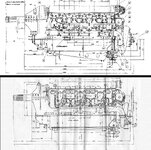
This is absolutely false.

The VK-105 is 2,027 mm long, the VK-107 2,166 mm (+139 mm or 5 3/8").

The weight is 580 kg compared to 769 kg for the VK-107.

See the manuals for these two engines:


Below is a scale drawing of both.
 

Attachments

  • Compa VK-105 107 1.jpg
    Compa VK-105 107 1.jpg
    563.2 KB · Views: 30

Users who are viewing this thread

Back