
A7M2 Reppu & Engine Performance - Grok Edition

Laurelix

Senior Airman
370
266
Joined
Jun 13, 2016
1788536207046.png

A7M2 Reppu:
Empty Weight: 3267kg
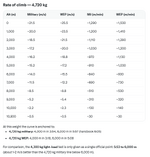
Loaded Weight: 4720kg
Wing Area: 30.86m2
Engine: Ha-43-11 [MK9A]
1788535619212.png

Note: WEP is 5 min regime, Military Power is 30 min regime.

1788535641561.png

1788536379081.png

-
Estimated Sustained Turn Time by Grok at SL-1000m, no flaps (4720kg loaded weight):
1788535953680.png

-
Armament:
4x 20mm Type 99 Model 2 Mark 5
(200 Rounds per gun, 800 rounds total)
-
Maximum Safe Dive Limit:
780km/h IAS

—————————

Saburo Sakai was actually chosen to test fly the new fighter. This is what he had to say:

"Both fighters were very good, but the A7M Reppu was better than the N1K Shiden. On top of that, the Reppu's design was started before the Shiden's, and if Mitsubishi had not been forced to distract themselves with other projects, the A7M would have been deployed as early as mid-1944. But back then, towards the end of 1942, the question of adopting new types of airplanes into the forces was almost entirely managed by Genda or people who trusted his authority without question. They overloaded Mitsubishi with generally senseless work to modernize the Zero, which significantly slowed down the development of the A7M. And this was an armored airplane with four cannons, an even higher speed than the Mustang, and the same familiar maneuverability as on the Zero! Even the Americans, having captured one of these fighters after the war, were amazed by it. The N1K1-J Shiden was not as good. But Minoru Genda preferred the Shiden. Kawanishi did not have the same fighter building experience as Mitsubishi, and so it became clear immediately after the first test flights that the Shiden required much additional development. Initially, the Shiden was a mid-wing aircraft. It had to be redesigned into a monoplane because its landing gear was too long and weak – an entirely obvious mistake that Mitsubishi's experts would never have missed. In addition, Kawanishi was simply technically incapable of producing these planes in a sufficient quantity. We also found numerous manufacturing defects in the Shidens that were delivered to the forces and had to repair them in situ. But this did not make the navy command falter in its intention to receive precisely the Shiden, which did go on to participate in battles. Although they were not outwardly disdainful of the Reppu, it was clear they didn't like it. I still don't fully understand why the navy command so insistently demanded that the A7M be equipped with an 18-cylinder Nakajima engine (specifically the Nakajima Homare) when Mitsubishi's own engine was superior. When they were finally allowed to equip the Reppu with a Mitsubishi engine and test-fly its prototypes, it was too late. American aircraft were already bombing Japanese factories in full force, and the Reppu never reached frontline pilots. I won't claim that Minoru Genda was the sole reason that we never got the Reppu, but the fact that he was somehow connected to the Kawanishi leadership is indisputable."

References:
• Reppu & Reppu-kai(烈風と烈風改),Gakushu Kenkyusha(学習研究社)Tokyo,2003

• A7M Manual, 1945

• X-Planes of Imperial Japanese Army & Navy 1924-1945

• Samurai! - By Saburo Sakai
 

Attachments
  • 1788535678114.png
    1788535678114.png
    46.3 KB · Views: 23
Last edited:
My conclusion is...
The A7M could match the top speeds of a clean loaded F6F-5 Hellcat whilst also being able to retain the turn rate of late A6M series.
However at the same time the fighter no longer suffered with vulnerability to damage like the zeros or the rather lack luster maximum dive speed. A6M2/M3 respectively had 630-670km/h IAS limit. Furthermore the A7M would of outclimbed any fighter the US could field in the Pacific until arrival of F8F Bearcat. It's 2200hp engine would also allow it to engage US bombers at 10,000m with better efficiency than N1K2-J or Ki-84.
It's 4x 20mm cannons are newer model 2 marks 5's which have 50% greater rate of fire than the mark 4's on late A6M5's, N1K2-J, J2M's.
Also, no Saburo the A7M wasn't faster than a P-51D mustang. It definitely would out accelerate and reach speeds faster than a P-51D, however the maximum speed is still definitely heavily on the side of the P-51D.

What the A7M also demonstrates is how awful the Hellcat airframe is. Both the A7M2 and F6F-5 have similar engine power, and both planes reach roughly same top speed. However in every single category the Reppu stomps on the hellcat without sacrificing its survivability, dive speed or range. Both are carrier based fighters.
 
Last edited:
The Hellcat airframe is so "awful" it shot down more Japanese aircraft than any other fighter. The Hellcat design made tradeoffs that sacrificed top speed for other attributes, but it remained fast enough to do the job it had to do. That's what mattered. If the Japanese introduced substantially faster aircraft in significant numbers, the US Navy had the option of trading some F6F for F4U. The F4U-1D made some tradeoffs to be optimized as a fighter-bomber, but it could be cleaned up to be potentially a 431mph fighter. The F4U-4 was a 440-450MPH fighter. A cleaned up F6F-5 with water injection had the potential to do about 410 at best altitude. The Navy declined to buy the F6F-6, which would have been the corollary to the F4U-4, maybe 20 MPH slower, because the F6F-5 was good enough, and not changing the lines made more available.
 
My conclusion is...
The A7M could match the top speeds of a clean loaded F6F-5 Hellcat whilst also being able to retain the turn rate of late A6M series.
However at the same time the fighter no longer suffered with vulnerability to damage like the zeros or the rather lack luster maximum dive speed. A6M2/M3 respectively had 630-670km/h IAS limit. Furthermore the A7M would of outclimbed any fighter the US could field in the Pacific until arrival of F8F Bearcat. It's 2200hp engine would also allow it to engage US bombers at 10,000m with better efficiency than N1K2-J or Ki-84.
It's 4x 20mm cannons are newer model 2 marks 5's which have 50% greater rate of fire than the mark 4's on late A6M5's, N1K2-J, J2M's.
Also, no Saburo the A7M wasn't faster than a P-51D mustang. It definitely would out accelerate and reach speeds faster than a P-51D, however the maximum speed is still definitely heavily on the side of the P-51D.

What the A7M also demonstrates is how awful the Hellcat airframe is. Both the A7M2 and F6F-5 have similar engine power, and both planes reach roughly same top speed. However in every single category the Reppu stomps on the hellcat without sacrificing its survivability, dive speed or range. Both are carrier based fighters.

Why is Hellcat airframe awful, while that of the similarly slow Reppu it is not? What was taken out from the Reppu so it can be under 5 tons, all while featuring a big 18-cly engine, armor protection, a 4 cannon battery, sizable fuel tank to feed a 2200 HP engine, big prop and oil system, a 330 sq ft wing, undercarriage strong enough for rough landings, all while being fully carrier capable? Is there an actual weight breakdown sheet available?
Let's not turn the Reppu into a wunderwaffe.
BTW - the XF6F-6, a contemporary of the Reppu, was making 425 mph.
 
My conclusion is...
The A7M could match the top speeds of a clean loaded F6F-5 Hellcat whilst also being able to retain the turn rate of late A6M series.
However at the same time the fighter no longer suffered with vulnerability to damage like the zeros or the rather lack luster maximum dive speed. A6M2/M3 respectively had 630-670km/h IAS limit. Furthermore the A7M would of outclimbed any fighter the US could field in the Pacific until arrival of F8F Bearcat. It's 2200hp engine would also allow it to engage US bombers at 10,000m with better efficiency than N1K2-J or Ki-84.
It's 4x 20mm cannons are newer model 2 marks 5's which have 50% greater rate of fire than the mark 4's on late A6M5's, N1K2-J, J2M's.
Also, no Saburo the A7M wasn't faster than a P-51D mustang. It definitely would out accelerate and reach speeds faster than a P-51D, however the maximum speed is still definitely heavily on the side of the P-51D.

What the A7M also demonstrates is how awful the Hellcat airframe is. Both the A7M2 and F6F-5 have similar engine power, and both planes reach roughly same top speed. However in every single category the Reppu stomps on the hellcat without sacrificing its survivability, dive speed or range. Both are carrier based fighters.
Hmm, I was wondering since you seem to know more about the Reppu more than me, why do you really think it was not produced and the Shiden / Shiden Kai were? I know Sakai said Genda and others didn't like it and I'm sure that was part of it. I personally feel that it may have been due to logistics. While the Reppu had better guns and engine, I think another reason why the Japanese chose not to produce it was for logistical reasons such as the Homare either being easier to make or quicker to put into production as well as cost efficiency on the earlier cannons. Thanks for the thread by the way, I really want to learn more about this pane but sadly there is nothing really out there for it in English :(
 
Some insight on how close the A7M came to being more than a paper airplane would come from what resources Japan had committed for the mass production of the aircraft. Was there a factory that was built and ready to immediately start production as soon as the final design was signed off on, or was/were the factory or factories earmarked for production still producing other types and without the tooling for the new type? If someone has information on where the A7M was to be produced and the status of the plants in July or August of 45, please share. My hunch is that General Motors was closer to producing thousands of Bearcats than Mitsubishi or Nakajima was to producing the A7M.
 
There were two posts by Jim Lansdale at J-Aircraft back in 2007, which gave some details about Reppu production. The posts contain information that he had received from Jiro Horikoshi via Martin Caidin. As the J-Aircraft site seems to be down this morning, I cannot find the link so I hope that Jim's ghost will forgive me for simply quoting part of his post:

However, time had run out. We had hardly completed flight tests and taken the initial steps preparatory to commencing mass production of the Reppu fighter when on 7th December the Nagoya city district was shattered by a tremendous earthquake. The Superfortresses were bad enough, but this blow of nature following closely upon several particularly damaging bombings wrecked the Nagoya factories beyond any hope of repair. Salvageable machine tools and equipment were pulled from the wreckage and dispersed to factories still operating. Even this emergency step was fruitless; our production lines were in a state of chaos.

On 6th and 15th December we assembled in Yokosuka for an engineering-study meeting of the A7M2 and A7M3-J Reppu fighters. Nature joined in another devastating alliance with the rampaging B-29s and the Tokai district reeled from the shock of a severe earthquake; the greater part of the Oe Airframe Works of the Mitsubishi Combine in Nagoya temporarily suspended all production activities.

Six days later, B-29s made their first attack against the Daiko Engine Works of Mitsubishi in Nagoya and, on 18th December, returned to batter the Oe Airframe Works. The air raids smashed machines and production lines, killed hundreds of workers, and threw the great factories into a wild state of confusion. The New Year brought even worse air attacks; the Daiko Engine Works received the heaviest blows. It was unfortunate that this tremendous engine plant was so badly hit, for it was responsible for the production of the Mitsubishi MK9A engine.

With production of the engines reduced to an insignificant trickle, the anticipated date of the Reppu's entry into combat was indefinitely postponed.

Our entire problem revolved about the production of the MK9A engine; so long as power plants were available, we could solve the assembly operation without too much difficulty. On the assumption that the engine works would soon be functioning again, the Navy ordered full-scale production at the Oe Airframe Works in Nagoya and at the Mitsubishi Nankai Factory in the southern district of Osaka. Every effort was made to resume engine production at Daiko in Nagoya.

Of the several Reppu fighters already completed, the Navy accepted one A7M2 'plane for extensive flight-testing. On 4th February 1945, Lieutenant-Commander Kofukuda flew the No.2 A7M2 to Yokusuka and, by driving himself continually; he completed the official flight-testing program in the exceptionally short period of two months.

Despite the stimulus which the Reppu's outstanding performance imparted to our civilian and military personnel, our best efforts were fruitless. By the time the flight-testing program was complete, the intensity of air raids by the American heavy bomber and carrier 'planes had become unbelievable. Wave after wave of enemy bombers smashed at our factories almost every day and every night. Production in many major plants suffered and in some factories halted altogether.

Our basic trouble was that despite all our heart-breaking efforts the engines simply were not available. The Daiko Engine Works was repeatedly hammered and literally reduced to a graveyard of twisted steel girders and smashed machinery. Engine deliveries for the A7M2 No.3 fighter and subsequent models were reduced to a few assembled units. The assembly factories ground to a standstill and the entire Reppu production program foundered. And still the enemy bombers came.

Added as edit: J-aircraft is now up and the above comes from The Design and Development of Carrier Fighter Reppu by Jiro HORIKOSHI! Part I~II
 
Last edited:
There were two posts by Jim Lansdale at J-Aircraft back in 2007, which gave some details about Reppu production. The posts contain information that he had received from Jiro Horikoshi via Martin Caidin. As the J-Aircraft site seems to be down this morning, I cannot find the link so I hope that Jim's ghost will forgive me for simply quoting part of his post:

However, time had run out. We had hardly completed flight tests and taken the initial steps preparatory to commencing mass production of the Reppu fighter when on 7th December the Nagoya city district was shattered by a tremendous earthquake. The Superfortresses were bad enough, but this blow of nature following closely upon several particularly damaging bombings wrecked the Nagoya factories beyond any hope of repair. Salvageable machine tools and equipment were pulled from the wreckage and dispersed to factories still operating. Even this emergency step was fruitless; our production lines were in a state of chaos.

On 6th and 15th December we assembled in Yokosuka for an engineering-study meeting of the A7M2 and A7M3-J Reppu fighters. Nature joined in another devastating alliance with the rampaging B-29s and the Tokai district reeled from the shock of a severe earthquake; the greater part of the Oe Airframe Works of the Mitsubishi Combine in Nagoya temporarily suspended all production activities.

Six days later, B-29s made their first attack against the Daiko Engine Works of Mitsubishi in Nagoya and, on 18th December, returned to batter the Oe Airframe Works. The air raids smashed machines and production lines, killed hundreds of workers, and threw the great factories into a wild state of confusion. The New Year brought even worse air attacks; the Daiko Engine Works received the heaviest blows. It was unfortunate that this tremendous engine plant was so badly hit, for it was responsible for the production of the Mitsubishi MK9A engine.

With production of the engines reduced to an insignificant trickle, the anticipated date of the Reppu's entry into combat was indefinitely postponed.

Our entire problem revolved about the production of the MK9A engine; so long as power plants were available, we could solve the assembly operation without too much difficulty. On the assumption that the engine works would soon be functioning again, the Navy ordered full-scale production at the Oe Airframe Works in Nagoya and at the Mitsubishi Nankai Factory in the southern district of Osaka. Every effort was made to resume engine production at Daiko in Nagoya.

Of the several Reppu fighters already completed, the Navy accepted one A7M2 'plane for extensive flight-testing. On 4th February 1945, Lieutenant-Commander Kofukuda flew the No.2 A7M2 to Yokusuka and, by driving himself continually; he completed the official flight-testing program in the exceptionally short period of two months.

Despite the stimulus which the Reppu's outstanding performance imparted to our civilian and military personnel, our best efforts were fruitless. By the time the flight-testing program was complete, the intensity of air raids by the American heavy bomber and carrier 'planes had become unbelievable. Wave after wave of enemy bombers smashed at our factories almost every day and every night. Production in many major plants suffered and in some factories halted altogether.

Our basic trouble was that despite all our heart-breaking efforts the engines simply were not available. The Daiko Engine Works was repeatedly hammered and literally reduced to a graveyard of twisted steel girders and smashed machinery. Engine deliveries for the A7M2 No.3 fighter and subsequent models were reduced to a few assembled units. The assembly factories ground to a standstill and the entire Reppu production program foundered. And still the enemy bombers came.

Added as edit: J-aircraft is now up and the above comes from The Design and Development of Carrier Fighter Reppu by Jiro HORIKOSHI! Part I~II
Thank you for sharing :) I have been waiting for months for the admins to approve my application there :(
 
What the A7M also demonstrates is how awful the Hellcat airframe is.

Pilots who flew the F6F commented on how easy it was to fly and operate from a carrier. It's also universally considered to have been one of the most robust fighters of the war, known to be very maneuverable, and was an excellent gun platform - all of these attributes making it highly capable in a dogfight. Overall performance was "good enough to get the job done" as no Japanese fighter ever seriously challenged it. None of these facts would be true if the Hellcat had an "awful" airframe.

The Reppu only made it into the pre-production phase with a mere ten prototype aircraft being completed, making the comparison between the two a 'what-if' scenario at best. The A7M never proved it's superiority over any allied aircraft, and this includes the Hellcat. And while it was initially designed for carrier use, by the late stages of the war it became nearly impossible for the small number of Japanese carriers left in service to operate effectively at sea, and thus Mitsubishi was forced to continue its development as a land-based fighter design.

It must also be noted that Saburo Sakai had a long history of being exceedingly skeptical of Kawanishi, calling it a "third rate" aircraft firm, so his opinion that the N1K2 was an inferior design should be taken in that context.
 
Last edited:
What the A7M also demonstrates is how awful the Hellcat airframe is. Both the A7M2 and F6F-5 have similar engine power, and both planes reach roughly same top speed. However in every single category the Reppu stomps on the hellcat without sacrificing its survivability, dive speed or range. Both are carrier based fighters.
Should make the concept clear as I used to hold the same thought, but found that to be wrong.

The A7M was designed to have a wing folding only 1.7m to its wing tip, and the folding mechanism got cancelled on the third A7M2 prototype, in comparison, F6F and F4U had wing folding right at its root-joint kink, which saved much more space for carrier ops. This folding mechanism costs around 700 pounds, or around 300kg average for both F6F and F4U, in comparison to 50kg on the A7M, and the folding line increased the drag.

The A7M2 was recorded to have 4720kg gross weight fully loaded for combat, which was around the similar weight as the XF6F-1, the latter weights around 10.558 lbs or 4780kg when fully loaded, which was also in prototyping stage.
1793953089399.png

The A7M2 carried no armor plating nor self-sealing fuel tank for its wing, as the tank to be too heavy and couldn't fit into the wing profile, per Kofukuda said. If the A7M was designed according to the U.S. standard carrier based fighter, it would need to add that 300kg wing-folding mechanism, at least 150kg for armor plating and self-sealing tanks, and remember the A7M was still prototyping, the weight was expected to increase to improve structure and accompany more devices as soon as the plane put in actual service, as we've seen the general trend for most service airplanes.

The final weight for the A7M2 as a service airplane can be expected to be 4900kg for Japanese standard and 5200-5300kg for the U.S. standard, which makes its weight advantage diminished when compared with the 5600kg U.S F6F and 5400kg F4U.

Furthermore, as the A7M mainly used low-drag airfoil, its lift coefficient got sacrificed somewhat, comparing its U.S. counterpart which utilizes the NACA 230 series. The A7M1 1/7 scale wing tunnel test demonstrated a CLmax of 1.17 clean, 1.58 with 25deg flaps and 1.65 full flaps. Considering the stall aoa was recorded around 14-16 deg to the thrust line, the result is very similar to the full-scale tunnel testing held at low airspeed with no propeller (<70mph), considering Renolds effect and adding idling propeller effect.
1793953963564.png

The A7M2 thus expected to have CLmax 1.3-1.35 for idling clean condition, CLmax 1.85 for full flaps. Comparing the figure CLmax 1.4/2.0 for the F4U and 1.5/2.1 for the F6F under similar condition, even the manueverability advantage for the serviceable A7M would expected to be marginal. Both F4U and F6F have their automatic combat flap system developed, which is of the blow-up type, and with a larger span percentage, provides more lift coefficient boost compare to the A7M's flap.

With the above mentioned parameters, a 4900kg Japanese serviceable A7M2 would have the equal stall speed and turn radius as a 5600kg F6F-5, with and without flaps. A 5300kg USN serviceable A7M would have equal the turn with the F4U.
 
Last edited:

Users who are viewing this thread

Back