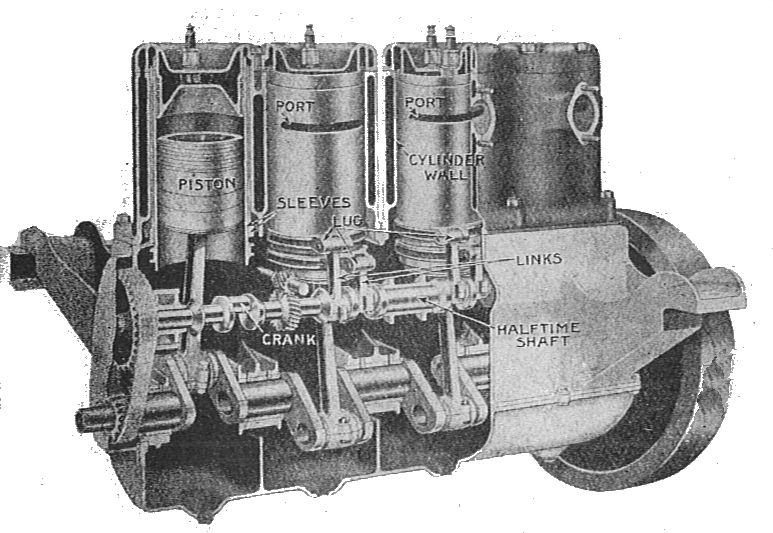
Where to begin . . . where to begin

Unfortunately there are just too many variables involved in the sleeve vs poppet argument to give a compact coherent comprehensive statement/answer. Just for the power curves alone we would need everyone to post whatever they have - in order to compare them. Then we would have to sort out the ones using 130 vs 150 grade fuel, ADI or no ADI, type/efficiency of supercharger, whether they should be considered similarly mature/developed or not, along with what other factors (ie other than sleeve vs poppet) contributed to the engines performance.
The following items are not necessarily meant to counter what others have said above. But they are details that I believe need to be taken into account as they contribute significantly to the pros and cons of the sleeve vs poppet argument.
1. re Using maximum boost as a measure of efficiency. What was the cylinder CR (Compression Ratio)?
This is important because, if everything else is equal, the maximum usable boost will be:
CR1 x "Hg1 /CR2 (approximately)
An example would be if we compare the Merlin 25 to the Sabre. Both engines were liquid-cooled with 1-stage/2-speed superchargers. The Merlin 25 had a CR of 6 and a maximum boost using 130 grade of +18 lbs/66.5"Hg. The Sabre had a CR of 7. This means the best we should expect in terms of boost from the Sabre, everything else being equal, would be:
6 x 66.5 / 7 = 57"Hg or +13.3 lbs when using 130 grade fuel
What was the highest realistic boost used by the Sabre in service - when using 130 grade fuel? IIRC the boosts were:
Sabre IIB_____2400 BHP at 3700 rpm at +11 lbs (1944)
Sabre VA_____2600 BHP at 3850 rpm at +15 lbs (1946)
What if everything else is not equal?
Again, using the Merlin 25 as the engine baseline for comparison.
2. Is the supercharger more or less efficient (in terms of heat added to the charge)? As far as I know the Merlin 25 supercharger was considered more efficient than the Sabre supercharger. Greater heat rise due to the supercharger would result in a lower altitude rating and/or a lower boost rating and/or lower BHP.
The Griffon engines in my lists are the 65 and 85, both well developed and using the 'Hookerized' supercharger and inter-/after-cooler. As far as I know none of the Sabre series used an inter-/after-cooler. Yet the Sabre still had the advantage in output. If the Sabre had a supercharger and inter-/after-cooler similar to the Griffons we can assume significantly improved performance from the Sabre.
3. Is the engine air-cooled or liquid-cooled?
As shown by my lists upthread, in terms of comparable displacement and type of cylinder cooling, none of the poppet-valve engines matched the BHP/in3 of the sleeve-valve engines. This is (I think) unarguable?
In my list I have only the Griffon to use in comparison to the Sabre for liquid-cooling, and the Sabre clearly comes out ahead in BHP/in3. Possibly there are other developed engines that could be compared (maybe German or Soviet?) that might provide a significantly difference aspect to things.
In the air-cooled sleeve vs air-cooled poppet category, it seems to me that the difference is less, but still noticeable. As my lists show, the Hercules 100 had 240 in3 less displacement, but still matched/exceeded the R-2600-20 engine output (both engine models being best of their war-time series?). As Shortround6 pointed out, the Hercules 100 was a slightly later development than the R-2600-20. If the R-2600-20 had the same supercharger design as the Hercules 100 how much difference would it have made?
4. Scale effects, ie how much would the difference in engine size make?
There are no (I think) reasonably developed sleeve-valve liquid-cooled engines in the 1650-1710 in3 range. This makes (I think) any direct comparison to the Merlin or V-1710 impractical.
Unfortunately, there are (I think) also no reasonably developed poppet-valve liquid-cooled engines in the size of the Eagle 22 sleeve-valve engine. So again, there is (I think) no way to make conclusive comparisons. Possibly someone would like to try comparing the less well developed US large hyper engines? Unfortunately, as far as I know there is not a lot of confirmable data on most of the engines. The Allison V-3420 is the only large displacement poppet-valve engine comparable in size to the Eagle 22. But it is an earlier design, with significantly less efficient supercharger(s), and it was not really fully developed (I think) even though it was operated in various platforms over a significant period of time. What data I have shows it at very great disadvantage to the Eagle 22.
The only other well developed air-cooled poppet-valve engine of note was the Dagger VIII. It was an air-cooled H24-cylinder design with a displacement of 1037 in3 - very significantly smaller than the Merlin & V-1710 - with a CR of 7.5 and max boost of +5 lbs on 87 grade fuel. Its output was 1000 BHP at 4200 rpm at +5 lbs. In terms of output this is more in the range of the Peregrin V12 poppet-valve engine. The 1296 in3 Peregrin had a CR of 6 and put out about the same 1000 BHP when running at 3000 rpm and +9 lbs boost on 130 grade fuel. Even though the Dagger was air-cooled, on 87 octane it ~matched the 30% greater displacement liquid-cooled Peregrine engine at +9 lbs. When the Dagger VIII was rated on 130 grade it reached 1115 BHP at 4400 rpm at +7 lbs, which ~matched the Peregrin's 1100 BHP at 3000 rpm at +12 lbs.
4. Combinations of the above differences
In practice, it took the R-4360 to match the Eagle 22 in output, but it used 4360 in3 of air-cooled poppet-valve vs 2817 in3 of liquid-cooled sleeve-valve - or 55% more displacement for the same output. The R-4360 variant I used in my lists is the one used in the B-50, so it had turbosuperchargers with inter-/after-coolers. The Eagle 22 is the mark used in some of the post-war prototype aircraft, and it had an improved 'Hookerized' 2-stage/2-speed supercharger with inter-/after-cooler.
NOTE According to RR/Fedden the Eagle was 'overbuilt' partly in order to accommodate the stresses of the large contra-rotating props, and partly to accommodate future growth in output. It was thought that 4000 BHP was not unrealistic with further development using higher grade fuels and ADI.
5. In addition to the above, I think we need to add reliability in the actual applications.
How much of the difference in performance between the V12/R-xx poppet-valve engines and the H24/R-xx sleeve-valve engines was due to inherent issues with the concepts, and how much was due to more or less success in practice (inherent manufacturing problems vs quality control for example) and/or timing (ie X years earlier/later design, put on the back burner due to priorities, knowledge/technology not available at the time of comparison, etc).
In conclusion, I suspect that this argument is similar to the one of whether 2-, 3-, or 4-blade propellers are more efficient. In theory and reality, a well designed 2-blade propeller will be more efficient than a 3-blade prop,
if the 2-blade prop can absorb the BHP (This is basic physics and hydrodynamics). If the 2-blade prop is already at maximum allowable diameter, and you want to increase the usable BHP, then when using similar blade design you will have to go to a 3 (or more) blade prop. While each individual blade of the 3-blade prop will be acting less efficiently than the individual blades of the 2-blade prop, when combined the blades or the 3-blade prop will be able to absorb more BHP than the 2-blade prop.
Bleh
need more coffee.