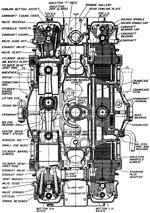
There are certainly many metal alloys with very good heat conductivity. I suspect we shouldn't discount the effect of the oil film, particularly if there are voids (bubbles) in the film, that could cause the heat conductivity to drop dramatically. If the interface between the cylinder wall and the sleeve insulate the sleeve, it doesn't help that much if the sleeve itself has good heat conductivity.
The enginehistory.org site has a paper about sleeve valves referring to two articles by Fedden [1] and Hives [2] claiming a measured 50C difference in piston temps vs a comparable poppet valve engine. If this is representative of sleeve valve engines in general, that's quite a huge difference.
[1] Fedden, A.H.R., "Aircraft Power Plants – Past and Future," Journal of the Royal Aeronautic Society, Vol. 48, pp. 397-459, October 1944.
[2] Hives, E.W. and Smith, F.L., "High Output Aircraft Engines," SAE Journal, Vol. 46, No. 3, pp. 106-117, March 1940.
The sleeve material has to meet many criteria, however the essential requirement was identical thermal expansion at the sleeve OD and barrel ID interface. To make it more complicated the later Hercules and Centaurus had tapered bores. I understand that the clearance had to be 0.8 thou around the entire bore. In the paper I attached earlier, Mr Evans from Bristol stated " I would say that sleeve and barrel clearances are almost negligible. The sleeve is almost a push-fit in the barrel, but there is no difficulty in producing sleeves and barrels to the tolerances we require." p657. He earlier stated "With the sleeve valve the difficulty has always been to prevent over-lubrication, but we have been able to cope with the problem. As an instance, I would mention the sleeve valve or sleeve ball rig which we use on a mechanical breakdown test. Mr. Mansell had a great deal of trouble with overflow from the sleeve of this rig, and we had to fit a cover. The single sleeve acts as a good oil pump, unless the oil flow is controlled at the bottom end." p655. Thus a lack of oil is not an issue and there is likely not enough space for a void bubble to form.
The KE965 is a cast austentic stainless steel, and thus has a relatively poor thermal conductivity. Many years ago I worked on a DN600 stainless pipe that had to span 22 metres between supports. From 11 AM until around 3 PM during construction (i.e. empty) it would lift off one of the supports, due to the sunlight on top causing far more thermal expansion than the underside. More recently I had a cat dump line from an FCCU that would snake a large distance (~2" for an 8" pipe) in a different direction every time it dumped the 1300°F catalyst. The only saving grace for the sleeve is that it is rather thin - a poor conductor across a short distance does not result in a significant temperature delta.
In the Fedden paper you mentioned, the quote is: "The heat differential between the piston and cylinder, via the sleeve, is of the order of 40-50°C, clearly bringing out the limitations of this material from a conductivity point of view, although it is good from expansion, hardness and wear aspects. "
In my calc, the heat differential between the combustion gases and the sleeve wall (assuming piston has passed) was around 50°C due to the convection losses.
Understanding the heat conduction between the ring land area of the piston, through the ring and sleeve and into the barrel is way out of my league.
The Hercules (possibly only the later ones) and the Centaurus had oil cooling jets directed at the pistons. I understand in Lycoming GSO-480 engines, this dropped the piston temperature by around 200°F. The jets appear to shoot towards the centre of the piston, so I don't know whether this was able to lower the temperature in the ring land region where the problem is. (I am currently looking at why the Sea Fury engines keep failing, and ring deposits & incorrect dispersants is one rabbit hole that is taking a long time to investigate.)
Ricardo in both the 4th and 5th edition of his work (i.e. post war) states:
"Again, later tests, when the technique of measuring piston temperatures by means of fusible plugs had been developed, confirmed that the piston temperature in a liquid cooled single sleeve-valve engine was actually a little lower than in a poppet-valve engine of the same dimensions and output."
I do note that he deliberately nominated liquid cooled. Whether that was due to the test only being done on liquid cooled engines or it did not apply to air cooled engines is not clear.
TLDR: I don't think bubbles in the oil film are likely.