Hi Davparlr,
>>>3) Production line incorporated the 50 cal, implementing the 20 mm would interrupt the line.
>>That is not a strength of the 12.7 mm Browning, but another failure in US procurement planning. The British with their much narrower industrial base seem to have had few problems to supply enough cannon for the RAF ...
>This has nothing to do with the 50 cal or US procurement planning; it is just a reality when an established production line is interrupted with any type of modification.
It is a question of procurement planning because if the planners had made a timely decision, the production change-over could have taken place early enough to put the 20 mm cannon in production in 1941. That's what the British accomplished.
Of course the US had a technical problem as well as a procurement problem, but both of these problems were home-made as on the other side of the pond, the Hispano was mass-produced and successfully made in combat.
>By mid 1942, a useable US 20mm was not assured.
Due to mistakes made earlier ... and the same applies to possible installation problems in F4F, F6F and F4U. Supermarine came up with a "universal wing" Spitfire that would accept 12.7 mm Browning and Hispano cannon within the same structure - I'm sure the Grumman and Vought could have come up with something similar.
>To deem this a failure sixty years later is not reasonable, especially considering the performance historically shown.
If you're lucky, you can get away with a failure, and Admiral King obviously thought that was what had happened at Midway. However, this doesn't make it any less a failure.
>I am sorry if I came across condescending, although I see how you could take it that way, it was only a pathetic attempt at humor.
Ah, no offense taken then. Irony somehow does not work as well on the web as it works in personal conversation - I have had irony back-fire on me like that too, and more than once :-/
>However, the arguments I made about 1944 were just as valid for 1942, probably even more so, since the US 20mm was very problematic at time.
I can see your point regarding lead times. However, it still comes down to a failure to have a 20 mm cannon ready for (say) Midway, where a cannon-armed F4F would have enjoyed undeniable and important advantages over a machine-gun armed F4F. Even if we consider it impossible to the Hispano cannon to be made ready in time, US procurement also failed to have an indigeneous US cannon developed, or simply a foreign cannon built under license. Small countries like Denmark and Switzerland were producing their own aircraft cannon, and even a country with such a narrow industrial base as Japan had an operational cannon fighter ready for the Battle of Midway ... obviously, the Imperial Navy's procurement was doing a better job than the US Navy's.
>The decision by the US military not to change from a proven weapons system to another without accurate information on kill effectiveness (which was unavailable in 1942, as it apparently is still)
As the British switched to 20 mm cannon after careful consideration of all the options available to them, skipping the 12.7 mm machine gun rather quickly, and had already collected quite a bit of combat experience with them, the US military could simply have learned from the British example. There certainly was a lack of appreciation of the strengths of cannon in the US military, and not because these strengths were not evident at the time - all other major combattants employed cannon armament as a matter of fact.
>Another interesting point was that the British could not clear stoppages in the 20 mm guns.
Do you mean "clear stoppages in flight"?
>The 50 cal on the other hand, has thousands of down enemy aircraft to testify that the decision to keep the 50 cals was valid.
Nonsense - the RAF shot down hundreds of aircraft with 7.7 mm machine guns during the Battle of Britain, and yet there's no denying that they would have been better off with more powerful weaponry. It's the same with the 12.7 mm machine gun.
>Again, unless you can show something like kills per sortie, and it would have to be significant, your comments are only supposition, not warranting the comment of "failure".
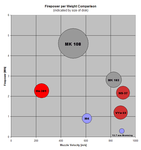
Don't fool yourself - the firepower and the weight of the guns in question can be calculated rather easily, and there is no way around energy as key parameter for destructiveness. The superiority of cannon is so great that any approach based on the physical parameters of the guns will show it, and in fact Tony's "traditional" approach shows it as well. Tony' approach underestimates mine shells, but German war experience has shown that mine shells are considerably more effective against fighters than standard high-explosive (or armour-piercing) shells.
The Bad Eilsen comparison shows that the Germans considered the 20 mm shells 3.75 times as effective as the 15 mm projectiles against bombers, and in direct comparison to the 12.7 mm gun, the 15 mm weapon fired a projectile of 150 - 160 g at 850 - 960 m/s, compared to the 12.7 mm's 112 g at 890 m/s. Accordingly, the 20 mm Mauser was vastly superior to the 15 mm Mauser which was markedly superior to the 12.7 mm Browning (so much that the US copied it with the intention of replacing the 12.7 mm Browning).
In terms of total muzzle energy, the 20 mm mine shell (found to be highly effective against fighters by the Germans) has about 6.0 - 6.5 times the value of the 12.7 mm Browning API projectile, which means that the energy comparison matches the German Bad Eilsen documents well. The belting instructions from the Schießfibel, showing that the best belting against fighters includes a higher proporition of mine shells than the best belting against bombers (putting to rest the myth of mine shells being dedicated anti-bomber armement), validates the assumption that against fighters, high explosive projectiles are (particularly) effective.
(In my calculations, I'm using the 1

3 Sprgr.L.

zgr.:M-Gesch. mix recommended by the Schießfibel, so the total energy factor over a pure 12.7 mm API belting is only 4.4 on the average.)
I don't see any way someone could come up with a different method of comparing firepower based on the physical realities that would yield a radically different picture from the results Tony and I have determined.
Regards,
Henning (HoHun)