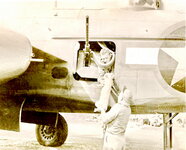
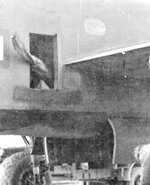
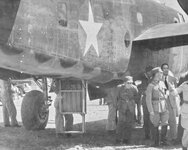
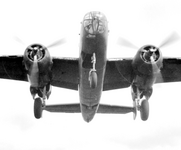
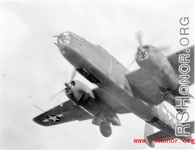
Hello, I recently discovered this forum and this thread while working on some research for a model project involving B-25 41-13088 Chatter Box. All of you are a wealth of information, I thank you for what you have accumulated here. Keeping in mind earlier comments that each B-25's situation was often unique, is there any knowledge on at what point the ventral turrets were removed on these early strafer conversions, on Chatter Box in particular but info on any of them would be helpful if I end up having to make an informed guess.
Additionally, when the ventral turrets were removed, is there any knowledge on how the resulting hole was treated? Were they skinned over to smooth the surface or simply left open? I would think that leaving them open would cause increased drag and reduced performance, but I did not want to entirely dismiss the possibility.
I remember reading that an additional fuel tank was often put in when the ventral turret was removed, so this may or may not also be part of the answer.
Thank you all in advance for any help you may be able to offer.
Doug
Hi Doug!
These are some questions that deserve detailed answers. I'll try to formulate very short notes and you can work your way up.
1. When modifications started in different war theaters the ventral turrets were almost always deleted. Such mods were the famous Pappy Gunn's strafers from Townsville (4-th Air Depot,
Chatterbox is one of them), all HAD mods (Hawaiian Air Depot), the Air Depot in Tontouta, New Caledonia (13th ADG). In North Africa the modified bombers (those were not strafers) came from Warner Robins Air Logistics Center in Georgia and their local copies were modified in Sidi Ahmed Air Base in Bizerte. In CBI the local depots in India were doing the same job but on a smaller scale. Marine PBJs lost their ventral turrets either in the NAA-modification centres, straight out of the factory or in the Navy modification centres in the States.
All mods (of the ventral turret area) were basically similar but never exactly the same.
1A. North American Aviation in Inglewood and Kansas City stopped installing the lower turret as follows:
-B-25D-25, -30 and -35 (Kansas City)
-starting with B-25G-10 (Inglewood)
2. When the turrets were removed the openings were skinned over (exterior) with sheets metal. The type of cover differs: square sheet over the round opening and guns' cut outs, round sheet over the opening only, square sheet over the round opening only etc.
Check
here a PBJ modified in the Fairfax Mod centre (this is the NAA factory in Kansas City) with a round cover over the opening only. It is possible that a radar would be installed later in a Navy mod centre.
On the inside there was a plywood cover over the opening as well - if you check interior photos with the turret you'll see that the floor is higher in this area and creates kind of a "well" - see
here.
I read some memoirs of a former B-25-pilot, telling a story when on an
AT-24 (the training variant of the B-25 - see posts below) without belly turret, a student went through both covers, plywood and metal and just "disappeared" . Only the courage of the second student who instantly caught him and could pull him slowly back, saved his life.
3. The additional tank in the turret area was used for transition flights (e.g. from the States to Egypt) or for long missions, mostly in the Pacific theaters. Often the additional tanks were deleted after the specific mission(s) or the long distance flight.
I remember posting photos of "Mitchells" without ventral turrets on many occasions and sometimes writing about the different types of covers, depending on the modification. You might find them in this thread or in the other, more general B-25 thread.
Cheers!



 .
.