B-26 Engineering Data/Technical Information (From Martin's Own Blueprints) (1 Viewer)

Ad: This forum contains affiliate links to products on Amazon and eBay. More information in Terms and rules

Here are a couple rather useful dimensional drawings. I have a lot more technical drawings on the B-26, way more than is reasonable to post here in a single thread.

- Ivan.
Thank you for the sending Mendenhall's drawing, Ivan. It's a good drawing though has some mistakes. I will make a post after the end of the semester addressing those, some of which are mistakes Mendenhall made and others actual draughting "errors" in the Martin drawings themselves. Mendenhall's drawing is equivalent to drawings 344000 and 360000, the 3-views for the B-26B1 and B-26C, which themselves were rather crudely adapted from the original B-26 and B-26A drawings since their main purpose was to show general dimensions and list subassemblies. I have been planning for some time to use my model to make 3-view drawings but that requires completing the model first.

On O2 tanks....Found a reference that 41-31973 thru 41-30272 carried (3) F-1 tanks, and each had it's own permanently mounted filling system. I also found references that showed permanently mounted O2 regulators in various C models. Filling ports were located in the bomb bay for all 3 systems.
I am not too sure how filling works on the portable system. I think the E&M manual explains it but I haven't had the time to go back and look and plan on doing so before making the larger oxygen system post. If you can send the reference my way I'd appreciate that greatly as more sources are always good and my sources are not always correct.

A-9 or A-9A regulators are mentioned in many of the B-26B1/C manuals, usually with a note saying late models don't have them. This is because the B-26B-10 and early B-26Cs had the older style permanent oxygen system fitted (which is a combination of interconnected F-1 and G-1 bottles which is filled through the bomb bay). I do not know when this change happened on the B-26C. Because I prioritized the short-wing models when I bought my original 8 rolls of microfilm and the way drawing numbers were allocated I have far more info on the early B-26B1 (-10 & -15) than on the C currently. I hope to start remedying this soon.
 
I had never heard of a retractable navs turret. Did it enter service?
It's just odd Martin-specific terminology. That's the astrodome, which goes in the same "hole" as the navigator's roof hatch. I'd imagine the name comes from the fact that it rotates (one side has different curvature so that it can properly retract into the fuselage). The astrodome's hinge is mounted to the left of the "hole" while the hatch's hinge mounts to the right, both swing inwards.

Edit for clarification: The plexiglas dome itself is on rollers that rotate around the hinged mounting ring, so it can face any direction once fully "extended". The side with the different curvature has a flat sheet of plexiglas inside it as well. My best guess would be that this is the side the navigator points their sextant towards, and rotates the whole dome so that it faces the star being observed.
 
A few photos of the navigator's compartment from manuals, showing the hatch in place and the astrodome stowed:

Radio-Nav Station B-26B 1-2 Astrodome Retracted.png
Radio-Nav Station B-26B 1-3 Astrodome Retracted.png
 
Even though these drawings were in Charles Mendenhall's book, I was not entirely convinced that he was the actual artist. I found a couple places where there were identical drawings but with a different more credible credit. They seemed to be pretty good for basic dimensions though.
The actual reference drawings I used were from one of the Polish books. I scaled them up to 1 pixel = 0.01 foot which was the resolution of my design program. At that point, once I picked an appropriate CoG (by eyeball), everything could easily be measured as an offset from that point.

Attached is a photograph of something that isn't often seen.
AftBombDoors.jpg

- Ivan.
 
Even though these drawings were in Charles Mendenhall's book, I was not entirely convinced that he was the actual artist. I found a couple places where there were identical drawings but with a different more credible credit. They seemed to be pretty good for basic dimensions though.
The actual reference drawings I used were from one of the Polish books. I scaled them up to 1 pixel = 0.01 foot which was the resolution of my design program. At that point, once I picked an appropriate CoG (by eyeball), everything could easily be measured as an offset from that point.

Attached is a photograph of something that isn't often seen.
View attachment 835267
- Ivan.
That's a great photo! I do not know for sure who drew the drawing in Mendenhall's book, I assumed it was him because his signature is just behind the tailskid on the side view.
 
That's a great photo! I do not know for sure who drew the drawing in Mendenhall's book, I assumed it was him because his signature is just behind the tailskid on the side view.
I believe that the only part of the drawing that was actually Mendenhall's was the signature you just mentioned. He had access to pretty good information, but I believe he was a lousy writer. As for the drawings, if you look at them in detail, the shapes are really reflective of NO MODEL of the Marauder. As mentioned before, the Marauder in any version was a combination of complex curves. The basic fuselage was a round cigar shape, but there was a bulged section for the cockpit area which faired smoothly into the rest of the fuselage and the tail had a serious change in cross section as well. If you look at the Front view, all you see is a bunch of circles for the fuselage and cowlings and neither should be that way. Where are the carb intakes and other intakes under the cowl which were present on all Marauders? Nevertheless, the dimensions seem to be accurate which is why I posted the drawings, but you are telling us there are errors.

I found Mendenhall's book at a local public library and took it to work where we had a really good scanner. This particular library has a couple rather famous authors living in close proximity and I believe they occasionally donate some of their work there though I am not certain. I just know they had a very good collection pre-COVID.

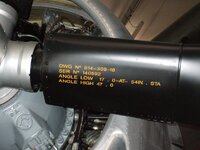
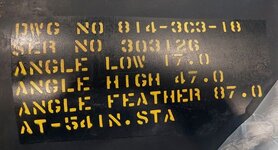
Attached is a photograph which shows the propeller pitch range which is sometimes difficult to find.

- Ivan.

helice_2.jpg
 
I believe that the only part of the drawing that was actually Mendenhall's was the signature you just mentioned. He had access to pretty good information, but I believe he was a lousy writer. As for the drawings, if you look at them in detail, the shapes are really reflective of NO MODEL of the Marauder. As mentioned before, the Marauder in any version was a combination of complex curves. The basic fuselage was a round cigar shape, but there was a bulged section for the cockpit area which faired smoothly into the rest of the fuselage and the tail had a serious change in cross section as well. If you look at the Front view, all you see is a bunch of circles for the fuselage and cowlings and neither should be that way. Where are the carb intakes and other intakes under the cowl which were present on all Marauders? Nevertheless, the dimensions seem to be accurate which is why I posted the drawings, but you are telling us there are errors.

I found Mendenhall's book at a local public library and took it to work where we had a really good scanner. This particular library has a couple rather famous authors living in close proximity and I believe they occasionally donate some of their work there though I am not certain. I just know they had a very good collection pre-COVID.

Attached is a photograph which shows the propeller pitch range which is sometimes difficult to find.

- Ivan.
Thanks again for the photo. It has been a long time since I've read Mendenhall's book, so I have no comment on his writing. Indeed, the drawings in his book do not match any specific model. This is because I believe they are copied from Martin drawing 344000 or 360000 with only some small changes. These issues were present in the original drawings and are there because Martin simply traced their original B-26-MA 3-view and made a few changes to give the general idea of the later models. This is why the spinners, small air intakes, waist windows and early camera hatch are still in the side view and part of why the stabilizers are not quite right. During this process the only actual part of the drawing Martin drew instead of tracing were the wings.

The original 3-view/general arrangement drawings were never intended as a source for modelers, they are engineering drawings and simply give the aircraft's general dimensions and outlines as well a list for mechanics and engineers of which drawings are relevant to each model and production block (which was erased in the Mendenhall drawing), so Martin took the simpler route and sometimes even copied over some dimensions incorrectly. Not great for us, but it succeeds in its actual task. I do not know if this trend continued with the B-26F and G as I don't have their 3-view drawings yet. The front view is actually even older than the B-26-MA, dating back to one of the early design iteractions with large ducted spinners that were flush with the cowling, with the intakes faired into the spinner at the front. The outermost circle is the largest external diameter of the nacelle, the middle one is the line between the spinner and the cowling, and the inner circle is actually the diameter of the duct. There were originally propeller blades shown going into the spinner and two bumps outside the outermost circle for the air intakes which I assume the artist mistook for wing fairings. Both are missing in the Mendehall drawing. The cockpit was also very off in both the top and front view of the original B-26 drawings, drawn taking up the whole width of the fuselage on the top view and similarly to the Mendenhall drawing in the front view. Again, fine for demonstrating the general shape of the aircraft, but inconvenient for modelers.

I have now lined up some of the 3-views in blender and none of Martin's originals really match up with the dimensions they themselves provide, not even the original B-26-MA ones. It seems Mendenhall (or whoever drew it) did notice that the empennage was for the wrong model and scaled it up to roughly correct size, though his shapes are not quite right, and many of the details he added are for the wrong models. Some of the dimensions listed agree with the Martin drawings while others disagree heavily. I was going to list all the differences but given that I haven't started work on the long wing models I'm not sure how right the Martin ones are either. As established on a previous post, none of the short-wing models have the correct wing dimensions in their 3-view drawings, so I don't know yet if the dimensions provided for the long-wing models are correct in the Martin drawings. When I do know I'll definitely explain it here. One thing I can say for sure is that the top turret should be at station 460.25, not 495.375, and that the fuselage length should be 698". 698.375 is a misreading of 698.395, which is the length of the B-26-MA & B-26A fuselage projected onto the thrust line (698.5 x cos 1°) and was mistakenly copied by Martin onto early copies of the drawing (I have a version with this mistake and another where it has been fixed).
 
Hi all,

I have been neglecting this thread too long as I was traveling and it will sadly stay on the back burner as classes start back up again. I will be attempting to resume work on the 3D model as well, which will also be taking priority over this thread. I have made a few more rib outlines but there is not much to show and the model has its own thread iirc.

I am posting here as I have finally caught up on some recent Kermit Weeks videos, and he has recently shown that his B-25B still has the original AFCE autopilot system installed, and has shown some footage of it on the video attached below around 24:10 and 31:28.

View: https://www.youtube.com/watch?v=0bzqvW_DwAA&t=1440s

The heart of the system are four large motors and one large gyroscope, all visible on Kermit's video mounted on the pilot's floor forward of the rudder pedals, just behind the bombardier's rear bulkhead. The motors are connected to the control surfaces via dedicated cables and pulleys. They are mounted on a similar location on the B-26, but arranged differently and hidden by metal covers. I briefly mentioned AFCE earlier in this thread and will cover it in more depth at a later date. If anyone knows how to contact Kermit, Carl or Steven Whitby do let me know as I have not been able to find any more information about this (at the time) confidential system.

I have theories as to how the individual components and the system as a whole work, but will save those until I can confirm or debunk them. As for the big picture, the AFCE system is mostly there for accuracy in bombing, the fact that it eases the pilots' workload during long flights seemingly merely a bonus. The only controls the pilot has are the on/off toggle switches for three of the four motors and the master switch, along with a pitch control wheel. The bombardier has the toggle switch for the last motor and a bank/level toggle switch, which selects whether the system will keep the wings level or follow the directional inputs placed into the Norden bombsight by the bombardier. Thus the bombardier has limited directional control while the pilot can only control pitch. There are no altitude hold or heading hold modes. The system was used in early B-17s, B-25s, B-26s and likely other aircraft I don't know about yet. One memo I was able to find from either General Royce to General Harmon or the other way around states the following on AFCE (page 331):
24 June 1942: "Incidentally, I think the A.F.C.E. is of practically no use. it must be altered so that all controls can be adjusted from the pilot's cockpit or replaced by the standard automatic pilot."
To which the reply states:
27 June 1942: Present production planes (B-17s) are now coming out with C-1 type automatic pilots, controllable from the pilot's cockpit. -Air Force Materiel Command
On the B-26 the installation was also replaced by a C-1 autopilot, though some drawings seem to imply an A-5 (Sperry) was used instead. I have seen drawings for a C-1 control box and its mount, as well as a turn control knob for the bombardier, and the operation and appearance of the autopilot as described on the B-26B manual match the C-1, though it only ever calls it the "Minneapolis-Honeywell A.F.C.E.S.", which it differentiates from "Norden A.F.C.E."

That is all for now, I hope to get back to you with more information on AFCE at some point.
-Maty

Edit: Had wrong timestamps, 24:10 and 31:28 are correct.
 
Last edited:

Users who are viewing this thread

Back