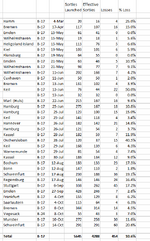
I went through the missions from January to October when the 8th AF was flying unescorted missions into Germany and found that the B-24 didn't actually fly on most of them and certainly didn't fly on the deep penetration ones
Interesting, where does the B-17/24 split data come from? The Richard Davis spreadsheets only have bomb tonnages.
Pre Torch there were 7 B-17 and 2 B-24 groups in England, that dropped to 5 B-17 (1 non operational) and 1 B-24 in the first week of December 1942. The 93rd group returned and resumed flying missions on 25 February 1943. By the time of the June detachment to the Mediterranean it was 15 B-17 (13 operational) to 3 B-24 (2 operational). The 8th flew no B-24 combat sorties 27 June to 7 September. 16 B-17 to 4 B24 groups on 9 September but down to 1 B-24 group for the second half of September due to the second Mediterranean deployment. The next B-24 groups arrived in early November, which started the B-24 build to end up at 21 B-17 to 19 B-24 on D-Day. Conversions made that 26 to 13 in late August, finally 26 to 12 on 10 November. At the other end of the war all the B-24 groups were gone by end July 1945, leaving 19 B-17 groups. It means in 1943 the 8th reports 107 B-24 MIA, 20 Category E and 23 non operational salvage while operating out of England, versus 863 MIA, 136 Category E and 68 non operational salvage B-17.
Officially the Mediterranean deployments were 93rd group 13 December 1942 to 20 February 1943, 44th, 93rd, 389th groups 2 July to 21 August 1943, and the same groups 21 September to 1 October 1943. 47 strike days, 1,453 sorties, 1,288 effective, 3,365 tons of bombs on targets, 69 aircraft MIA. The 8th flew 28,115 heavy bomber sorties from England in 1943.
8th Air Force Heavy Bomber losses on operations for 1944, percentage of effective sorties
| A/c | MIA | Cat E | credit sorties | effective sorties | MIA % | MIA+CAT E % | Cat E/MIA |
| B-17 | 1957 | 502 | 121882 | 109736 | 1.78 | 2.24 | 0.26 |
| B-24 | 858 | 346 | 66154 | 56300 | 1.52 | 2.14 | 0.40 |
| Total | 2815 | 848 | 188036 | 166036 | 1.70 | 2.21 | 0.30 |
The bomber efficiency report in message 151 has the B-17 taking off at 65,000 pounds, the B-24 at 61,500 pounds, yet both types were cleared to 65,000 pounds by 1945, another 1,000 pounds of bombs on the B-24 would still leave 3,500 pounds for fuel, at 5.84 pounds per gallon that is around 600 gallons. (100 Octane Fuel density is just under 5.8 pounds per US gallon at 30 degrees C, to just over 6.2 pounds per gallon at -30 degrees C).
Roger Freeman quotes the B-17G at 65,500 pounds, 6,000 pounds of bombs, 2,810 gallons of fuel range 2,000 miles at 182 mph at 10,000 feet, with no bombs and 3,630 gallons of fuel range 3,400 miles at 180 mph at 10,000 feet. For the B-17E at 51,000 pounds, 4,000 pounds of bombs, 1,730 gallons of fuel, range 2,000 miles at 224 mph at 15,000 feet, with no bombs at 53,000 pounds, 2,520 gallons of fuel, range 3,200 miles at 180 mph at 10,000 feet.
Extra wing fuel tanks. B-17F-80-BO production starting with 42-29932 began in mid March 1943, B-17F-30-VE starting with 42-5855 began in late March 1943, B-17F-25-DL starting with 42-3074 began in mid January 1943, first reports 8th AF losses for all three versions is May 1943. The first Douglas Tokyo tank versions began emerging from the modification centres in mid/late February 1943. Boeing 2,300 B-17F (1,200 in blocks 1 to 75), Douglas 605 (110 in blocks 1 to 20), Lockheed/Vega 500 (150 in blocks 1 to 25)
USN PB4Y-1 as of 1 November 1944
| Gross Weight Pounds | 62,900 | 63,000 | 63,000 | 63,000 | 62,000 |
| Fuel Gallons | 3,214 | 3,063 | 2,019 | 1,272 | 3,614 |
| Bomb load No. x Pounds | 0 | 2x500 | 8x1,000 | 8x1,600 | |
| Bomb Bay Tanks Droppable No. x Gallons | 1x400 | 1x400 | 0 | 0 | 2x400 |
| Max Range Statute Miles | 3,440 | 3,260 | 2,065 | 1,255 | 4,190 |
| Max Range Average Speed MPH | 151 | 148 | 154 | 155 | 153 |
| Max Endure./Range Altitude Feet | 1,500 | 1,500 | 1,500 | 1,500 | 1,500 |
USN PB4Y fleet from new production, built at San Diego unless noted, was 233 B-24D (4 from Fort Worth), 1 G (North American), 367 J, 186 L and 145 M, with the M versions accepted October 1944 to January 1945.
RAF pilots notes have B-24 fuel as 2,354 US gallons (1,960 imperial gallons) normal internal fuel, plus 450/374 wing cells plus 800/670 bomb bay. It indicates non bomb bay tankage was about the same for the B-17 and B-24. The B-24 tended to cruise faster than the B-17, the question being how much of that was due to the Davis wing living up to its promise of being lower drag.
The B-24D range and endurance chart, which has all fuel available for cruise (The notes say deduct 75 gallons for warm up plus the fuel used in the climb and also allocate reserves), take off at 65,000 pounds, cruise at 1,000 feet range is between 2,125 miles at 231 to 241 mph to 6,100 miles at 165 mph, at 5,000 feet between 2,200 miles at 239 to 251 mph, to 6,250 miles at 171 mph, at 10,000 feet between 2,300 miles at 248 to 253 mph to 6,250 miles at 159 mph, at 15,000 feet between 2,355 miles at 258 to 276 mph to 6,300 miles at 193 mph, at 20,000 feet between 2,475 miles at 269 to 292 mph to 5,750 miles at 220 mph, at 25,000 feet between 2,600 miles at 280 to 311 mph to 5,300 miles at 240 mph, at 30,000 feet between 3,650 miles at 280 mph to 5,100 miles at 260 mph. The 20,000 feet and higher charts have a longer range curve but the speed is not specified.
Service ceilings at gross weight, 23,000 feet at 65,000 pounds, 26,900 feet at 60,000 pounds, 29,400 feet at 55,000 pounds, 31,900 feet at 50,000 pounds, 34,100 feet at 45,000 pounds, 36,300 feet at 40,000 pounds, 38,900 feet at 35,000 pounds.
Fuel consumption 4 engines running, military power 2,700 RPM, 630 gallons per hour at sea level 670 gallons per hour at 26,500 feet when the turbo limit of 23,400 RPM is reached, 100% power 2,550 RPM, 575 gallons per hour at sea level, 595 gallons per hour at 27,000 feet when the turbo limit is reached (21,300 RPM?), 90% power 2,490 RPM 505 gallons per hour at sea level, 530 gallons per hour at 29,500 feet when the turbo limit of 21,300 RPM is reached, 80% power 2,400 RPM 425 gallons at sea level, 445 gallons per hour at 30,000 feet, 75% power 2,325 RPM 385 gallons per hour at sea level, 405 gallons per hour at 30,000 feet, 70% power 2,400 RPM 345 gallons per hour at sea level, 360 gallons per hour at 30,000 feet, 65% power 2,200 RPM 305 per hour gallons at sea level, 320 gallons per hour at 30,000 feet. Above is "Power-AR" setting, remainder are "Power-AL" setting, 65% power 2,200 RPM 250 gallons oer hour at sea level, 265 gallons per hour at 30,000 feet, 60% power 2,050 RPM 205 gallons at sea level, 215 gallons per hour at 30,000 feet, 55% power 1,900 RPM to 25,000 feet then 2,000 RPM, 175 gallons per hour at sea level, 190 gallons per hour at 30,000 feet, 50% power 1,750 RPM to 15,000 feet, 1,850 RPM to 25,000 feet then 2,000 RPM, 175 gallons per hour at sea level, 190 gallons per hour at 30,000 feet. At 35% power the maximum height is 24,000 feet, at 30% power 12,000 feet.
RAAF aircraft performance summaries,
Appendix 1 – British, American, German, Italian and French Service Aircraft, 1939–45
RAF Fortress I/B-17C, 7,400 pounds of bombs, 1x0.30 inch, 6x0.50 inch, 1,415 gallons of fuel, 1,900 miles range at 240 mph at 30,000 feet. No bombs, 2,075 gallons of fuel, 3,000 miles at 240 mph at 30,000 feet. The ranges deduct a 150 gallon allowance for warm up, take off, climb, time over target, navigational errors and other emergencies.