Best Pacific Fighter?

Best Pacific Fighter?


  • Total voters
    146

Ad: This forum contains affiliate links to products on Amazon and eBay. More information in Terms and rules

Status
Not open for further replies.
MP-Willow said:
The pol was created with some thought, the ki-100 and ki-61, two of the Jaonese designs I like are late commers and were not to have a great impact. But if the war were to have gone on and assuming Japan could find production space the N1J2 would have given the B-29s ad even the P-51H problums. ;)

What? With a top speed of 363 mph, mediorcre climb performance, and serious power loss at altitude, the Kawanishi N1K2 "George" was no match for a competently piloted P-51D (437+ mph) or an F4U-1d (425+ mph), let alone a P-51H (480 mph) or F4U-4 (463 mph - 448 with capped pylons as on all service units). The George was however a fairly good matach against an F6F-5 Hellcat (380 mph).

It could not fly high enough to successfully intercept the B-29, and it was totally outclassed by the P-51H in virtually every catagory.

=S=

Lunatic
 
ok mybe I was reading somwthing elts. Or that information as wrong. but I do remember reading that thy were developing and had produce I small nubers planes that could deal with the new USAAC and USN fighters. But thanks for corecting me on my wayward thoughts ;)
 
Trying to develop is more accurate, all that is based upon the engines performing to design specs, but repeatedly Japanese engines failed to do so. They even had jets in the works, though none were deployed anywhere with working engines.
 
RG, that is true, they did have engine problums in almost all of the aircraft types.

I have a question for you we have all said what we liked but maybe weshould have stated this topic at just Pacific Fighters. What do you think? ;)
 
So CC, nice Sig picture! I would ask then your thoughts and those of thee others here of the P-47 in the Pacific ;)
 
evangilder said:
WIth drop tanks, the P-47N had a range of 2350 miles. Joe Baugher has a good write-up on the P-47N at:
http://home.att.net/~jbaugher1/p47_13.html

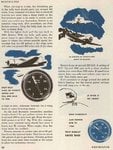
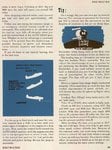
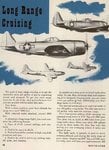
According to the P-47N manual a plane fitted with two 165 gallon wing drop tanks and one 110 belly drop tank had a range of 2920 miles. Accounting 90 gallons for combat, this would reduce this range figure to about 2750 miles. Because only 1120 miles of the range figure is from external tanks, and 1800 (or 1630 accounting for combat usage) is from internal fuel, the combat radius is half the range figure.

It was also possible to carry two 300 gallon wing drop tanks (it is unclear if a 110 belly tank could also be carried), which would have extended range to about 3400 miles.

The P-47N was the longest range fighter of WWII.

=S=

Lunatic

Source:
PILOT TRAINING MANUAL FOR THE THUNDERBOLT P-47N
Hq. Army Air Forces, Washinting 25, D. C., 1 Sep 45
 

Attachments

  • p47n_manual_longrangecruising_pg30_845.jpg
    p47n_manual_longrangecruising_pg30_845.jpg
    139.2 KB · Views: 718
  • p47n_manual_longrangecruising_pg29_492.jpg
    p47n_manual_longrangecruising_pg29_492.jpg
    145.1 KB · Views: 710
  • p47n_manual_longrangecruising_pg28_635.jpg
    p47n_manual_longrangecruising_pg28_635.jpg
    136.5 KB · Views: 704
wow them's good pics, although in the combat shot it does look like a P-47 shooting annother P-47..........
 
Since the P-38 shot down more Japanese aircraft than any other plane, and was a land-based figher to boot (meaning it did not have a floating airfield to deliver it to enemy territory) I have to go with proven performance vs speculation. Also, the P-38 was continually upgraded, and the P-38L-1-LO was the longest ranged American fighter of the war, with a combat radius of 1500 miles (this I discovered on a site about the P-47N!)
 
I wouldn't call the P-47N a speculation. Testing had shown it quite capable, and it was beginning to see action when the war ended. The 1,500 mile radius number on the P-38 is under ideal conditions. Yes, the P-38 shot down more Japanese planes, but it was also in the war longer. The P-38 had a lot of bugs that had to be worked out before it was really a viable fighter. Don't get me wrong, I like the P-38. But after studying it, the Hellcat and the Corsair, I would have to say the Corsair was the best Pacific fighter.

Editted to correctly state the P-47N, not the P-38N...
 
acesman said:
Since the P-38 shot down more Japanese aircraft than any other plane, and was a land-based figher to boot (meaning it did not have a floating airfield to deliver it to enemy territory) I have to go with proven performance vs speculation. Also, the P-38 was continually upgraded, and the P-38L-1-LO was the longest ranged American fighter of the war, with a combat radius of 1500 miles (this I discovered on a site about the P-47N!)

Range was up to 3000 miles, using 330 gallon. That is far from combat radius, which appears to have been more in the area of 900-1000 miles.

The P-47N was a late entry to the war, so it didn't rack up the kills of the P-38. That does not make the P-38 a better plane.

=S=

Lunatic
 
Lets see, the P-38 was designed in 1937, and the combat version entered active service in May 1941. The P-47N was developed in 1944 and entered service in 1945. Considerable strides were made between first generation WWII aircraft (1939-1941) and last generation WWII aircraft (1943-45). And yet the P-38 flew air superiority missions till the last day of the war, and the P-47 flew in the Pacific theater after Japanese air power had been broken. The P-47N was a fine aircraft that had no chance to prove it's mettle in the Pacific. The P-38 compiled a fine record in the Pacific, even with early bugs and being improperly used (trying to get in a turning match with a Zero). And given its longevity, I believe that it was the best Pacific Theater fighter, and probably one of the most significant planes in the theater.
 
It all depends on which era of the pacific war- early or late because there's an awful lot of difference between a Brewster Buffalo and a Corsair in production techniques. Just look at the RAF, they were using biplanes as fighters in 1940 and in 1945 we were using jets
 
Status
Not open for further replies.

Users who are viewing this thread

Back