wrbrd - hope I can help you. It's 4am and I can't sleep!
The basic operating principle behind the constant speed prop, in the aircraft I have flown, is as flyboy said. The max efficiency prop RPM will be determined by specific powerplant considerations. However, tension of the speeder spring can be adjusted w/ a prop rpm lever, or also a combined prop RPM/condition lever as I've seen in some A/C, which will adjust the operating RPM that the governor will maintain prop speed at, below max. The propeller governors will act to monitor and adjust propeller blade angle to maintain this prescribed max prop efficiency.
If you are running your prop at maximum RPM, let's say 2200, and you increase engine power, at the same given prop blade angle, you would create an overspeed condition. The governor's function is to be able to sense this overspeed condition, and correct by adjusting prop blade angle to bring prop RPM back to it's maximum efficiency.
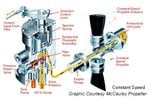
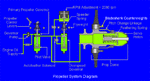
The prop governor acheives this monitoring and adjusting of prop blade angle through the basic components that were shown in flyboy's above post. So, we'll continue w/ our example: you increase power, creating an overspeed condition. The flyweights serve to sense this momentary overspeed condition, as centrifugal force will force them outward in their rotation. This will open the pilot valve, which will drain pressurized oil from the dome assembly. The high pressure oil acts to exert force upon a servo-piston(the force in this case is decreasing), which resists a feathering spring and bladeshank counterweights to increase blade angle (since the piston's counterforce is decreased because we drained the high pressure oil) and maintain the desired prop RPM.
The opposite is true if you decrease your power setting. The flyweights will move inward in their rotation, increasing flow of high pressure oil through the pilot valve, increasing force exerted on the servo piston and overcoming the bladeshank counterweights and feathering spring and decreasing the prop blade angle.
Hope this quick rundown of how a constant speed prop works helps. They also include a feathering provision, and can employ a backup or overspeed governor in case the primary governor fails. If you would like to know how anything else functions - just ask!
Matt