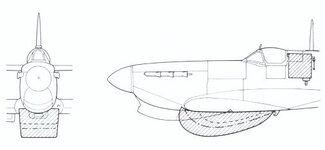
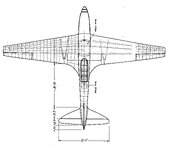
IMO, a good case study could've been the DH Comet racer. Even though it was twin engine, it had several things that should've been studied or observed, such as a high cruse speed, relatively small for the fuel it carried, etc. Granted, using a Merlin would eat into that, as well as cannon armament, armor and self sealing tanks,
- Empty weight: 2,930 lb (1,329 kg)
- Max takeoff weight: 5,550 lb
The Comet was designed to be a long range "racer" it was not designed to perform combat maneuvers. Please add hundreds of pounds (or over 1,000) of structural weight for combat. (
It does help illustrated some of the problems. If you want a lot of fuel in a small airplane it either needs to go close to the center of gravity or you need a lot of tanks stuck in out of the way places and careful fuel management (don't have tank in use go dry at an embarrassing moment).
Spitfire I with wooden prop
Structure 1890lbs
Power plant 2,035lbs
Load (pilot, fuel (84 Inp Gal) , guns, etc) 1585lbs
"Sundries" 365lbs
Total,,,,,,,,,,,,,,,,,5875lbs
Thus, either someone outside of the established system would have to design it, or an established maker could design it, but someone else would have to make it.
Trouble was there was nobody to make it, established or otherwise. There was no spare capacity in Great Britain and not much in Canada (or anywhere else). There were no empty factories (with or without machinery) and no labor force sitting around have tea waiting for something to do. Canada (not slight the rest of the Commonwealth) did great things,
but, they often had to wait for the US to supply the machine tools/equipment. British Machine tools were being absorbed by existing industries as fast as they could be produced.
. England and France were thinking of adopting the 13.2mm FN machine guns (basically an AN-M2 Browning re-barrelled to fire the 13.2x99mm Hotchkiss HMG round instead of .50 BMG), but Belgium was overrun before that happened. Germany realized during the Battle of Britain that the low velocity 20mm MG FF cannons were obsolescent and the 13mm MG131 was the better bet, or for sure the 20mm MG151 (which was being designed at the time).
Both German guns had been in design/development for several years in 1940.
The FN guns are rather phantom like. They existed in small quantities, and that means we are back to the production problem. FN never made very many. The actual performance is subject to question. It took the US four years with 3 different companies working on projects (none of the them Colt) to get to the rate of fire that FN claimed. Of course FN never listed the jam/malfunction rate either.
Now who was supposed to make them for the British?
At one point in WW II the Americans had 9 companies making the M2 Browning. Some were established gun companies, others were places like A C Spark Plug, Saginaw Division of GM, Kelsey-Hayes Wheels.