Could the Bf 109 E really out-turn the Spitfire Mk I? (2 Viewers)

Ad: This forum contains affiliate links to products on Amazon and eBay. More information in Terms and rules

Yes, and this was the point I wanted to make before S Squish made any tests: For example, while the K-4 has a DB 605 D with a FTH of 6.8 km at 2600 rpm and no RAM, one G-14 version has a DB 605 AM with FTH of 5.6 km at 2600 rpm, another a DB 605 ASM again with a FTH of 7.8 km at 2600 rpm. But at least one G-10 has the same DB 605 D as in the K-4 I think, so this could serve as a substitute for the B4 powered 1.8 ata DB 605 D powered K-4. In addition, there was also a 1.98 ata version of the K-4 that ran on C3 fuel, and IIRC then these were designated DB 605DB and DB 605 DC respectively to distinguish them. And to complicate things even further, some of these engines could be operated at 2800 rpm as well for short periods of time.
The unrestricted DB 605 versions after Autumn 1943 were all back to the original 2800 U/min rating. The 2600 was the Climb and Combat rating, but of course, the 2800 was most likely to be used in a turning fight. I think you might be thinking that some of the genuine data for speeds and climbs was at the 2600 U/min power, which of course was all at the much lower 1.45ata MAP and not in the range for MW50 operation, even if so equipped.
The actual Manifold pressure limits are quite complicated, through all the different late versions, what I was trying to point out was that a very late 1.98 ata rated engine held back to 1.80 ata by not using full throttle travel will only reach about 2700U/min at that 1.80 ata point and would not perform as well as a 1.80 rated engine at 1.80 because the automatik control was set differently and the 1.98 engine will not reach 2800, it will only reach about 2700 at 1.80ata below the 1.98 ata FTH (4.9km). However, they would be the same at 6.0km, the FTH for 1.80ata ! This is because the supercharger was the same and even with full throttle travel the ata was reduced to 1.80 by the reduction of ambient air pressure, not limited to 1.80ata by the manifold pressure controller as a 1.80 set-up engine is.
This is all quite complicated in detail.
You are generally correct about the DB/DC versions, and the ASB/ASC.

Eng
 
There will be discrepancies regardless but just doing some looking at starshark figures for minimum radius it looks like around 415m for the G-14/G-10 and 440m for K-4. Those figures don't appear to be radically different than the Messerschmitt chart if we are just looking at radius at the end of the turn as being close to min radius.

The sustained turn rate at this altitude for this configuration is around 12.5 degrees per second for all 3 aircraft with smallest fractional advantage in favor of G-10. The peak initial turn is around 19 degrees per second at around 570kph TAS.

In order to meet chart performance the averaged turn rate would have to be 15 degrees per second and I think that we will probably end up pretty close to that +/- 0.75 second depending on how AoA limit is treated.

Interesting. I'm assuming that these sustained turn rate and radius numbers are for 6 km altitude and at 1.8 ata?

And can you tell me at what weights for the G-14, G-10 and K-4 respectively are these radiuses and turn rate numbers achived?
 
In summary, it looks like War Thunder has done a remarkably good job here given how close these numbers are. And I think this is within the acceptable margin of error, given that both mine and the German WW2 data are based on calculations, so anything below 5% must be said to be acceptable.

However, this comes with the caveat the same type of deviations (4% optimistic for turn angle, 4% optimistic for turn time, and 4% pessimistic for speed retention) are replicated across the board for other aircraft as well in War thunder. For example, the P-51D. Because then you retain the relative performance relationships between the aircraft, thus making them interesting (and realistic) to fly against each other. And not like you see in the attached figure below, where the deviations are not consistent.

I don't think any of the games will hold up to this standard and especially not WarThunder just due to the sheer number of aircraft that it has modeled. This is partially a game engine limitation, gameplay based decisions, or just due to different sources saying different things.

Ultimately there are some relationships that are accurate and some that are skewed. For instance in the game the Typhoon 1B Late has exceptionally good turning performance compared to Luftwaffe and American fighters. Maybe the math proves that it does and should but I am suspicious of just how well it turned in real life vs the game.


But based on the data we have so far, this again makes me question the low status War Thunder seems to have in the flight sim community. Especially given that flight simulations that are credited as being more realistic, such as Il-2 and DCS, not only have very wobbly and oscillating flight models, but also sometimes produce some strange numbers when you test them. And as an example, here is a compilation of how the sustained turn performance for the Bf 109 F4 and G2 has been modeled in relation to the Yak-1 and LaGG-3 in Il-2 Sturmovik.

The way that most people interact with War Thunder is not through the simulator game mode but rather some form of one of the other modes that feature mouse-aiming / 3rd person view of planes. There are also some decisions that are made to facilitate those game modes.

Another issue is as a gaming community, simulator players are weirdly territorial about whatever game they decide to play and insist that their poison of choice is the most realistic out there.

To put things in perspective, there was a point where Gregs Airplane's was promoting Aces Of Thunder, which is Gaijins VR re-packaging of War Thunder, and was insistent that the game and flight models were only loosely based on War Thunders. They are not loosely based on WarThunder...they are a 1 for 1 copy. The only difference besides the VR interactivity was the fact that Aces Of Thunder has prop torque effects turned off by default; so in practice it's a simplified version of the sim mode in War Thunder.

I just recently posted a clip from Il-2 and the it already turned into a battle between players arguing which game is more realistic. The first thing that my audience noticed about my clip from Il-2 is how differently the game handles stalls.

1000011935.png


But now, given we got such a good result from this instantaneous turn trial in War Thunder, would it be possible to also test (or are the StatShark numbers reliable enough?) the Bf 109 E-4's and Spitfire Mk I's sustained turn performance without flaps as present in the video in the OP about 30 s into the video?

I can do turn rate test on P-51 later today. The game pretty much has all variations of P-51s with the different manifold pressure settings.

Can you post circle graph for the P-51D and -7 engine running at 75 or 72 inches manifold pressure? That is what I would cross-check against.

What I suspect is that the P-51 at 72 or 75 is going to be very close in turn performance to the K-4. The radius is probably about the same and it's +/- 1 second on the 360 turn time depending on the AoA schedule. The way that things are modeled in the game makes the P-51 more efficient at higher speeds so problem gets around the first half turn faster with more energy but then becomes less efficient as the plane gets slower. Once turn is already established at very low speeds then the K-4 likely wins by small margin due to power to weight ratio. However this is also dependent on power to weight of P-51.
 
S Squish : It's getting late here and won't be able to do any simulations today. So keep things moving, if you could do the P-51 D testing I asked about above and then we can compare later when I've done my simulations?

Just use the same starting conditions as for the Bf 109 K-4 tests and use the 75" boost for the P-51 D and tell me the weight, and I'll replicate that in the C++ simulations sometime tomorrow.

In addition, would be helpful if you could answer the questions connected to the G-14, G-10 and K-4 sustained turn rates and weights I made above.
 
In addition, would be helpful if you could answer the questions connected to the G-14, G-10 and K-4 sustained turn rates and weights I made above.

The planes are modeled with different empty weights and the G-14 and G-10 are modeled slightly differently in terms of their power distribution.

G-10 = 5996lb
G-14 = 6084lb
K-4 = 6216lb


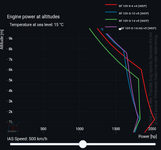
This will be a more intuitive calculator to show the differences in engine performance based on speed and altitude.


Attachments

  • performance_plot.png
    performance_plot.png
    44 KB · Views: 22
I assume that the "Il-2 Sturmovik" mentioned earlier was the so-called "Great Battles" edition, not the older (2001) original.

Just for info, the old game (nowadays called Il-2 Sturmovik 1946) has a cool utility called IL2 Compare. Among other parameters, it contains turn times and speeds with/without flaps. The utility was developed for several game versions, including modded versions such as HSFX, Ultrapack and BAT. There is even an Android app.

Some graphs.
IL2 Compare for 4.13.4 (stock game version).
Bf 109 K-4
109K4_turntime.jpg

109K4_fanplot.jpg


IL2 Compare for Ultrapack 3RC4.
Bf 109 E-4 (blue) vs Spitfire MkI (red)
109E4vsSpitFIb.jpg

Larger curves - no flaps.
I think that fuel is 100% by default. Some variants of IL2 Compare used to include additional sets of data for other fuel conditions.
This pack contains IL2 Compare variants for several stock game versions (4.09, 4.11, 4.10.1, 4.13.4) and for modded versions (HSFX, BAT, UP):
 
S Squish : It's getting late here and won't be able to do any simulations today. So keep things moving, if you could do the P-51 D testing I asked about above and then we can compare later when I've done my simulations?

Just use the same starting conditions as for the Bf 109 K-4 tests and use the 75" boost for the P-51 D and tell me the weight, and I'll replicate that in the C++ simulations sometime tomorrow.

In addition, would be helpful if you could answer the questions connected to the G-14, G-10 and K-4 sustained turn rates and weights I made above.


View: https://youtu.be/fOkMn9v0uis


1783473179019.png


Basically in-game the Bf.109 will complete the turn by about 1/2 to 1 second sooner and will retain a little bit more energy overall. The difference though is quite small though.


This is an acceleration test at 6000m using WEP. The K-4 in this test is at 1.98 ATA; a K-4 at 1.8 ATA will have acceleration similar to the G-14 in this test. The D-30 is 75" manifold pressure and the D-5 is 67" manifold pressure. All are using the -7 engine. The starting speed is 350kph TAS and the intervals are in 10 seconds. Basically we can see that the Bf.109s have good low end acceleration and then there is a point where the low-drag airframe of the P-51 offsets that acceleration difference. Another thing to note is that in-game the P-51s can run full manifold pressure indefinitely while the 109s will have to open their radiators to keep from over-heating and it will reduce their speed.
1783473380301.png
 
There are observations that should be made about the Bf 109 as well.
The statement that "The RAF fighters had changed to 100 octane fuel which improved the power of the engine from around 1,000hp to 1,300hp at their rated heights." is misleadingly phrased. The power of the engines was only improved below their original 6.25lb 87 Octane rated heights. The single stage Merlin at that time could only make the full 100 Octane increased Boost of 12lb at 9,000feet, by the previous rated altitude of 16,250feet they were right back to their 6.25lb boost and the same power as on 87 Octane. In some ways, the Germans did better, with some versions of the Bf 109 DB 601 engines having their rpm ratings raised to 2600rpm and so the rated altitude actually raised and their Manifold pressure limits also raised with their 96 Octane fuel.
The Bf 109 had had a VP propeller that allowed multi pitch settings for several years before the BoB. However, the German equivalent of the automatic Constant speed propeller was introduced during the BoB.

Eng
First I must thank you for this clarification. Fortunately for the RAF a lot of fighting took place below 16,000 ft.

There is one piece which I admit is going from memory. During the BOB the only 100 octane fuel Germany had was captured RAF stocks. Some Me109 units modified their engines to use this but the majority had to do without. The aircraft modified had a visual reminder in the form of a logo by the refuelling cap.

German 96 octane came later.
 
First I must thank you for this clarification. Fortunately for the RAF a lot of fighting took place below 16,000 ft.

There is one piece which I admit is going from memory. During the BOB the only 100 octane fuel Germany had was captured RAF stocks. Some Me109 units modified their engines to use this but the majority had to do without. The aircraft modified had a visual reminder in the form of a logo by the refuelling cap.

German 96 octane came later.

The Germans did use captured British stocks of fuels. However, the 100 Octane fuel was mostly re-blended to suit the German requirements, ie mixed with lower grade stocks to get a larger quantity of medium grade.
There might have been some local misappropriation of the 100 Octane by someone but, it would not improve engine performance unless the engines were modified. If you have proof of this please show. Most likely, some was used without modification of aircraft or re-blending and made no difference, but the tale of using British fuel was started.
The uprated DB 601 N with higher compression, rpm and using C2 or C3 fuel (different original references say both) was coming into Bf 109 E4/N service in July 1940. The 601N engine appears to have had various modifications and standards during tho period 1940/1941and is tricky to tie down details. However, it was more powerful than the DB 601 A and it did use higher specification fuel. It is definitely known that the DB 601 A and N were allowed to use increased 2600 and 2800 U/min respectively in later 1940.
All Luftwaffe aircraft had fuel type triangle logo's by the refueling points.
German fuel blends changed many times during WW2.

Eng
 
The planes are modeled with different empty weights and the G-14 and G-10 are modeled slightly differently in terms of their power distribution.

G-10 = 5996lb
G-14 = 6084lb
K-4 = 6216lb


This will be a more intuitive calculator to show the differences in engine performance based on speed and altitude.


These are "Rüstgewicht" numbers without the weights of ammunition and fuel etc. I need the weight numbers for which the turn data is valid.

So again, I need the weights at which the sustained turn data for the Bf 109 G-10, G-14 and K-4 you posted earlier on is valid for.

In addition, I see you posted turn data for the P-51 D now which is great.

But as I said before: I can't do any C++ simulations until I have the weight at which your turn trials were done.

It would also be helpful if you are clear on how much fuel the aircraft are assumed to be carrying, i.e. for the sustained Bf 109 turn data, and the P-51 D instantaneous, is the fuel percentage, 25, 50, 75% or some other percentage of the max internal?
 
Last edited:
First I must thank you for this clarification. Fortunately for the RAF a lot of fighting took place below 16,000 ft.

There is one piece which I admit is going from memory. During the BOB the only 100 octane fuel Germany had was captured RAF stocks. Some Me109 units modified their engines to use this but the majority had to do without. The aircraft modified had a visual reminder in the form of a logo by the refuelling cap.

German 96 octane came later.

The Germans did use captured British stocks of fuels. However, the 100 Octane fuel was mostly re-blended to suit the German requirements, ie mixed with lower grade stocks to get a larger quantity of medium grade.
There might have been some local misappropriation of the 100 Octane by someone but, it would not improve engine performance unless the engines were modified. If you have proof of this please show. Most likely, some was used without modification of aircraft or re-blending and made no difference, but the tale of using British fuel was started.
The uprated DB 601 N with higher compression, rpm and using C2 or C3 fuel (different original references say both) was coming into Bf 109 E4/N service in July 1940. The 601N engine appears to have had various modifications and standards during tho period 1940/1941and is tricky to tie down details. However, it was more powerful than the DB 601 A and it did use higher specification fuel. It is definitely known that the DB 601 A and N were allowed to use increased 2600 and 2800 U/min respectively in later 1940.
All Luftwaffe aircraft had fuel type triangle logo's by the refueling points.
German fuel blends changed many times during WW2.

Eng

As I understand it, the Germans could make both the lower grade B4 and their higher grade C3 from the same coal based raw material, but that the production of more C3 meant that they would get less total fuel out of a given amount of coal.

So they always had to compromise quality and volume, and as I understand it, this was why they did not produce more C3 than they did. They could do it, but then their stocks of B4 would suffer, and as we know, aviation fuel was always in short supply for the Luftwaffe.

In addition, it was interesting to read in Calum Douglas' book about the problems that plagued the DB 601 N engine since the qualification testing as I understand it had been made with C2 fuel, while in service it was run on C3, which did not boil off sufficiently at the low coolant temperatures the Bf 109 was forced to run at due to the low pressure coolant system, and thus spelling trouble due to oil dilution.

Finally, yes, with 100 octane, the Spitfire Mk I is superior to the Bf 109 E-4 on all accounts at low to medium altitudes: It's faster, climbs better, and of course turns much better.
 
Dimlee Dimlee : Yes, I think I have Il2 Compare on one of my old computers, and it was interesting to see how they modeled back then. However, a lot of water has run under the bridges since then, and I think both the modeling they used back then is a bit dated, and in addition, the Il-2 developers have done lot of updates on the flight models since then, but as a historical document it certainly is interesting.
 
These are "Rüstgewicht" numbers without the weights of ammunition and fuel etc. I need the weight numbers for which the turn data is valid.

So again, I need the weights at which the sustained turn data for the Bf 109 G-10, G-14 and K-4 you posted earlier on is valid for.

In addition, I see you posted turn data for the P-51 D now which is great.

But as I said before: I can't do any C++ simulations until I have the weight at which your turn trials were done.

It would also be helpful if you are clear on how much fuel the aircraft are assumed to be carrying, i.e. for the sustained Bf 109 turn data, and the P-51 D instantaneous, is the fuel percentage, 25, 50, 75% or some other percentage of the max internal?

Weight on Bf.109 K-4 is 3187kg.
Weight on P-51 D-30 is 4130kg.
50% fuel. Full ammo.

I did not do direct comparison of Bf.109 G-14 or G-10 in-game and the figures I quoted for turn performance are just the Statshark values and probably taken at 30% fuel weight.
K-4 3120kg
G-14 3049kg
G-10 3008kg.
 
As I understand it, the Germans could make both the lower grade B4 and their higher grade C3 from the same coal based raw material, but that the production of more C3 meant that they would get less total fuel out of a given amount of coal.

So they always had to compromise quality and volume, and as I understand it, this was why they did not produce more C3 than they did. They could do it, but then their stocks of B4 would suffer, and as we know, aviation fuel was always in short supply for the Luftwaffe.

In addition, it was interesting to read in Calum Douglas' book about the problems that plagued the DB 601 N engine since the qualification testing as I understand it had been made with C2 fuel, while in service it was run on C3, which did not boil off sufficiently at the low coolant temperatures the Bf 109 was forced to run at due to the low pressure coolant system, and thus spelling trouble due to oil dilution.

Finally, yes, with 100 octane, the Spitfire Mk I is superior to the Bf 109 E-4 on all accounts at low to medium altitudes: It's faster, climbs better, and of course turns much better.
Agree. My replies attempt to answer the more generalised comments that are made without writing a dissertation for each. Calum's book covers most of this, if people are bothered to read it, most don't.
The early C3 fuel which did not suit the 601 N was, as you say, a problem with a high distillation component not boiling off. Not a problem as such of the engine, more of a fuel compatibility issue. Mind you, at least the DB coolant was not flammable, unlike the pure Glycol in early Merlins.
I note that your last line is somewhat generalised, did you mean "ALL accounts"?

Eng
 
E Engineman : With "on all accounts" I mean that at lower altitudes, then there is not a single performance metric that the Bf 109 E-4 can compete with if the Spitfire Mk I has access to +12 boost. However, here I will throw in the caveat that this is without flaps, and that at higher altitudes, then the Spitfire can no longer benefit from the added boost 100 octane fuel allows, and that this will be covered in the longer video I mention in the video linked in the OP. ;)
 
Wing loading is absolutely an important factor: But for induced drag (and by extension turn performance), the big determinant is actually the span loading, as in the weight divided by the wing span. This is why for example the Ta 152 H was quite good in turns, even though it had quite a high wing loading.
Notably the Ta 152 had a very high aspect ratio. I have no idea what the Oswald factor was, but the (CL)^2/pi *AR*e sould be dramatically lower than FW 190D.
Then when it comes to drag, the drag of the slats is something that is often quite misunderstood: Sure, it looks horrible with those things sticking out, and many make the mistake that this then must mean that they cause a lot of drag. And sure, on wing profile level they do. But this actually drowns in the massive induced drag the huge vortices shed from the wingtips cause.

And added to that, when the flaps are out, you get another couple of huge vortices at the middle wing stations where the flaps end, thus making the slats drag contribution even smaller. And this (the induced drag) absolutely dominates, so the drag contribution of the slats are just a few percent of the total in a tight turn close to stall. In fact, I write quite a lot about this in my book, and also calculate a percentage range, which the interested reader can find described there in my book in more detail. ;)

And yes, the simulation model I use takes the degrading Oswald factor into account, as this is as you say needed to get reliable results. Since assuming this constant between aircraft (I model this different) and at higher Cl will not yield reliable results. Same goes for propeller efficiency: This has to vary with blade angle, speed and tip Mach number even for a constant speed propeller. And yes, as speed declines angle of attack changes, and Cl and Cd is continuously recalculated in an instantaneous turn. In addition my model separates the thrust vector from the speed vector, so I capture those effects as well.
How have you modeled the different blade data to calculate reduced prop efficiency when airspeed is below CL/CDmax - where efficiency is reduced and THP must be constantly tied to the reduced prop efficency at relative low Mach No. tip speeds? I have various HamStd and Curtiss prop data as a function of airspeed buried somewhere, but that is about all. Where does one get data for Bf 109, etc?
Then about the Spitfire's and Bf 109's ability to maintain altitude while still having the flaps out: During WW2, the famous British aerodynamicist M B Morgan published a report (RM 2349) on the Spitfire's turn capabilities as affected by flaps: And it turns out that even with split flaps dropped in the landing position at 85 deg down, this even so improved the turn performance (even while maintaining altitude) as high as 12,000 ft and above! So the power to overcome the added drag from flaps was there. In addition, in the report Morgan has a theoretical example of the improvement with the Spitfire's flaps set at 30 deg (As we know IRL it could only do 0 or 85 deg flap): And that lowered the turn radius to about 80% of that without flaps, so quite comparable to my simulation in which I get 79% (See doghouse chart about 6 min into the video) for the Bf 109.
Excellent.
So in conclusion, I think both my simulations, and RAE RM 2349 show that flaps do indeed improve turn performance. And given that the Bf 109 could crank out its flaps gradually as the speed wound down, this was a nice "tool" to have if you needed it.

A bit like the 4-wheel drive on your SUV: You probably seldom need it, but when you do, you're glad it's there. ;)
Off topic but perhaps relevant - Willy decided on slats because they introduced roll authority as lift was washing out at low speed - but he didn't want to punish his airplane with wing twist, which would create more Induced Drag throughout the flight envelope. I wonder if he ever gave a thought to turn performance?
 
Off topic but perhaps relevant - Willy decided on slats because they introduced roll authority as lift was washing out at low speed - but he didn't want to punish his airplane with wing twist, which would create more Induced Drag throughout the flight envelope. I wonder if he ever gave a thought to turn performance?

I would tend to think WM and the Bf team would have thought about turn performance. They were designing to compete and beat Biplanes in the early 30's and one of the factors would have been the manoeuvereability factor. I do think that the patented Handley-Page Slat was originally a low-speed safety design, but the advantages of having wing performance aids have grown from that.
Generally, Messerschmitt designed for simplicity and efficiency. That is not to say he made things crude, more like as simple as possible with efficient function. This showed well in the Bf 109 which, although not fully redesigned, was at least fairly effective even late in the WW2.

Eng
 
The numbers given for War Thunder in this post can be found in S Squish posts above.

Comparison of Bf 109 K-4 sustained turn performance at 6 km at a weight of 3120 kg in War Thunder and C++ simulations with same weight:

War Thunder:

Circa 12.5 deg/s and a radius of 440 m.

C++ simulations:

Circa 11.9 deg/s and radius 552 m.

So quite good when it comes to turn rate rate which is only around 5% higher, but turn radius is way off being around 20% lower. And 20% is of course a bit on the steep side. But if this replicates across the board, i.e. that in War Thunder then the turn radiuses of ALL aircraft show about the same tendency of all being about 20% less, then the relative performance is still maintained, and perhaps something one can live with. So it's mostly when these types of larger deviations are not consistent that a simulation breaks down IMHO.

Then when it comes to the instantaneous turn tests:

Comparison of instantaneous turns at 6 km altitude, Bf 109 K-4 at 1.98 ata and 3187 kg, and P-51 D at 75" boost and 4130 kg:

War Thunder:

End speed average for Bf 109 is 129.3 m/s and for P-51 D 119.2 m/s, which is then a 10.1 m/s speed difference at 23 s into turn.

C++ simulations:

Bf 109 K-4 (time into turn s, speed m/s): (6,165.8), (11,153.7), (17,143.0), (23, 135.6)

P-51 D (time into turn s, speed m/s): (6,165.8), (11,154.1), (17,140.9), (23, 129.2)

Difference in speed at 23 s: 6.4 m/s

Conclusions: War Thunder has the right trend: The Bf 109 is slightly better, and while the speed difference is 10.1 and 6.4, this is at speeds in the order of 120 to 130 m/s, so only about 3%, i.e. well within the margin of error. The C++ simulations are a bit more optimistic about speed retention though, and has an end speed that is about 5-8% higher than in War Thunder.
 
Notably the Ta 152 had a very high aspect ratio. I have no idea what the Oswald factor was, but the (CL)^2/pi *AR*e sould be dramatically lower than FW 190D.

Yes, exactly. Even though there is no reason to believe that the Oswald factor was any worse for the Ta 152 than for any other of its contemporary fighters, it's the huge aspect ratio in the denominator of the Cdi equation which is the key to its good sustained turn performance.

How have you modeled the different blade data to calculate reduced prop efficiency when airspeed is below CL/CDmax - where efficiency is reduced and THP must be constantly tied to the reduced prop efficency at relative low Mach No. tip speeds? I have various HamStd and Curtiss prop data as a function of airspeed buried somewhere, but that is about all. Where does one get data for Bf 109, etc?

Yes, the propeller modeling is key to getting reliable results. And while you will see many people doing calculations always assuming something like 0.8 for propeller efficiency, to get results as accurate in all flight conditions requires a more detailed propeller model. In my model, I take into account how highly loaded each propeller blade is, i.e. is it operating at close to L/D max or at a more sub-optimal operating point. In addition, for dive simulations, you need to account for propeller tip Mach as well. But then that is not enough either, because at about M=0.5 drag creep starts to set in and assuming Cdo constant with Mach does not work. Also, like you say, one needs to adjust the thrust when at really low speeds since otherwise you will have infinite thrust on takeoff.

Off topic but perhaps relevant - Willy decided on slats because they introduced roll authority as lift was washing out at low speed - but he didn't want to punish his airplane with wing twist, which would create more Induced Drag throughout the flight envelope. I wonder if he ever gave a thought to turn performance?

I'll go out on a limb here, and say that the main reason the Bf 109 had slats, was that the Bf 109 is basically a Hot Rod version of the Bf 108 which also had slats. I write about this in my book, and once you look at these two aircraft's three-view drawings you can see much of the Bf 108 in the Bf 109, and there are also a number of design features like the slats, the adjustable stabilizer, and the two cockpit control wheels for stabilizer and flap control that carry over.
 
Last edited:
So quite good when it comes to turn rate rate which is only around 5% higher, but turn radius is way off being around 20% lower. And 20% is of course a bit on the steep side. But if this replicates across the board, i.e. that in War Thunder then the turn radiuses of ALL aircraft show about the same tendency of all being about 20% less, then the relative performance is still maintained, and perhaps something one can live with. So it's mostly when these types of larger deviations are not consistent that a simulation breaks down IMHO.
How would the radius be 20% smaller the load-factor is the same, the turn time is the same, and at any one point in the circle we are going the same speed? It seems that 20% value is quite high and beyond what I would expect.
 
Last edited:

Users who are viewing this thread

Back