Claidemore is quite right, my apologies!
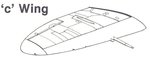
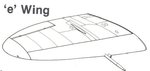
Although the 'C' wing was the first so-called 'universal' wing, due to the ability to accept differing armament fittings, it is generally accepted that the 'E' wing was referred to as the 'universal' wing. Yes, the .50 cal Brownings WERE mounted inboard on this wing, not out or in as I originally wrote! The reason was, if the cannon and .50cal were mounted, as Claidemore quite rightly stated, it allowed more room for the cannon ammunition and the feedway/feed mechanism, which was a lot 'bulkier' than that for the .50 cal. Also, on the 'E' wing, capable of carrying up to 1,000lb of external stores, it had been found that, if two cannon were mounted (per wing), the weight of the stores and rack was causing stress problems, effecting the structure of the wing, as the rack hard-points were near, if not on, the same mounting area for the guns.
I have attached two sketches of the relevant wings, and note that the 'E' wing sketch shows the .50 cal in place (blunt end to fairing). On the 'C' wing, the single cannon (per wing) could be mounted inboard, or outboard, depending on time of manufacture, i.e., before later production modifcation. (That was my area of confusion/brain fade in my earlier response!) If the 'stub' fairing has a domed cover, then that weapon's position is empty. Note that on the earlier 'C' wings, the upper surface 'blister' over the cannon hatch was wider, and flatter and, if you need drawings of this, I can supply them. However, when the MkXIV was introduced in the XIV c, the blisters were the later, narrow, long type. Note also the differences in the size/shape of the cannon access hatches on the 'E' wing. NB, the letters (E/C) are normally shown in lower case in the mark numbers, I used upper case for clarity.
Again, hope this helps, and thanks to Claidemore for prompting me to check my errors!
Terry.