Fast bombers alternatives for 1939-40

Ad: This forum contains affiliate links to products on Amazon and eBay. More information in Terms and rules

tomo pauk

Creator of Interesting Threads
15,443
5,430
Apr 3, 2008
Bombers that might've been actually fast :)
1-engined, 2-engined, 3-engined, 4-engined - whatever is your cup of tea. Please, look beyond of just 'make an early Mosquito'; not that aircraft is a bad role model, but some variety is good. Cancel the actual bombers being produced, in order to free up the factory floor, materials, engines and manpower required.
Some sort of the bomb bay is required, or the bomb(s) might be faired in or 'semi-buried' in the airframe in order to cut the drag and thus keep the speed up. Aircraft can have some guns' armament. Engines for them - whatever a respective country can get, but preferably what was made domestically. Bombs used - the historical types; bomber will need to do better than just to carry 50-100 kg types in order to be useful.
Bombers still need to have an useful range/radius, so just attaching the bombs on a Spitfire or Bf 109E will not cut it.
 
The brand-new McDonnell Aircraft Corporation put together something along the lines of a fast light bomber, as a sort of parallel effort to the Model 2 that they were doing as a follow-up to their unsuccessful Model 1 entry in the Army's R40-C. It's quite an interesting sketch.
1759258274182.jpeg
 
Bombers that might've been actually fast :)
1-engined, 2-engined, 3-engined, 4-engined - whatever is your cup of tea. Please, look beyond of just 'make an early Mosquito'; not that aircraft is a bad role model, but some variety is good. Cancel the actual bombers being produced, in order to free up the factory floor, materials, engines and manpower required.
Some sort of the bomb bay is required, or the bomb(s) might be faired in or 'semi-buried' in the airframe in order to cut the drag and thus keep the speed up. Aircraft can have some guns' armament. Engines for them - whatever a respective country can get, but preferably what was made domestically. Bombs used - the historical types; bomber will need to do better than just to carry 50-100 kg types in order to be useful.
Bombers still need to have an useful range/radius, so just attaching the bombs on a Spitfire or Bf 109E will not cut it.
Might also require a bomb sight?
And a Bomb aimer?

and
Bombers still need to have an useful range/radius, so just attaching the bombs on a Spitfire or Bf 109E will not cut it.
old book (William Green so numbers may be off.

French LeO 451 B4
4 men two GR 14N 48/49 engines 1140hp T-O and 1035hp at 15,75ft. max speed 307mph at 15,748ft
Range with 1100lb bomb load............1439 miles............... economical cruise 227mph at 8,200ft

Bomb load (?)..................................................Fuel
one 1102lb bomb..........................................712imp gal
two 441lb bombs..............................................."..........."
two 1102lb bombs........................................530imp gal
two 1102 + two 441lb..................................398imp gal
two 1102 + five 441lb..................................220imp gal

There was room for one 441 or 220lb in each wing root. No idea what that did to fuel load

Now how far could it fly (and how fast) with even the two 1102lb + two 441lb load?
Granted there were more powerful engines than the GR 14N in 1939/40 (but not for the French)
LeO-451-1940.jpg

Yes you can get rid of the 20mm and turret what else are you going to take out/cut down?

If all you want is tip and run raids 100km with a 500kg bomb load over the front lines you can do a lot better.
If you want to go 300-400km with 1000kg things are going to get a lot harder.
 
Might also require a bomb sight?
And a Bomb aimer?

Yes, especially if the dive bombing is not the main modus operandi.

If all you want is tip and run raids 100km with a 500kg bomb load over the front lines you can do a lot better.
If you want to go 300-400km with 1000kg things are going to get a lot harder.

How do you suggest that we tackle the problem? At least for the countries that can supply the better engines of the day for these needs?
 
That is sort of the problem.
The Americans split the difference. You have the fast A-20s with R-2600 engines, you don't have to follow it exactly but four 500lbs (?)bombs, 500 US gallons to start with (?) and a speed of over 340mph which is very fast for 1940.
Actual bomb load for early A-20s is a bit confusing as the US was using 100lb, 300lb, 600lb and 1100lb bombs. Early A-20s could carry four 300lb, two 600lb or one 1100lb bomb. However in overload condition they could carry sixteen 100lb bombs and even eighty (80) 30lb fragmentation bombs so the load carrying ability was there. The bomb bay size and racks were not. But this is a what if and they didn't have to do much juggling.
But if you want more bombs and/or more fuel you windup heading for B-25 territory. Even early B-25 with no power turrets.
The McDonnell aircraft in the above sketch has similar bomb loads to the early A-20s but way, way more guns/ammo. Not sure were the 1200hp Allisons came from ;)
and is the better streamlining going to make up for the 200hp less at Altitude ? (or 400hp less really low?)

The Mosquito was designed for four 250lbs and Merlin X engines. That is as good as the British could do in 1940. The Merlin XX came along part way through the design process.
Somewhere on the forum a number of years ago there was a table/chart with number of early Mosquito proposals with both Merlin X and Merlin XX engines but I can't remember the estimated differences in performance.

Perhaps the Germans could have done better than the Bf 110 fighter bombers or the Ju-88 (lack of high power engines for most of 1940)

And for some of these we have to go back to the intended targets. A fast bomber with eight-ten 50 kg bombs might be useful for somethings. Bridge busting is not one of them.
In 1939-40 everybody bombs and bombers would be much more effective than they actually were so many air staffs were happy with small bombs and small bomb loads. A fast bomber might be able to hit targets 300-400km behind the lines but are eight-twelve 50kg bomb loads really destroy the intended target/s? Like European masonry factory buildings or heavy machinery? deep cratering of roads, runways, railroads?
 
The requirements for this thread are a bit too squishy. What exactly is considered "actually fast" in 1939, what is the minimum internal bombload, and what is a "useful" minimum range?

I'd posit the Martin Maryland would probably be a pretty good fast bomber in 1939-40, particularly if it could be outfitted with slightly more powerful engines that were available in this timeframe.
 
Perhaps the Germans could have done better than the Bf 110 fighter bombers or the Ju-88 (lack of high power engines for most of 1940)
Ironically, the bombed-up Bf 110 was faster than the Ju 88 with the external bombs. External bombs eat both speed and range/radius.
The Do 215 seem to be closest of them to the Schnellbomber idea, since it will not suffer in that regard with bombs aboard. The stillborn Do 17R, with DB 601A engines and streamlined cockpit and nose would've been even closer. One also wonders about the early Do 17 fuselage + the wing not bigger than what the Bf 110 used - a good deal of wing-related drag would've been nixed.

A Bf 110 with the fuselage in front of the main spar reworked and turned into a bomb bay might've also been interesting. Sorta proto Me 210.

Cancel the Halifax and have Handley Page build the high speed unarmed bomber proposed by their chief designer.

Two 2,000hp engines (Vulture or Sabre later), 3 man crew, no guns, bomb loads as per P.13/36 (8,000lb max).
Is the Vulture a viable engine in 1939-40?

The requirements for this thread are a bit too squishy. What exactly is considered "actually fast" in 1939, what is the minimum internal bombload, and what is a "useful" minimum range?
Not every country/service had the same requirements. Germans were both into long-range bombers as well as the short-range types. British were trying with longer ranges, even with the Battle and Blenheim. Many countries have had 1-engined light bombers for tactical needs, and were either purchasing and/or trying to make longer-ranged types for strategic needs.
Japanese were eager to get to the very long ranges and reputable speeds, while sacrificing the bomb load (among other things). They still made the 1- and 2-engined light bombers, that were pretty unremarkable.

A fast bomber will need to be perhaps 90% as fast as the current better fighters. Talk at least 500 km/h (~315 mph) for the European use. Bomb load - minimum 500 kg, optimum probably 1000 kg. Opt for dive bombing, need be. Yes, dive bombers can also be fast. Radius of some 250 miles for the tactical types, 500 miles for the strategic types? Japanese will try to get even more miles, while a small European country, like Belgium, Czechoslovakia or Switzerland will gladly trade radius for speed or bomb load.

I'd posit the Martin Maryland would probably be a pretty good fast bomber in 1939-40, particularly if it could be outfitted with slightly more powerful engines that were available in this timeframe.
Excellent choice.
 
Is the Vulture a viable engine in 1939-40?

It was viable enough to be put into production and into service with the Manchester.

The Manchester went into service in late 1940 and first flew in mid 1939.

IIRC, the extent of the Vultures issues were highlighted during the Manchester's testing and into its service.

A smaller, and ligher, airframe with lower drag may hve been easier on the engines too.

To minimise the risk of the Vulture, have Avro change their aircraft to 4 Merlins (as Handley Page did to create teh Halifax).
 
It was viable enough to be put into production and into service with the Manchester.

The Manchester went into service in late 1940 and first flew in mid 1939.

IIRC, the extent of the Vultures issues were highlighted during the Manchester's testing and into its service.

A smaller, and ligher, airframe with lower drag may hve been easier on the engines too.

To minimise the risk of the Vulture, have Avro change their aircraft to 4 Merlins (as Handley Page did to create teh Halifax).
Perhaps the British and the Allies might've saw a better utility of a fast bomber that is available in good numbers at least before the German offensive in May of 1940.

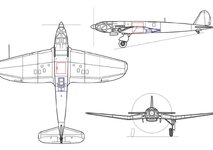
No love for the He 119 Heinkel He 119 ?
It is still a young thread :)
But why not, not every bomber needs to be of the 'classic' layout.
 
No love for the He 119


960px-Heinkel_He_119_V4_3-view.svg.png


As is.................no!
You want the center of the bomb bay at around 30% of cord to prevent large change in trim (CG) when you drop 500-1000kg of bombs out of the plane.
You can play games with fuel tanks, used tanks in different orders or return to 1/2 full tank as trim changes. Dropping bombs is a lot weight in 1-3 seconds.
You could put bomb cells out in the wing?
You could stretch the fuselage out, move the engines forward a bit and put ballast in the tail?
Have to figure out where the bombsight goes? Somewhere were there is less vibration?
Also wonder how well the plane would have performed with "normal" engines instead of the evaporative cooling system.
Were the bombs on V7 & V8 to be carried inside or outside (where does the speed go?)
Speed was great................operations on a regular basis???
XzAAGqzk1JgDu3OX0sTcmoMDsCAhT-JUD196zrfr8&usqp=CAU.jpg
 
It was viable enough to be put into production and into service with the Manchester.

The Manchester went into service in late 1940 and first flew in mid 1939.
Only by enough to win a bar bet.
No 207 squadron had eight (more?) by the end of Dec 1940 and they didn't fly a combat mission until Feb 24-25tt 1941 and that was to Brest.

Wiki claims (?) they were grounded on April 13 1941 for a brief period due to bearing failures and again on 16th of June. This one lasted until August 1941.

For part of it's combat life they were de-rated from 1750hp down to around 1600hp by limiting max rpm.
 
The Martin 167s may have been very good at the time. But they varied from 1939 into 1940. P&W was building single speed superchargers in 1939 and branching out to two stage superchargers and then (3rd) to two speed single stage superchargers. They were also transitioning from 91 octane fuel to 100 octane (or 100/100). Only the F4Fs got the two stage superchargers but the R-1830s went from 1050hp to 1200hp take-off and gained 5-7,000ft of altitude at around 900hp with the two speed supercharger. This doesn't give the two speed engine all that much high (teens) altitude performance. What it means is that single speed P & W engines peaked around 7-9,000ft for truly dismal performance in the teens.
Also means that Martin 167 bombload could vary a lot depending on exact model and source. Somewhere between 1100/1200lbs and 2000lbs.
 
Roughly the position of the bomb bay for 6 bomb cells (each for a 250 kg bomb) in the red, and the position for the bomb aimer in the blue:
(click on the pic for the high res)

HE 1191.jpg
 
Last edited:
In regards to the Bf162 I mentioned above - it's proposal was beat by the Ju88.

However, another contender was beat by the Ju88 as well: the Hs127.

The reason why the Ju88 won the competition was not for it's speed, which the Hs127 dominated the three contenders, but for it's bomb load.

It seems to me, that if the RLM wanted a true "schnellbomber", then the Hs127 would have been the best choice.
 

Users who are viewing this thread

Back