Anti-aircraft artillery & firepower alternatives, 1930-1950

Ad: This forum contains affiliate links to products on Amazon and eBay. More information in Terms and rules

TANSTAAFL

A projectile that needs a small propelling charge may be able to carry that charge inside the projectile.
But if you are looking for high velocity you need a certain amount of propellent to get the projectile (of a certain weight) up to that speed inside the barrel.
Splitting the propellent in two parts, one in the cartridge case and one in the projectile does not make things more efficient. You want 20% more velocity? you need 40% (or more) propellent, how you add that is the question. British 2pdr HV shells lost about 14% of their weight to help get the extra velocity.
Using rockets outside of the barrel solves the problem of higher pressure inside the barrel, doesn't really solve the problem of the needed amount propulsion (energy needed to get X amount of mass up to desired velocity). A small charge in the base of a shell is not going to turn an 88mm/56 into an 88mm/71. That 25% increase (820 to 1000ms) required a 100 increase in propellent and the longer barrel. If you want to use a rocket motor to get rid of the extra barrel length OK, but now you need around 2.5 kg of propellent in the back of the 88mm shell and you need either a longer shell or a much reduce HE charge. Much longer shell may require a different rifling twist in order to stabilize.

Rocket propelled or rocket assisted artillery shells have always had an accuracy problem. Rocket assist was a really big thing in the 1970s/80s with huge gains it range from existing 155mm guns/howitzer and even 105mm howitzers. These worked by delaying the rocket firing for a number of seconds after the projectile left the barrel. The rocket motor fired after the shell had lost some of it's initial velocity and boosted it back up and/or helped maintain velocity. And the rocket fired in thinner air so you need a bit less propellent to fight air resistance. However accuracy was usually poor. The rocket motors did not all fire at the exact same point in the trajectory which is curved so large variations in range. All shells wobble a bit in flight. That is the nose is making a small circle as the shell rotates. When the rocket motor fires the shells tended to take off in a new direction, which in a shell that was still thousands of meters from it's target doesn't have to be a big deviation.
Artillery customers finally gave up and just bought guns with longer barrels and more streamlined projectiles. And that is with 1970s-80s-90s machining capabilities and design and aerodynamics.

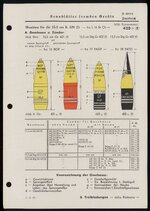
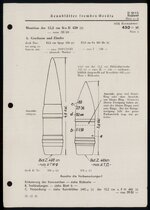
Better shaped projectiles could have done a lot for better performance. German 30mm MK 108 ammo shows some of the difference. The Ausf C was still moving at 370ms at 600meters while the Ausf C shell was doing 370ms at 300 meters when both were fired at 500ms. Ausf C shell arrived at 600 meters about 0.25 seconds sooner. Maybe the Ausf A would have the same time of flight if it was fired at 600ms instead of the 500ms but that would need a lot more propellent and a longer barrel.
Few AA shells were as badly shaped (blunt nose) as the MK 108 Ausf A unless they were WW I left overs.
 
A projectile that needs a small propelling charge may be able to carry that charge inside the projectile.
But if you are looking for high velocity you need a certain amount of propellent to get the projectile (of a certain weight) up to that speed inside the barrel.
Splitting the propellent in two parts, one in the cartridge case and one in the projectile does not make things more efficient. You want 20% more velocity? you need 40% (or more) propellent, how you add that is the question. British 2pdr HV shells lost about 14% of their weight to help get the extra velocity.
Using rockets outside of the barrel solves the problem of higher pressure inside the barrel, doesn't really solve the problem of the needed amount propulsion (energy needed to get X amount of mass up to desired velocity). A small charge in the base of a shell is not going to turn an 88mm/56 into an 88mm/71. That 25% increase (820 to 1000ms) required a 100 increase in propellent and the longer barrel. If you want to use a rocket motor to get rid of the extra barrel length OK, but now you need around 2.5 kg of propellent in the back of the 88mm shell and you need either a longer shell or a much reduce HE charge. Much longer shell may require a different rifling twist in order to stabilize.
On a heavy AA shell, even a small rocket engine in the shell bottom might help to push through the thickest air in the low altitudes. Say, 3 sec duration - even when fired at SL could mean that by 2.5km the heavy shell still has the same velocity as it had when it left the barrel. That indeed will not make the L56 as good as the L71, but it might've split the difference in dealing with the targets flying above 20000 ft.

With the lethality business - aircraft hit by the 2pdr shell that has the part of HE content sacrificed for the rocket motor is still likely to go down.

Rocket propelled or rocket assisted artillery shells have always had an accuracy problem. Rocket assist was a really big thing in the 1970s/80s with huge gains it range from existing 155mm guns/howitzer and even 105mm howitzers. These worked by delaying the rocket firing for a number of seconds after the projectile left the barrel. The rocket motor fired after the shell had lost some of it's initial velocity and boosted it back up and/or helped maintain velocity. And the rocket fired in thinner air so you need a bit less propellent to fight air resistance. However accuracy was usually poor. The rocket motors did not all fire at the exact same point in the trajectory which is curved so large variations in range. All shells wobble a bit in flight. That is the nose is making a small circle as the shell rotates. When the rocket motor fires the shells tended to take off in a new direction, which in a shell that was still thousands of meters from it's target doesn't have to be a big deviation.
Do some experimenting and testing. Bigger or smaller motors, longer or shorter thrust duration, when to fire the motor etc.

Better shaped projectiles could have done a lot for better performance. German 30mm MK 108 ammo shows some of the difference. The Ausf C was still moving at 370ms at 600meters while the Ausf C shell was doing 370ms at 300 meters when both were fired at 500ms. Ausf C shell arrived at 600 meters about 0.25 seconds sooner. Maybe the Ausf A would have the same time of flight if it was fired at 600ms instead of the 500ms but that would need a lot more propellent and a longer barrel.
Few AA shells were as badly shaped (blunt nose) as the MK 108 Ausf A unless they were WW I left overs.


The MK 108 probably needed the to be with the less sedate MV to begin with. Like, use it's "own" Mine shell design, 250-270 g, so the MV can be more conductive to accurately shoot at the greater distance and against the targets that can maneuver well. Accept the loss in the singe-shell lethality and move on.

FWIW, some thought was given to the increase of the MK 108 RoF from 600 to 1200 (it was admitted that it will be quite a task to do it).
 
FWIW, some thought was given to the increase of the MK 108 RoF from 600 to 1200 (it was admitted that it will be quite a task to do it).
... like this, in a post-war report:

1200.jpg

Seems like the MK 108 also featured as an anti-aircraft gun as-is:

108 flak.jpg
 
The report that the Edgar Brandt company made on AA guns and ammunition (October 1940) is quite interesting as well.

Brandt argues that to expect to hit a modern aircraft, the flight time to the aircraft must be between 8 and 10s to minimize the volume that it can maneuver in and thus avoid missing a plane that already changed course. He also recommends increasing the HE ratio compared to the optimum for ground artillery, as the lower density at higher altitudes allows lighter fragments to retain their energy better.

To obtain said practical flight times, Brandt recommends increasing the muzzle velocity and improving the shape of the projectile to better retain this velocity. For a given gun, this may be obtained with a lighter projectile with an elongated ogive that goes as close to the base as possible, requiring a discarding guiding band (e.g a ring sabot near the middle of the projectile). A higher HE ratio is conducive to a lighter round, and a good ballistic cap works very well with a lighter round.
While a lighter round is normally worse at energy retention, the practical flight distances are much smaller than the trajectory's maximum flight distance/altitude.
The fuze may be designed to be lighter and better shaped.

For sufficiently high calibers (90 and up), using actual subcaliber projectiles is practical and beneficial because:
- they allow high velocities out of comparatively short barrels and low pressures, increasing thermodynamic efficiency
- the powder charge size and projectile weight and length are reduced, facilitating higher rates of fire
- the wear is also reduced, enabling higher rates of fire when wear patterns are a concern
- due to the low projectile momentum, it is possible to install a more powerful barrel firing only subcaliber projectiles on an existing mount, which is good as barrels are generally faster to develop than mounts.

Brandt for example suggests replacing the 90mm CA 39 firing piece (11kg round at 820 m/s and 260 MPa), with a 230 MPa 105mm gun firing 80mm 6kg at 1220 m/s. In spite of a 20% increase in power, the 19% lower momentum allows use of the existing mount.

Naturally, a lot of this seems to be made in the context of a gun seeking an aimed hit on a target, rather than firing dozens or hundreds of guns in a box of air. Brandt's concept probably works better with good fire control systems and VT fuzes that enable high hit probabilities for individual shots, and where a low time-of-flight projectile reduces the impact of aiming errors.

The tables given from page 12 onwards show that lightweight projectiles with discarding guiding bands and a lightweight fuse with BC turn obsolete 75mm 570 m/s guns into near-75mm Mle 1928 (715 m/s) analogues.
For 75mm Mle 1928-pattern guns (CA 32), the lightweight concept saves 1.1 and 1.5 seconds respectively to 4 and 5km altitude (actually flight distances as the gun fires straight up at 90° here). Savings are even greater when the lightweight fuze with BC is used, and the small loss in HE payload with the first round is negligible with the lightweight fuze.
Even in ammo where the HE mass is reduced, the ratio to the total projectile mass is increased, to obtain more and lighter fragments.

The 90mm firing 80mm HE-DS outright reaches 1040 m/s using a projectile that is slightly heavier and has slightly more HE than a 75mm service round. Worth comparing to the hypothetical 105/80mm weapon.
Even the obsolete 105mm Mle 1913 firing 85mm HE-DS reaching 852 m/s instead of 550, has barely worse flight times than the considerably more powerful 90mm CA 39 with its service round.
 
Last edited:
Brandt argues that to expect to hit a modern aircraft, the flight time to the aircraft must be between 8 and 10s to minimize the volume that it can maneuver in and thus avoid missing a plane that already changed course. He also recommends increasing the HE ratio compared to the optimum for ground artillery, as the lower density at higher altitudes allows lighter fragments to retain their energy better.

To obtain said practical flight times, Brandt recommends increasing the muzzle velocity and improving the shape of the projectile to better retain this velocity. For a given gun, this may be obtained with a lighter projectile with an elongated ogive that goes as close to the base as possible, requiring a discarding guiding band (e.g a ring sabot near the middle of the projectile). A higher HE ratio is conducive to a lighter round, and a good ballistic cap works very well with a lighter round.
While a lighter round is normally worse at energy retention, the practical flight distances are much smaller than the trajectory's maximum flight distance/altitude.
The fuze may be designed to be lighter and better shaped.
Germans pretty much agree with his reasoning. The high-velocity 88mm gun was with the much greater ceiling and range than the 105mm gun, let alone the 'normal' 88mm gun. The main shortcoming of the long 88 was the low barrel life, several times lower than of the normal 88.
They were also suggesting several ways of improving the MV on the existing guns: under-caliber ammo*, going squeeze bore**, as well as well as loading the ammo hotter. If one does not have a fast and easy way to obtain the proximity-fused ammo, going to hit-to-kill will be much easier to do with the faster shells.

* this type of ammo is noted as reducing the barrel life on the field guns; however trading the barrel life for the greater lethality on the guns that are available in the thousands seems to me as a more economic way than making the much more expensive high-power guns that again have the much lower barrel life to begin with, while also using the much more expensive and powerful ammo
** again, lowers the barrel life, but same comment as above applies IMO
 
* this type of ammo is noted as reducing the barrel life on the field guns; however trading the barrel life for the greater lethality on the guns that are available in the thousands seems to me as a more economic way than making the much more expensive high-power guns that again have the much lower barrel life to begin with, while also using the much more expensive and powerful ammo
** again, lowers the barrel life, but same comment as above applies IMO
The other consideration is that making ever more powerful guns firing conventional ammo leads to much heavier and bulkier systems than if you were using special ammo.
 
Do you have that document saved? Seems like it disappeared from that site.
I fixed the link, it wanted to paste an unrelated discordapp link instead if the drive link.

Sad thing about this doc (other than page 8 being missing) is that only the lightweight ammo is shown (possibly not even those with the new fuze), but not the subcaliber ammo.
 
Naval ammo was early adopter of the HE shells with aerodynamic caps, that looked like the APCBC ammo outwardly. That improved the length/diameter ratio, thus improving the aerodynamics without making the shell too heavy, or requiring the top-notch steel. Armies were slow to pick up on that, at least on the usual 15-15.5cm bracket. But here is the French 155mm shell, together with the usual shell for comparison (same shell was also used on the 155 GPF, while the similar shells were also available for the 145mm and the bigger guns):

155spitzer.jpg

Granted, this is something that might not be worthwhile to make in small calibers, as well as if the quick operation on the time fuses is required, but it will come in handy with the 75+mm guns when the hit-to-kill is wanted.

Also this:

152 long.jpg
 
Last edited:
Sometimes less radical solutions can work well.
Some shells were not very good to begin with a small changes can make significant differences without going for the last 10-15%.
A bit more attention to base of the shell (boat tail) can also pay dividends, but may be harder to manufacture. Exact taper and length of the boat tail may require some experimentation.
This is with 20/20 hindsight as it took quite awhile for many small arms bullet makers to either figure out (or publish) different ballistic co-efficients for different velocities for the same bullets.
Problem for AA shells in the larger calibers was getting access to the fuse.
q=tbn:ANd9GcTXsseRK3oQaLd8xD0hyQwmlWsO37eqBVOKxQ&s.jpg

Crewman inserted complete round in the fuse setter and the fuse setter twisted the fuse to the correct time as sent by the fire control equipment.
A large amount of error was built into the system.
The US would up (late in the war) with a system that set the fuse while the in the loading position. Crew dropped the round into the feed tray and the round was then held by arms while the fuse was set (needs locating tabs on the shell to get proper alignment) and then powered rollers moved in against the complete round and rammed it into the breech a fraction of a second after the fuse was set. This powered ramming also increased the rate of fire of the gun.
With the German method (everybody's method in 1930s and early 40s) there was a 2-3 second delay in getting the round out of the fuse setter, flipping it around 180 degrees and using shoulder/arm muscles to ram the round into the breech of a gun pointed up at 70-85 degrees.

Short time of flight was only part of the problem.
Perhaps more important with guns that had crappy range finding and crappy sights?
 
It will also depend on a shell. A 75-90mm shell will be far weaker with the time fuse than the 120-130mm shell, and here (for the smaller shells) going for a hit-to-kill might've worked better than going for a timed explosion. The time fuse was probably a few times more labor-extensive and more expensive than the ordinary impact fuse - important to note if one looks to make hundreds of thousands, or even millions of the fuses.
Granted, with the impact fuse, there is no psychological effect of the heavy AA fire, and there is no such thing as damaging of the enemy aircraft by the nearby explosions.

One thing that might've improved the hit probability of the time-fused heavy shell is if the design of the shell includes the the pre-made fragments, that will go further ahead in a cone pattern, rather than to just go in the circle away from the trajectory. Sorta low-tech Ahead ammo. Just make sure to under-time the detonation.
 
British tested the rockets against the V1 flying bombs, registering some kills: link
8 kills in 10 day, achieved by 10 'projectors', with each projector having 20 rockets.
 
French Army making a piggy-back on the Navy's 75mm guns (like this one here) would've saved them both the time and the coin.
Going on further, an early move towards an automatic 37mm would've upped their AA abilities significantly.

My neighbor, now deceased, served as a mechanic on the Tourville cruiser at Haïphong in 1945 / 1946.
He told me that one day, the 75 mm AA gunners had been ordered to fire on a moving train robbed by the Viet Minh and they missed it.
The gunnery officer was furious.
Unfortunately I have been unable to fight a track of this event.
 
The problem with the 2pdr pom pom is that it used a short cartridge with little taper or bottleneck and the gun body (receiver) was sized to suit.
View attachment 856805
The projectile is large (length) and perhaps necking down and using a shorter projectile will allow for a bit more case length. If you try to make the complete cartridge much longer you need a new gun body (receiver) and a longer bolt travel. If you make the rear of the case much bigger you need a larger bolt and possibly a wider/taller receiver.
Trying to save on barrel costs but having to spend time/effort redesigning the the body and guts of the gun seems to be false economy to get a low powered 37mm gun.
Just buy a French or Italian 37mm AA gun design.

The need for a compact gun is much less for ground/naval AA work than for aircraft work.
View attachment 856806
A big 20mm will fit in the same field ;)
The small 20mm will not be man portable and the worthwhile ammo is going to need a cart to haul it around.
Granted the 7.9mm gun is not very effective. which is why they tried to use twins.
View attachment 856807
But now you are into at least a small trailer or small motor vehicle the difference between a short Oerlikon and a long Oerlikon to the small truck in terms of weight or size is going to be minimal.
British gave up on using mgs for AA from tanks. They just closed the hatches and opened up the hatches when the German aircraft went away. Maybe the Germans killed one or two vehicles out of the unit. Playing with Bren guns against aircraft lead to a lot of dead or wounded commanders and/or loaders from bullets/shell fragments while trying to man the guns.
View attachment 856808
This may be under gunned for it's weight/cost. The need for smaller AA guns to fit small tanks or small trucks is a niche market. The army wants lager more powerful guns so that the same number of units (guns or gun batteries) can cover a wider area.
View attachment 856809
The Americans loved their .50 cal guns but I am not sure how many Enemy aircraft were shot down by them despite the tens (hundreds) of thousands of rounds fired.
The .50 cal found on every tank, truck, etc. in the US Army in WWII were "defensive" weapons. This means that they weren't meant to actually "destroy" an attacking aircraft (although the rare occasion when it happened was cause for celebration) but were to "drive off" or "spoil the aim" of the attacking aircraft. They were meant to keep the attacker "honest", so he would be reluctant to go in very low and close where his aim would be much better. The Chieftain talks about this in one of his videos.
 
Last edited:
The .50 cal found on every tank, truck, etc. in the US Army in WWII were "defensive" weapons. This means that they weren't meant to actually "destroy" an attacking aircraft (although the rare occasion when it happened was cause for celebration) but were to "drive off" or "spoil the aim" of the attacking aircraft. They were meant to keep the attacker "honest", so he would be reluctant to go in very low and close where his aim would be much better. The Chieftain talks about this in one of his videos.
You are correct. That is the primary goal of any AA gun or AA system. Some guns/systems were better than others obviously.
Using projectiles that carried enough tracer to last several thousand meters and were visible in daylight to the planes being shot at was a huge deterrent. Some AA guns (2pdr Pom Pom ?) were rather lacking in that regard.
7.5-8mm machine guns were also not great, depends on light and how close the planes wanted to get. Also depends on the amount of tracers in the ammo mix.
British .303 tracers burned for around 550 to 1000yds depending on exact mark of bullet.
British .5in SAP tracer burned to 800yds.
A lot of the British .50 cal tracer burned out at around 550yds but since the .50 cal used more tracer compound than the smaller rounds perhaps it burned brighter?
American .50 cal ammo may have had longer lasting trace but dimmer? and again they may have changed over the just the years of WW II.

If the aircraft don't know they are being shot at there isn't a lot of deterrence.

Tracers that were visible to rear helped the gunners. Tracers that were visible to the front or at least to side (burning particles in the wake of the bullet?) were a much greater deterrent.
in the 1930s and early 40s many nations used multiple rcmgs for AA,
00-maximgunfacts.jpg

in part because that what they could make quickly.
two 1000-1200rpm guns may not be that far behind four 600rpm guns in terms of bullets in the sky. Tracers are 5-20% of supplied ammo?
Some light AA was there for morale. If the men on the ground (or ships) thought they were shooting back they would stay in position longer under attack. Most did not know how poor the chances were of actually damaging their attackers.
The US quad .50 was a more credible threat not because of the .50 but because the power traverse and elevation offered much better tracking/aiming at fast moving targets. The M45 mount offered up to 60 degree traverse per second. It was tried against kamikazes but failed because it could not destroy the kamikazes in time to keep the wreckage from hitting the ship. Deterrence was not even a partial goal at this point. Navy wanted to destroy aircraft in flight to the extent they could not cross any distance even on fire or with parts missing.
And they wanted to stop 90-100% of them, not 5-10%.
 

Users who are viewing this thread

Back