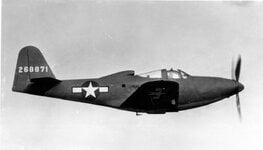
Finnish air force Mustang kills on Russian Front? (1 Viewer)

By the way, are you familiar with the publications by Dmitry Marchenko on the overclaim rates in the air fightings over Karelia and the Baltic sea? Unfortunately, I've only come across them online, and only in Russian (I can provide links if necessary). As far as I understand, he had access to the combat logs of the 13th Air Army and its units in addition to the aforementioned "Chronicle of Combat Operations..."

I'm not, but feel free to send me the links. In general I am also looking for data on the following:

-How many FAF aircraft did the VVS claim shot down in 1941-44?
-How many FAF aircraft did the VVS claim destroyed in bombing runs in 1939-40 and 1941-44?
-How many FAF aircraft did Soviet ground or naval forces (AA fire) claim shot down in 1939-40 and 1941-44?
-Did the PVO claim any FAF aircraft in either '39-40 or '41-44?
 
Perhaps confused it with an Allison powered Mustang?
To be honest, how anybody could tell a bunch of fast moving, evading specks apart from each other while trying not to be dead is beyond my eyes.
I bet generalleutnant Gunter Rall did know who he was fighting with...he had 275 kills.


Then again Kössi Karhila possibly had no idea if it was Mustang, Yak-7 or P-39. He was a reserv officer.

But the fact that he had already shot La-5s and Yak-7s makes me think it was someting else.

We would have to know where the P-51As were at the time of the air combat...to be sure.
 
I came to the same conclusion last week. Between this and the other thread where he's calling people clueless bots (myself included, lol), and Russian bots, constantly making fantastical claims without ever presenting a shred of evidence, ignoring everything written to him, and endlessly spamming ChatGPT-generated AI slop in his posts, I'm just glad this forum has an ignore button.

On the bright side, the stuff about the Spitfires sent to the USSR and how they were used there posted by multiple people who actually know a thing or two about what they're talking about, has been very interesting.


:D


It's a pie-in-the-sky idea, because how would the Finns obtain them in the first place. But for the sake of argument let's say there's a time portal that teleports 40 P-51Ds to the Finns in 1941. My answer to the question then is: probably less than one might initially think. There would've been no access to spare parts, the Finns only really had 87-octane fuel, their runways were unpaved (i.e. a lot of dust kicking up outside of winter, requiring the installation of tropical filters - or at least installing them was advisable) and by European, and I imagine American, standards short, and most air combat over and near Finland occurred at relatively low altitudes, perhaps at around 1,000-4,000 metres (~3,300-13,100 ft), or less. Perhaps @drgondog could comment on how the P-51D would do under such conditions and limitations. I genuinely don't know.

But I imagine even if it could have performed decently under those conditions, the lack of spare parts would've killed operating the aircraft. Historically a lack of spare parts grounded the few Finnish Hurricanes for most of the Continuation War (1941-44), and due to a lack of spare engines the Fiat G.50s were grounded for much of it too, particularly the latter half of that war (which is partly also why their KLR in Finnish use is very high, though not as high as is usually claimed; they were spared the hardest years of the air war). Conversely the Finns were able to keep their Brewster 239 and Curtiss Hawk 75A fleet flying the entire Continuation War and beyond. This was only possible because they could use spare parts obtained from Soviet planes and German stocks. In the 1930s the Americans had licensed the Soviets Wright Cyclone engines, among other things, and the Soviets then built very large quantities of their own spin-off designs. These were then captured by the Finns, and the Germans captured many more of them, which the Finns purchased from Germany. They weren't as well-made as the original American engines and engine parts, but with a little tuning they could be fitted onto the Brewster (the plane normally using a Wright R-1820-G5 Cyclone, American parts and all). The Curtiss Hawk used various iterations of the Pratt & Whitney R-1830 Twin Wasp (initially some had a Wright R-1820-G205A instead, but these were swapped out for Twin Wasps IIRC due to reliability issues), but a lot of Twin Wasps had been supplied to France before the French surrender, which were then captured by the Germans. They too were then, like the Curtiss Hawks themselves, purchased from Germany by the Finns.

One thing also worth mentioning is that the heavily armoured Il-2 was tough to shoot down with 4 x .50 cals. I'm not sure two more .50s would've made that big of a difference in that particular case. The engine-mounted 20 mm cannon on a Bf 109 G on the other hand, had little issue taking down Stalin's Sturmoviks. IIRC a few G models delivered to Finland in '44 even had a 30 mm cannon in the nose! And then there were the attachable 20 mm wing gunpods as well, though my understanding is it was preferred to fly without them due to how heavy they made the aircraft in a dogfight.

With all that in mind, the real question is, I think: what could the Finns have done with more Bf 109s, and earlier? Hell, throw in some Fw 190s too, which they did try to get but Germany wouldn't sell them any (the Germans needed them for themselves).

Also regarding the octane thing, I have made a table of the FAF's fuel and lubricant stocks, and I might as well put that here just to show how little high-octane fuel the FAF had in 1941-44.

View attachment 898113

I thank you for your detailed reply but I am afraid you took my comment very literally. It was clearly a fantasy statement but the information you give is impressive.

PS My personal view is the Spit IX would be a good option
 
I thank you for your detailed reply but I am afraid you took my comment very literally. It was clearly a fantasy statement but the information you give is impressive.

PS My personal view is the Spit IX would be a good option

It was a fun little thought exercise for me, I thank you for the opportunity. I do think Finnish Spitfires would've suffered from the exact same issues that kept Finnish Hurricanes grounded. ;)
 
I thank you for your detailed reply but I am afraid you took my comment very literally. It was clearly a fantasy statement but the information you give is impressive.

PS My personal view is the Spit IX would be a good option
Yes it is very detailed information...from finnish sources...but as he also believes 100% of the politruk archives then naturally we know whose side he is on....unfortunately.

Even using AI is in his book dekadent western bulls*it. I have seen this kinda commenting before in several finnish sites before....just prior to Russian invasion to Ukraine.

What it is aiming is that FAF had practically no scores over VSS. If there were some it was because of bad luck and some sort of mistake.
 
Last edited:
PS My personal view is the Spit IX would be a good option
In this case, the simplest explanation is the most plausible: Finnish pilots did not shoot down any Spitfires, Mustangs, or Lightnings, mistakenly identifying the type of aircraft. All other explanations are about as credible as an alien intervention.
Spitfire IXs appeared in the Leningrad area much later.
I don't understand why we're spending so much time discussing something that's pretty obvious to anyone who's taken an interest in the subject.
feel free to send me the links
Dmitry Marchenko:
proza.ru
LiveJournal

Battles of the 13th Air Army:
January 1944
February 1944
July 1944
Battles over the Karelian Isthmus: summary for July and the entire summer period

Scores of Finnish fighter pilots:
1943 Part 1
1943 Part 2
1944

Overclaim on the Karelian Isthmus:
Part 1: June 02–16, 1944)
Part 2: June 17–23, 1944)
Part 3: June 26-30, 1944)
Part 4: Summary

The text contains grammatical errors; I hope they won't interfere with the automatic translation. I haven't come across a more detailed analysis of the air battles over the Karelian Isthmus, but I won't claim that what the author has written is the undisputed truth. Anyway, I think these publications are worth reading.
 
Very unlikely that there were P-51s fighting against the Soviet Union. It must be misidentified as there were a lot of misidentifications back during the war.
 
P-51s were in soviet arsenal...like others..Spits, Airacobras, Kingcobras and what have you.

We finns were flying Gloster Gladiators ( Morane Saulnier and Fokker D XXIs ) and a handful of Me-109s that lasted only few hundred hours of flying.

But what AI says about the Allison Mustangs in USSR is as follows:


The Soviet Union had very little "faith" in the P-51 Mustang, resulting in it being completely rejected for frontline combat operations. While the P-51 became a legendary long-range escort fighter for Anglo-American forces, its early variants utterly failed to impress Soviet leadership and pilots. [1, 2, 3, 4]

The Soviet Evaluation of the P-51A
During World War II, the Soviet Union acquired 10 early-model Mustang Mk. I aircraft (the British designation equivalent to the Allison-powered P-51A) transferred under Lend-Lease from the Royal Air Force in 1941 and 1942. These aircraft were assigned strictly to the Research Institute of the Air Force (NII VVS) for testing, training, and evaluation. [1, 2]
The Soviets ultimately decided against ordering more or putting them on the front line for three key reasons:
    • Poor Low-Altitude Performance: The early P-51A variants utilized Allison V-1710 engines. At altitudes above 15,000 feet, these engines choked, and at the low altitudes favored on the Eastern Front (under 4,500 meters/14,700 feet), they lacked the nimble responsiveness required for sudden dogfights. [1, 2, 3]
    • Clash of Military Doctrines: The P-51 was meticulously designed for the Anglo-American doctrine of strategic air warfare—escorting heavy bombers deep into enemy territory. Conversely, the Soviet Air Force (VVS) operated purely on a tactical doctrine focused on close air support, low-altitude dogfights, and protecting ground troops. Long-range capabilities were practically useless to them, as Soviet airfields were frequently located just minutes from the front lines. [1, 2, 3, 4]
    • Preference for Domestic and Alternate Lend-Lease Planes: Soviet engineers and test pilots vastly preferred their own domestically produced fighters, such as the Yakovlev Yak-7B and Yak-9, as well as the American Bell P-39 Airacobra. The P-39, in particular, thrived in low-altitude ground attacks and became a massive success in the USSR, leaving no operational niche for the Mustang. [1, 2]
Consequently, the Soviet Union never flew the P-51 Mustang in combat, viewing it as an ill-suited tool for the brutal, low-altitude air wars of the Eastern Front

What AI knows about Allison Mustangs:

The early North American P-51 Mustang variants powered by the Allison V-1710 engine achieved a top speed of roughly 368 to 390 mph and excelled at low-to-medium altitudes. [1, 2]

Key Specifications
  • Engine: Allison V-1710 liquid-cooled V12 piston engine (variants like V-1710-39, -81)
    Horsepower: 1,100 to 1,200 hp (up to 1,360 hp with War Emergency Power)
    Maximum Speed: 368–390 mph (depending on the specific sub-variant and altitude)
    Length: 32 ft 3 in (9.83 m)
    Wingspan: 37 ft 0 in (11.28 m)
    Empty Weight: Approx. 7,635 lbs (3,463 kg)
    Loaded Weight: Approx. 10,000–12,100 lbs depending on load configuration [1, 2, 3, 4, 5]

Armament & Design
  • Guns: Varied by mark; early Mustang Mk I featured a mixed battery of four .50 caliber and four .30 caliber machine guns; later P-51A/Mustang Mk II models carried four .50 cal wing guns or four 20mm cannons. [1, 2]
    Supercharger: Single-stage, single-speed internal supercharger, which gave it strong low-altitude performance but caused it to lose power ("run out of breath") at higher altitudes compared to later Merlin-engined variants. [1, 2]
P-51D the Packerd-Merlin was a bit different:

The North American P-51D Mustang is a famous single-seat World War II fighter plane powered by a 1,490-horsepower Merlin engine with a top speed of 437 mph. You can review official archives at the National Museum of the USAF. [1, 2, 3, 4]

Engine and Power
    • Engine: Packard-built V-1650-7 Merlin V-12 liquid-cooled engine.
    • Power: 1,490 hp standard (up to 1,720 hp with War Emergency Power). [1, 2]

Dimensions
    • Length: 32 feet 3 inches (9.83 m).
    • Wingspan: 37 feet 0 inches (11.28 m).
    • Height: 13 feet 4.5 inches (4.08 m). [1]

Weight
    • Empty Weight: 7,635 lbs (3,465 kg).
    • Max Takeoff Weight: 12,100 lbs (5,488 kg). [1, 2, 3, 4]

Performance
    • Maximum Speed: 437 to 440 mph (703 to 708 km/h).
    • Cruising Speed: 275 to 362 mph.
    • Range: 1,000 miles internal (up to 1,650 miles with external drop tanks).
    • Service Ceiling: 41,900 feet (12,800 m). [1, 2]
 
Last edited:
We would have to know where the P-51As were at the time of the air combat...to be sure.
he Soviet Evaluation of the P-51A
During World War II, the Soviet Union acquired 10 early-model Mustang Mk. I aircraft (the British designation equivalent to the Allison-powered P-51A) transferred under Lend-Lease from the Royal Air Force in 1941 and 1942. These aircraft were assigned strictly to the Research Institute of the Air Force (NII VVS) for testing, training, and evaluation. [1, 2]
The Soviets ultimately decided against ordering more or putting them on the front line for three key reasons:
    • Poor Low-Altitude Performance: The early P-51A variants utilized Allison V-1710 engines. At altitudes above 15,000 feet, these engines choked, and at the low altitudes favored on the Eastern Front (under 4,500 meters/14,700 feet), they lacked the nimble responsiveness required for sudden dogfights. [1, 2, 3]
    • Clash of Military Doctrines: The P-51 was meticulously designed for the Anglo-American doctrine of strategic air warfare—escorting heavy bombers deep into enemy territory. Conversely, the Soviet Air Force (VVS) operated purely on a tactical doctrine focused on close air support, low-altitude dogfights, and protecting ground troops. Long-range capabilities were practically useless to them, as Soviet airfields were frequently located just minutes from the front lines. [1, 2, 3, 4]
    • Preference for Domestic and Alternate Lend-Lease Planes: Soviet engineers and test pilots vastly preferred their own domestically produced fighters, such as the Yakovlev Yak-7B and Yak-9, as well as the American Bell P-39 Airacobra. The P-39, in particular, thrived in low-altitude ground attacks and became a massive success in the USSR, leaving no operational niche for the Mustang. [1, 2]
Which goes to show if you are relying on AI for your answers, it and you will both be wrong.

The USSR received 10 early NA-73 model Mustang I aircraft, which were FOUR production models of the Mustang family BEFORE the NA-99 P-51A Mustang.

There were a number of differences between the early NA-73 Mustang I received by the USSR and the much later NA-99 P-51A.

USSR certainly never received any NA-99 P-51As, and what P-51As that served in the ETO with the RAF (as the Mustang II) and the USAAF, were all basically operating over western Europe in the low level Tactical Reconnaissance role.

The NA-73 Mustangs provided by the UK to the USSR were NOT provided under Lend Lease.

The Mustang was not as originally conceived, designed and manufactured "meticulously designed for the Anglo-American doctrine of strategic air warfare - escorting....", but most simply, initially as a fighter with performance equivalent to or better than the Curtiss P-40 fighter that was on offer and being purchased by the UK at the time the original approach was made to North American Aviation. It EVOLVED over time through the subsequent production models and with the changing requirements and situation in air combat over Western Europe and elsewhere into a long range escort fighter able to operate at higher altitudes.

The Allison engine Mustang I, IA and II operated by the RAF in western Europe were successfully used in a tactical role, focused on close air support, and were used in that role up to and beyond VE-Day (some of the original NA-73 Mustang I were still in front line operational service with the RAF on VE-Day).
 

Users who are viewing this thread

Back