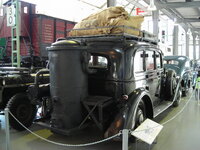
The only sensible solution is to have made more FT and Bergius plants, and to listen to advice they had early on from Professor Steinmann at Berlin University (and ignored) to build a more distributed system, instead of making one huge plant right next to each coal deposit. Later in the war they began building underground hydrogenation plants, which were not completed but were feasible despite significant ventilation engineering challenges.
The most efficient, not best, and Perfect is the enemy of Good enough, is to use more of that Coal, as Coal.
Save on not needing those expensive Synth Fuel conversion plants.
Rather than taking the hit of 6+ tons of Coal to one ton of Liquid fuel, just use the existing Coal distribution network to power civilian and rear are Heer needs for moving things around.
They were using Horses, that was even more inefficient than Coal.
Let's compare Fuels
Diesel Engine efficiency is 38% for 1940s, Gasoline 26% for stuff that is roadbound.
Boilers and double acting cylinders like the Stanley Steamer or Sentinel Road Waggon, 9%
External Combustion just isn't that efficient. but is low tech, 1890s stuff.
Diesel has roughly 40% more BTU/lbs than Coal, depending on the grade, but it takes 4-8 tons of Coal to make 1 ton of synthetic oil, depending on the type of Coal, so you lose on using Synth plants, and not just of the fuel input stage.
Germany devoted over 4 million tons of Steel for the various Bergius hydrogenation or the Fischer-Tropsch process plants, and around 70,000 Workers at the start of operations at the start of the War.
From the USSBS
Bombing hurts.
The number of workers engaged in operating and maintaining the oil plants was 34,000 in June, 1938. The Karin Hall plan called for 6,600 additional operating personnel in mid-1939, to be increased to 66,000 by the second half of 1942.
In September, 1944, according to a statement by the Economic Group of the Fuel Industry, 20,000 persons were employed in crude production, 14,500 in crude refining, 89,200 in the synthetic industry, and 13,100 in coal tar distillation a total of 136,800. This estimate did not include miners, and probably omitted construction workers. Hence, some 200,000 workers were probably engaged in the production of oil in Germany. In the United States, about 270,000 persons were employed in drilling, producing, and refining oil in 1939, but this country's production then was more than twenty times the peak of 8,000,000 tons per year which the Germans attained shortly before the strategic bombers began to smash up their plants.
So lets avoid Synth Plants as much as possible
But lump Coal, isn't very efficient to store on vehicles, or to feed into the Boiler. So you can take the efficiency hit, and have a full time job of moving Coal into the Boiler.
This is fine for Civilian and Rear Area Army usage.
Buyt besides working the Coal thru Synthetic Plant, there is another way, but a bit more Technology than a Guy with a Shovel.
Grind it very finely, and add water.
Bingo- Coal Slurry. It can be pumped to a burner easily for Steam Engines
Coal Slurry looks like a poor Diesel, but the process is far simpler than hydrocracking Coal for Bergius process, that had pulverization as part of the process anyway.
I'm not saying Coal Slurry is awesome, but in areas where you don't need high speed diesels, you aren't wasting 4-8 tons of Coal to make one of Diesel of very pure nature(and you want some sulfur as to not wear out your mechanical injectors and pump)
Smoke is the sign of incomplete combustion, in Coal fired, or for that matter, Diesel applications. Coal slurry has much less problem in ash and incomplete combustion that solid Coal, so you gain back in efficiency what is lost in using water for the slurry
Now Actual Diesel Engines are more complex than a Boiler using a Coal Slurry Burner, in going thru mechanical injectors to each cylinder, and firing at the right moment, and the Slurry is more abrasive than 'Real' Diesel or Synthetic Diesel, so will be more wear.
Still could work for Trucks and Panzers.
The history of Aero-Diesel engines is not a happy one, so little relief for the Luftwaffe
There is a ray of sunshine in that cloud, Coal Slurry in Turbines. They already had low times before rebuild, so no change there
This is a move from the Coal Dust that they tried OTL to Slurry
USA during the Malaise Era coming out for other fuels, given the Shadow of the Arab Oil Embargo, did do research on Coal Slurry for vehicles stationary plants, and abandoned, as that threat receded.