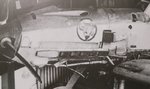
'Luftwaffe Crash Archive, Volume 3', shows photos of this aircraft before, and after it crash landed. The 'before' shot, taken from rear 3/4 starboard, shows the open canopy, without head armour.
It is confirmed that the yellow ID paint only extended up to the edge of the upper surface camouflage, clearly seen in all photos of this machine. The aircraft remained in the 'large, 12 acre field' for three weeks, before being moved and later put on display.
As Steve mentioned, there were basically two main types of head armour - the vertical plate, and one with a curved, horizontal plate on the top, both of which were attached to the rear frame of the opening section of the canopy. The former was mainly fitted to the earlier, curved canopy, due to space restrictions, although there were a few aircraft which also had the top plate. The armour pate with the top section was fitted to the later 'square' canopy, and in general, this seemed to be the norm by September 1940, although there were many exceptions, with canopies without head armour, either due to delays in fitting, or perhaps by personal choice of the pilot, as the armour restricted movement and view in an already cramped and restricted cockpit.
Hope this helps.
EDIT: I forgot to add, the canopy and rear glazing, complete with undamaged radio mast, are seen alongside the aircraft on display in Stanhay's Garage, Ashford, and presumably this was jettisoned immediately prior to belly-landing. There is no sign of 'kill' markings on either side of the fin or rudder.
The rudder was yellow.