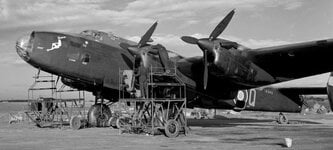
Handley Page Halifax B Mk III with 138 SD Squadron RAF Tempsford.

Ad: This forum contains affiliate links to products on Amazon and eBay. More information in Terms and rules

Roger Freeman

Airman
16
4
Sep 12, 2025
I am researching the use of late type Handley Page Halifax B Mk III (Hercules Eng) aircraft used by 138 & 161 Special Duties Squadrons RAF Tempsford, Bedfordshire circa 1943-44.

Do any of you Halifax 'experts' out there know if the H.P.Halifax B Mk III (Hercules Eng) was used by either 138 or 161 SD Squadrons at RAF Tempsford during the later war years and if so any aircraft serial number or other identification information ?.

It is well documented that H.P.Halifax B Mk I, II & especially the B Mk V (all with RR Merlin XX, 28 engines) were used extensively up to 1944-45 by both 138 & 161 Squadrons dropping SOE agents and containers/packages into occupied Europe.
I have not however been able to find any definitive evidence in such books as 'Halifax at War' by B.J.Rapier, 'The Handley Page Halifax' by K.A.Merrick or Osprey 'Halifax Squadrons of WW2' by Jon Lake, plus other Halifax Books, that H.P.Halifax B Mk III aircraft were used by either 138 or 161 Squadrons at Tempsford ?..
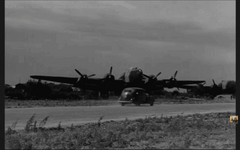
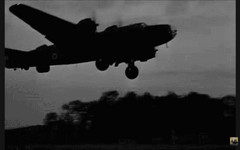
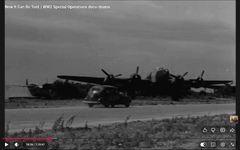
The only visual evidence I do have is from the RAF Film Unit film 'School for Danger' (also named 'Now it can be Told') which was released in 1947. As far as I know filming was started in 1944 and finished in 1946 so both 138 7 161 Squadrons were still operating from RAF Tempsford in 1944-45 when filming started. I beleive Short Sterlings were also being used as well as Halifax's in 1944 as Halifax losses increased and these are shown in the film dispersed as well. I have attached some 'screenshots' from the film which shows a car with SOE agents being driven on RAF Tempsford airfield to the 'Gibraltar Farm' dispatcing point. The car is shown passing by dispersed H.P.Halifax B Mk III's. They were either being operated by 138 & 161 Squadrons at the time of filming, or were being stored there ?. One shot from the film also shows a H.P.Halifax B Mk III taking off although in the film the two 'SOE agents' are shown entering a Merlin engined Halifax B Mk V aircraft with Dowty undercarriage.
 

Attachments

  • Screenshot 2026-02-14 184943.png
    Screenshot 2026-02-14 184943.png
    239.3 KB · Views: 50
  • Screenshot 2026-02-14 185353.png
    Screenshot 2026-02-14 185353.png
    148.1 KB · Views: 46
  • Screenshot 2026-02-14 185353.png
    Screenshot 2026-02-14 185353.png
    148.1 KB · Views: 46
  • Screenshot 2026-02-14 184714.png
    Screenshot 2026-02-14 184714.png
    248.4 KB · Views: 47
I am researching the use of late type Handley Page Halifax B Mk III (Hercules Eng) aircraft used by 138 & 161 Special Duties Squadrons RAF Tempsford, Bedfordshire circa 1943-44.

Do any of you Halifax 'experts' out there know if the H.P.Halifax B Mk III (Hercules Eng) was used by either 138 or 161 SD Squadrons at RAF Tempsford during the later war years and if so any aircraft serial number or other identification information ?.

It is well documented that H.P.Halifax B Mk I, II & especially the B Mk V (all with RR Merlin XX, 28 engines) were used extensively up to 1944-45 by both 138 & 161 Squadrons dropping SOE agents and containers/packages into occupied Europe.
I have not however been able to find any definitive evidence in such books as 'Halifax at War' by B.J.Rapier, 'The Handley Page Halifax' by K.A.Merrick or Osprey 'Halifax Squadrons of WW2' by Jon Lake, plus other Halifax Books, that H.P.Halifax B Mk III aircraft were used by either 138 or 161 Squadrons at Tempsford ?..
The only visual evidence I do have is from the RAF Film Unit film 'School for Danger' (also named 'Now it can be Told') which was released in 1947. As far as I know filming was started in 1944 and finished in 1946 so both 138 7 161 Squadrons were still operating from RAF Tempsford in 1944-45 when filming started. I beleive Short Sterlings were also being used as well as Halifax's in 1944 as Halifax losses increased and these are shown in the film dispersed as well. I have attached some 'screenshots' from the film which shows a car with SOE agents being driven on RAF Tempsford airfield to the 'Gibraltar Farm' dispatcing point. The car is shown passing by dispersed H.P.Halifax B Mk III's. They were either being operated by 138 & 161 Squadrons at the time of filming, or were being stored there ?. One shot from the film also shows a H.P.Halifax B Mk III taking off although in the film the two 'SOE agents' are shown entering a Merlin engined Halifax B Mk V aircraft with Dowty undercarriage.
But are the Halifax B.III?

Looking at the photos, the aircraft seem to have the later extended and more rounded wingtips. These were introduced on later batches of the B.III from about mid-1944 (nobody seems clear exactly when) but were also fitted to later versions of the Halifax.

A long shot might be to look into the history and ORBs of 426 squadron. This Canadian unit flew Halifax VII from June 1944. Now Halley (RAF and Commonwealth Squardons 1918 to 1988) says that they gave these up in May 1945 before relocating from Driffield to Tempsford on 25th June. At Tempsford they were to re-equip with Liberator C.VI/VIII but it didn't receive the first of these until 11 July. So the question is what were they flying between May and mid-July 1945 while at Driffield and then Tempsford for continuation traing to keep their flying skills up to par? Did the take some of their Halifax VII along?

I don't know but it is another avenue to pursue.
 
The only visual evidence I do have is from the RAF Film Unit film 'School for Danger' (also named 'Now it can be Told') which was released in 1947. As far as I know filming was started in 1944 and finished in 1946 so both 138 7 161 Squadrons were still operating from RAF Tempsford in 1944-45 when filming started. I beleive Short Sterlings were also being used as well as Halifax's in 1944 as Halifax losses increased and these are shown in the film dispersed as well. I have attached some 'screenshots' from the film which shows a car with SOE agents being driven on RAF Tempsford airfield to the 'Gibraltar Farm' dispatcing point. The car is shown passing by dispersed H.P.Halifax B Mk III's. They were either being operated by 138 & 161 Squadrons at the time of filming, or were being stored there ?. One shot from the film also shows a H.P.Halifax B Mk III taking off although in the film the two 'SOE agents' are shown entering a Merlin engined Halifax B Mk V aircraft with Dowty undercarriage.

Quite interesting I thought. I went through the movie on the Youtube to see what it is about. My notes ..

1. I agree the SOE agents are getting on the Halifax B Mk V, the Merlin engined plane. The code ltters on the fuselage NF indicates the no. 138 Squadron.
NF_1.jpg

NF_2.jpg


2. I agree the taking off Halifax looks like the B Mk.III. However it looks like there wouldn't be any aircraft code although the RAF roundel could be still noticed. It is very likely, it may be the matter of the movie copy but the censorship action could have been as well. Using the Gamma Correction option didn't reveal the squadron code on the plane.
NF_3.jpg

NF_3a.jpg


3. So I kept watching of the movie and in the next shots of the flying Halifax I noticed it wasn't the same one that took off earlier. Please notice the emblem of the plane nose and the shape of the wing tip. The squadron code letter also aren't seen.
NF_4.jpg

NF_4a.jpg


But at the 20.36 ( -1.09.01 ) time just for a wee while (about three seconds) the code appeared. And it starts with "S" letter while the aircraft individual letter is "T". So not the NF or MA code for the no.138 or 161 Squadron.
NF_5.jpg

NF_5a.jpg

NF_5b.jpg


4. So I got back to the movie beginning where a car is driving through the dispersal and on the first Halifax there I found the code that also started with the "S" letter. So again not the NF/MA code. Also please pay your attention to the fact that the scene with the car driving through the dispersal was taken during a sunny day and in a summer, judging by the dust and vegetation. But the scene with the SOE agents getting on the Halifax NF code was taken either late in the afternoon or in early evening and that there were the puddles of water all around the ground. What is more there is the another scene when a car is driving through the airfield on a quite misty and cold day with a lot of the puddles of water on the ground. The Stirlings can be noticed there. See my post below. All that let me to get believed the movie could be made at a couple of locations or time and using of different flying stuff.
NF_.jpg
 
To continue ...

5. Indeed the Short Stirling bombers can be noticed but as I had said before I'm not sure if the movie was made at the same airfield. However please notice that the nose of the Halifax plane in the second still frame ... IMHO the Stirlings might have belonged to the No. 149 Squadron RAF.
ss_1.jpg

ss_1a.jpg

ss_1b.jpg


6. The no. 138 Squadron code letters were NF while the no.161 used the "MA" and "JR" for Lysanders only in the 1944-1945 period. And the only reference to the no.161 Squadron seen at the beginnig of the movie is the Lysander ...
l1a.jpg

l1.jpg


Tu sum up ... the movie can't be an evidence the Halifax B Mk IIIs were used there by the no. 138 or 161 squadrons. The movie looks like a mix of scenes that could be taken at different time periods , airfields and not necessarily at the RAF Tempsford. However the Gibraltar Farm, Tempsford looks like it is the real place there. At least at the part of the movie although there is still the inconsistency in the weather and time.

cf.jpg
 
I am researching the use of late type Handley Page Halifax B Mk III (Hercules Eng) aircraft used by 138 & 161 Special Duties Squadrons RAF Tempsford, Bedfordshire circa 1943-44.

Do any of you Halifax 'experts' out there know if the H.P.Halifax B Mk III (Hercules Eng) was used by either 138 or 161 SD Squadrons at RAF Tempsford during the later war years and if so any aircraft serial number or other identification information ?.

It is well documented that H.P.Halifax B Mk I, II & especially the B Mk V (all with RR Merlin XX, 28 engines) were used extensively up to 1944-45 by both 138 & 161 Squadrons dropping SOE agents and containers/packages into occupied Europe.
I have not however been able to find any definitive evidence in such books as 'Halifax at War' by B.J.Rapier, 'The Handley Page Halifax' by K.A.Merrick or Osprey 'Halifax Squadrons of WW2' by Jon Lake, plus other Halifax Books, that H.P.Halifax B Mk III aircraft were used by either 138 or 161 Squadrons at Tempsford ?..
The only visual evidence I do have is from the RAF Film Unit film 'School for Danger' (also named 'Now it can be Told') which was released in 1947. As far as I know filming was started in 1944 and finished in 1946 so both 138 7 161 Squadrons were still operating from RAF Tempsford in 1944-45 when filming started. I beleive Short Sterlings were also being used as well as Halifax's in 1944 as Halifax losses increased and these are shown in the film dispersed as well. I have attached some 'screenshots' from the film which shows a car with SOE agents being driven on RAF Tempsford airfield to the 'Gibraltar Farm' dispatcing point. The car is shown passing by dispersed H.P.Halifax B Mk III's. They were either being operated by 138 & 161 Squadrons at the time of filming, or were being stored there ?. One shot from the film also shows a H.P.Halifax B Mk III taking off although in the film the two 'SOE agents' are shown entering a Merlin engined Halifax B Mk V aircraft with Dowty undercarriage.
Great post and question, I haven't ever seen any evidence of 138 or 161 SD Squadrons using MkIII Halifax (do not think Harris would let go of any!) The norm was for the Special Duties squadrons to get the Mks less suited for Bomber Command use. Hence why the Merlined Halifaxes were used followed by the Stirlings, which both 138 and 161 used. Also remember, by March 1945, 138 had departed Tempsford and converted to Lancasters on joining Bomber Command at North Tuddenham.

All the best

Steve A
 
BTW .. IMHO the Halifax seen in the second still frame seems to be of the name " Hagggis" and is the same we have already been discussing in your previous thread

ss_1a-jpg.jpg

haggis_.jpg

img_4356-jpg.jpg
 
To use RAF squadrons by Jefford,

138 squadron, formed when 1419 flight renumbered 21 August 1941, with Lysander IIIA until March 1942, Whitley V until November 1942, Halifax II until August 1944, Halifax V January 1943 to August 1944, Stirling IV June 1944 to March 1945, became a regular bomber squadron with Lancaster I and III March 1945. Formed at Newmarket, Stradishall 16 December 1941, Tempsford 11 March 1942, Tuddenham 9 March 1945. When formed had a detachment at Luqa.

161 squadron formed from 138 squadron and the King's flight on 16 February 1942, with Lysander IIIA until June 1945, Hudson I until August 1944, Whitley V until December 1942, Halifax II September to December 1942, Halifax V October 1942 to October 1944, Albemarle I October 1942 to April 1943, Havoc I October 1942 to December 1943, Hudson IIIA and V September 1943 to June 1945, Stirling IV September 1944 to June 1945, squadron disbanded 2 June 1945. Formed at Newmarket, to Gravelay 1 March 1942, Tempsford 8 April 1942. There were detachments at various times.

426 squadron, had Halifax VII June 1944 to March 1945, Halifax III December 1944 to March 1945. Moved to Driffield 25 May 1945, transferring to Transport Command, Liberator VI and VIII June to December 1945, Tempsford 25 June 1945, disbanded 31 December 1945.

Bomber Command retired the last of its front line Halifax II/V on 12 July 1944. At peak II/V strength in December 1943/January 1944 it had 21 squadrons, not all operational, with around 300 Halifax, including an increasing number of Halifax III. Halifax II and V used Merlin XX and 22, the Lancaster used Merlin 28.

Bomber Command had 22.5 Halifax squadrons in January 1945 down to 18.5 in early May 1945, mainly by conversion to Lancaster, to 4 bomber squadrons on 4 May, 1 squadron on 17 May, last one left on 25 May, the 3.5 squadrons in 100 group still around in July.

No idea about exact time of introduction of extended wing, but the VI and VII had it, Handley page built a batch of B.VII May to September 1944, replacing III on the production line, plus a batch of B.VI July 1944 to February 1945. All 5 lines produced mark III, ending production between June 1944 and April 1945, English Electric switched to B.VI in February 1945, plus it and Fairey built some B.VII January to March 1945. There was also the 1945 production of A.VII and C.VI by Handley page, Fairey and Rootes.
 
Thanks Ewen for your reply and the other four chaps who added comments as well to my possibly nieve questions.
Just to put you in the picture I have been completing research on RAF Tempsford now for several years and although I have lived in South Australia for over 35 years I was actually born adjacent to RAF Tempsford at 'Coldharbour' farm. My late father actually taught me to drive on Tempsford's runways/perimeter track in the late 1950's. It was still a complete airfield then and I remember that the Ministry of Ag and Fish used to store tons of sugar in the T2 hangers under guard (sugar still rationed in the England then). I knew the airfield then like the back of my hand.
I still visit the area from Australia most years and always continue my research on RAF Tempsford while I am there.
For over two years I have been researching the crash of 138 SD Squadron Halifax B Mk V Serial LK743 that crashed on returning to Tempsford on the early morning of the 8th January 1944 at nearby Tetworth Hill (seven RAF crew members and three SOE agents sadly died in the crash). Late last year together with an ex-RAF associate of mine we identified the actual crash site, which is on private land.
Enough of my waffle and thanks again for the reponse to my other questions posted last week.
The film 'School for Danger' ('Now it can be Told') by the RAF Film Unit I have had for many years as it was originally recorded/copied for me by the Imperial War Musem on a CD in the 1960's. The recording notes actually say that the film was made over a period of two years 1944-1945. It only mentions RAF Tempsford as the filming location however which is not to say it was possibly filmed at other RAF stations as well during the same period ?. I also had another RAF Film Unit film containing 'bits' of film on RAF Tempsford which unfortunately has been lost. I did however retain some terrible photos from it from which I took the prints of the Halifax B Mk V named 'Haggis' shown in my earlier post (still no positive identification on that aircraft unfortunately).
One of the photo's from 'School for Danger' of the car driving around the perimeter track is most certainly that showing 'Haggis' (the bottom of the scroll under 'Haggis' can just be seen).
I also have had copies of the 426 Squadron RCAF ORB's for 1944-1945 for a few years after obtaining these from the NA at Kew. London. As far as I can determine 426 Squadron flew their last 'bombing operational' mission from Linton on Ouse (after moving there from Driffield) to Wangarooge in the German Frisian Islands on the 25th April 1945 using Halifax B Mk VII aircraft. On the 25th/26th June 1945 426 Squadron ground crew (and air crew ?) started to move to RAF Tempsford and went from RCAF command to RAF command !. I can find no ORB or Summary record however that they took their Halifax B Mk VII's with them ?. Liberator training for 426 air and ground crew commenced in July and by the 13th July six Liberators had been delivered to RAF Tempsford from RAF/USAAF Bassingbourn. By the 19th July a total of eighteen Liberators were on hand. On the 10th August 1945 HQTC (HQ RAF Transport Command) gave orders to ferry a further nineteen Liberators from Bassingbourn to Tempsford. I can find no reference that 426 Squadron ever flew these Liberators from RAF Tempsford on anything other than training flights ?.


But are the Halifax B.III?

Looking at the photos, the aircraft seem to have the later extended and more rounded wingtips. These were introduced on later batches of the B.III from about mid-1944 (nobody seems clear exactly when) but were also fitted to later versions of the Halifax.

A long shot might be to look into the history and ORBs of 426 squadron. This Canadian unit flew Halifax VII from June 1944. Now Halley (RAF and Commonwealth Squardons 1918 to 1988) says that they gave these up in May 1945 before relocating from Driffield to Tempsford on 25th June. At Tempsford they were to re-equip with Liberator C.VI/VIII but it didn't receive the first of these until 11 July. So the question is what were they flying between May and mid-July 1945 while at Driffield and then Tempsford for continuation traing to keep their flying skills up to par? Did the take some of their Halifax VII along?

I don't know but it is another avenue to pursue.
 
Great photos and topic . Could someone tell me what type of car that is , and is it a " typical " RAF staff car ?
 
Roger: the ORB Form 541 (record of sorties) will record the details of operational aircraft on each day of operations, including their "Mark" . These can be obtained for free (with a subscription) from TNA (National Archives) at Kew. Use the "Discovery" search:

Using the RAF Commands search engine,


For 1944 and 138 squadron, Records AIR 27/956/1, AIR 27/956/2, AIR 27/956/3, AIR 27/956/4, AIR 27/956/5, AIR 27/956/6, AIR 27/956/7

For 161, Records AIR 27/1068/10, AIR 27/1068/12, AIR 27/1068/14, AIR 27/1068/16, AIR 27/1068/18, AIR 27/1068/20, AIR 27/1068/22, AIR 27/1068/24, AIR 27/1068/26, AIR 27/1068/28, AIR 27/1068/30, and AIR 27/1068/32.

I'm not going to download these for you. I have too many random ORBs that are surplus to my needs.

Jim
 
Jim,
Thankyou for the information on the RAF ORB's.
On my last two visits to England in the winters of 2024 and 2025 I spent several days at the NA Kew trawling through the various RAF/AM files on RAF Tempsford and specifically the ORB's for 138 and 161 Squadrons. I now have most of them on file from 1941 through 1944-45. Unfortunately it appears that a number of 138 Squadron ORB files were never received by the NA from the original RAF Air Historical Branch and a number are 'missing'. The specific area of my recent research, as I mentioned earlier, was to find as much as possible on the crash Halifax LK743 on the 8th January 1944 while returning to RAF Tempsford from SOE Operation's 'TYBALT 3' and 'THERSITES 4' over occupied Belgium. Although this operation, and the crash, has been well documented in the past by a number of 'historians' both local and otherwise the RAF ORB's forms 540 (Summary of Events) and 541 (Details of Work Carried Out 'actual sorties') for the period (Jan 1944) fail to give much information at all on this aircraft. AIR 27/956/2 (Form 540 Summary of Events) on page 7 only records the loss of the the seven RAF crew of LK743 'as the result of a crash'. The Form 541 (Details of Work 'sorties') for the same period appears to be missing from the archives as I could not find it even after extensive searching, subsequently it appears that there is no mention/record on the 7th/8th Jan 1944 of Halifax LK743 'J' for Johnny leaving RAF Tempsford for Belgium on Operations 'TYBALT 3' & 'THERSITES 4', or returning and crashing. At the moment the NA files for many of the RAF Squadron ORB's are being revised into a new format and are therefore not available online.
 
Thanks Roger. I did not realize there were missing ORBs. I am aware of other gaps, for example 617 Squadron.

Jim
 
As part of my ongoing research into Handley Page Halifax B Mk V Series 1a Serial No LK743 that crashed on the 8th January 1944 at Tetworth Hill Bedfordshire I wondered if any 'Halifax experts' out there were familiar with the Fairy Aviation Co Ltd files/documents that the RAF Museum, Hendon, has under Ref AC 73/30 ?.

I am specifically looking for production batch manufacturing details for this aircraft as to how it was delivered to 138 Squadron RAF Tempsford on the 4th January 1944 (e.g. did it have a full plexiglass nose or 'Tollerton' nose, did it have four blade Rotol propellers, did it have the later 'D' type rudders or the original trangular rudders ?.

HP Halifax LK743 was built by contractor Fairy Aviation Co Ltd at their Cheadle Heath factory at Stockport near Manchester between August 1943 and December 1943 as part of Contract AC/891 and it was delivered to 138 Special Duties Squadron at RAF Tempsford, Bedford shire on the 4th January 1944.

I am endeavouring to find out specific factory production manufacturing/modification details of the aircraft and would hope that these could be contained under the RAF Museum Ref AC 73/30 documents for Fairy Aviation Co Ltd based on their HP Halifax B Mk V production period August 1943 to end December 1943.

I already have the manufacturing details below for HP Halifax LK743 :

LK743 was a H.P.Halifax B/Met.Mk.V Series 1a aircraft manufactured by Fairy Aviation Co Ltd at their 'Heaton Chapel' factory in Stockport, Manchester, England between August 1943 and December 1943. (RAF Contract Cards LK743 Halifax V, allocated to RAF 138 squadron, allotment number 6309, delivered 4 January 1944, counted as January production, part of contract 891/SAS/C4C (also AC/891) built by Fairey Aviation. Original Requisition 1/E1/41 but other requisitions were made against the order, which ultimately became for 1,030 aircraft). HK743 was built within a batch of 96 H.P.Halifax B/Met.Mk.V Series 1a aircraft manufactured by Fairy Aviation Co Ltd in a production run between Serial No's : LK626 to LK746.

The attached photograph of Halifax LK640, of 'Iroquois' Squadron RCAF, is of the same production batch as LK743. It is the nearest I have been able to get of a Halifax B Mk V Series 1a and what LK743 'may' have looked like. As can be seen LK640 has 'Dowty' U/C, three blade DH propellers, the full plexiglass nose, but the original triangular rudders. It also has the relatively unusual 'Lancaster type' twin ribbed tail wheel ?.
 

Attachments

  • 66a3921de09db218d5435f91_60f9947815797a2b5b0a0b1e_Handley-Page-Halifax---Serial-No--LK640---Q-...jpg
    66a3921de09db218d5435f91_60f9947815797a2b5b0a0b1e_Handley-Page-Halifax---Serial-No--LK640---Q-...jpg
    66.6 KB · Views: 31

Users who are viewing this thread

Back