
Help identifying TBF Avenger "AA21" — which carrier/squadron used "AA" prefix?

Ad: This forum contains affiliate links to products on Amazon and eBay. More information in Terms and rules

beldridg

Airman
69
141
May 3, 2022
Hi all,

I've posted in this forum before about some airplane wrecks we have located and identified in Southern California. I'm now working on a book about those airplane wrecks and the stories of the pilots! One of the possible covers involves a photo I found on-line but I'm trying to find a high resolution version. I've contacted NHHC and NARA but they can't find the source photo without more data. Here is more background:

It would help to have the carrier and squadron associated with a WWII-era photograph of a TBF Avenger marked "AA21" ditching alongside what appears to be a carrier. The image has been posted online with conflicting attributions — some sources say USS Bataan (CVL-29), others say USS Tulagi (CVE-72) — but neither has been verified through official archives. NARA and NHHC have been unable to locate it.

Based on my research I understand the formal letter tail code system wasn't introduced until July 1945, so "AA21" was likely an earlier informal squadron or air group marking rather than a standardized carrier code. Can anyone identify which carrier air group or torpedo squadron used "AA" as a prefix in 1943-1944, and whether this helps narrow down the carrier?

I'm attaching the photograph for reference. Any help identifying the carrier, squadron, date, or incident would be greatly appreciated.

Thanks all,

Brett
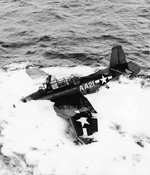
 

Attachments

  • bw.png
    bw.png
    149.7 KB · Views: 46
Per the "AI" know it all,

A TBM Avenger with an "AA" fuselage/tail code most commonly designates an aircraft assigned to Carrier Air Wing 17 (CVW-17)—formerly Carrier Air Group 17—or the Atlantic Fleet Strike-type Fleet Replacement Squadrons. [1, 2, 3, 4]
In the United States Navy's alphanumeric marking system, the two-letter tail code denotes the specific air wing. If you are looking at an "AA" Avenger, it was actively attached to: [, 2, 3]
  • Atlantic Fleet Carrier Air Wing 17 (CVW-17): The "AA" tail code was assigned to this East Coast-based air group.
  • Fleet Replacement Squadrons (FRS): "AA" was also used to represent Atlantic Fleet Strike-type FRS units, which trained pilots in models like the Avenger. [1, 2]
Historically, older WWII Avenger photographs occasionally featured an "AA" prefix as an informal torpedo squadron or Carrier Air Group marking (prior to July 1945, when the formal standardizing letter system was introduced). [1, 2]
For further reading on the exact appearance, radar equipment, and squadron stencils of TBM Avengers, consider these resources:

If you are researching a specific TBM Avenger, tell me the aircraft bureau number (BuNo) or the side modex number (e.g., AA-21). I can help you trace its exact squadron assignment and combat history.
 

Thanks for the help.

I think those are different accidents / aircraft numbers? One looks like A27, the other is AA68.

Which of the sites you referenced do those come from?

Again, I really appreciate the help. The reason I want the AA21 image is that it shows the pilot outside and the gunner inside and the book I'm writing is really about the human element of the accidents and aircraft we have found. I have some other alternatives but I think the AA21 one is the best of them.

Regards,

- brett
 
Throughout her wartime career Takanis Bay operated as a training carrier operating out of San Diego. From DANFS:-

"After shakedown, Takanis Bay operated out of San Diego with Fleet Air, West Coast, through the end of hostilities with Japan in mid-August 1945. She trained pilots for carrier operations; and, between 24 May 1944 and 28 August 1945, she qualified 2,509 of them."

She was one of a number of CVE detailed for that purpose on the West Coast and at Pearl Harbour during early 1945. As training carriers they did not have their own air groups. Shore based units would use them for deck landing training and practice, and perhaps sometimes spending several days aboard as training needs dictated before returning to their shore bases. So while the photos may have been taken of aircraft crashing on / around the Takanis Bay it does not mean that AA*** was a code assigned to her.

In Jan/Feb 1945 there were a large number of Composite Squadrons (VC units) based on the West Coast working up for future use on operational CVE.

You can see the locations of USN aircraft in the official reports, but that does not help with codes used by individual units while ashore.

With regard to the photo in the original post, I'm struggling to see a gunner in the turret. Also missing is the third crewman. Unless I'm missing something, it is possible that with this being a training sortie, the aircraft was manned only by the pilot.
 
Throughout her wartime career Takanis Bay operated as a training carrier operating out of San Diego. From DANFS:-

"After shakedown, Takanis Bay operated out of San Diego with Fleet Air, West Coast, through the end of hostilities with Japan in mid-August 1945. She trained pilots for carrier operations; and, between 24 May 1944 and 28 August 1945, she qualified 2,509 of them."

She was one of a number of CVE detailed for that purpose on the West Coast and at Pearl Harbour during early 1945. As training carriers they did not have their own air groups. Shore based units would use them for deck landing training and practice, and perhaps sometimes spending several days aboard as training needs dictated before returning to their shore bases. So while the photos may have been taken of aircraft crashing on / around the Takanis Bay it does not mean that AA*** was a code assigned to her.

In Jan/Feb 1945 there were a large number of Composite Squadrons (VC units) based on the West Coast working up for future use on operational CVE.

You can see the locations of USN aircraft in the official reports, but that does not help with codes used by individual units while ashore.

With regard to the photo in the original post, I'm struggling to see a gunner in the turret. Also missing is the third crewman. Unless I'm missing something, it is possible that with this being a training sortie, the aircraft was manned only by the pilot.

Yes, it is a little hard to tell and I'm not sure if there is a gunner in there or not. I've attached a version of the photo that was colorized by Jets and Props (I've tried contacting them in many different ways so it would be great if anybody here has a contact there). In the colorized photo, the pilot is much more obvious and it looks like he is looking back (possibly checking on somebody else)? Of course, it could have just been flying practice without anybody else on-board.

I really hope I can find the original photo. It is perfect for the book cover!

703503549_977093021978690_4154676012348960994_n.jpg


Thanks for all the help!

- brett
 

Users who are viewing this thread

Back