Help needed for identifying an old Luftwaffe Flight Instrument

Ad: This forum contains affiliate links to products on Amazon and eBay. More information in Terms and rules

Spyros

Airman
15
6
Nov 15, 2016
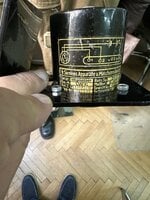
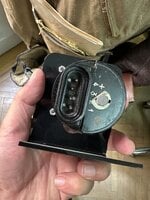
I am wondering, what was the usage of an old Luftwaffe's instrument I have added to my collection some years ago.
Does anyone know how it was working and what for?
Is it possible it was used for the bomber's airmen following the Knickebein Radar System?

Many thanks in advance.
 

Attachments

  • IMG_4103.jpg
    IMG_4103.jpg
    1.3 MB · Views: 31
  • IMG_4104.jpg
    IMG_4104.jpg
    1.2 MB · Views: 28
  • IMG_4105.jpg
    IMG_4105.jpg
    1.2 MB · Views: 32
Bezeichnung: elektr. Stellungsanzeiger für Kühlerklappen (Wegmesser)
Anforderungszeichen: Fl.20853-2
Gerät-Nr.: 127-1077 D-1
Baumuster: LWK
Messbereich: 0 – 60°
Hersteller: SAM, Siemens Apparate- und Maschinen GmbH, Berlin
Baujahr: 1939
Eingebaut in: z.B. Junkers Ju 87, frühe Baumuster

Radiator grill cooling flap control.

1750768876689.jpeg
 
I agree it is the position indicator for radiator flaps ( actually a temperature guage ), the version of 1940 ( according to the deutscheluftwaffe.de site ). The indicator Fl.20853-02 of the 1939 had a different dial. See here ... Fl.20853-2 elektr. Stellungsanzeiger für Kühlerklappen, 1939 | Deutscheluftwaffe

IMHO here is the same indicator that was bought by Spyros from the site ( the link below).
Fl20855-02.jpg

the pic source: Fl.20853-2 elektr. Wegmesser, 1940 | Deutscheluftwaffe
 
but it is the Fl.32502-4 Strom- und Spannungsmesser ... Dora on left , the Berta on right ...

wegemesser_.jpg

ju87.jpg

here the indicator Fl.32502-4 .... the dials for different values.
Strom- und Spannungsmesser.jpg


and here is the Wegmesser Fl.20853-02 , two versions , one of the 1939 on the left and 1942 on the right ...
Fl.20853-2-Stellungsanzeiger-Kühlerklappen.jpg


wegemesser_b.jpg


also it could be the Wegmesser Fl.20853-01 ( on left ) quite similar to the Fl.20853-02 with slightly different dial ...
wegemesser_c.jpg
 
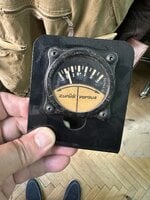
To sume up ... IMHO the indicator could be a fake. The dial bears traces of remodeling or repair. If you have a close up look at the piece you may notice the old values printed there. I say these were 0°... 30°... 60°. What is more, the entire dial looks like rotated counterclockwise direction ( 90 degree left ) and the new graduation was written manually. Because the orginal glass of the indicator was possible cracked or just broken, it was replaced with the new one and the additional piece made of a cardboard with the inscription "zurück-voraus" addded. Finally , the Fl number that was correct as it was the FL20853-02 got scored the digit "3" out and almost erased. Because of these doubts I don't believe it has someting in common with the Knickebein system. Certainly I may be wrong ... but ...

dial1.jpg

dial2.jpg

dial3.jpg
 
To sum up ... IMHO the indicator could be a fake....
Wojtek, just a thought: could this be a war-time reuse of an older dial? I see all the changes you described but they could be old as well. With other words the part could have been used in its repurposed form and is not a "fake" manufactured in our days, for profit.:rolleyes:
 
Wojtek, just a thought: could this be a war-time reuse of an older dial? I see all the changes you described but they could be old as well. With other words the part could have been used in its repurposed form and is not a "fake" manufactured in our days, for profit.:rolleyes:

Ives, I have thought about that as well. However , what purpose would be the kind of the modification ? For sure the entire indicator looks orginal externally with no doubt. The dial and the indicator case look like the one of the 1939. But the dial got the graduation made manually. If it would be a factory made indicator the dial inscriptions, the glass would look differently. So there is a question ... which WW2 German aircraft had someting that was moved 3 degrees forward and back ? Slats .. rather not , because these were automatic and there wasn' the need of controllingl their moving. Flaps, landing gear, ailerons and trim tabs were moving down and up usually. The LWK abbreviation may stands for the tail assembly ( Leitwerk ). I mean the horizontal stabilizer and vertical stabilizer. But agin what part could be moving forward and back? Either up and down or left and right , right? Additionally I have thought it might be made by a maintenance crew to replace a damaged factory indicator. But again I haven't seen a such factory gauge for a WW2 German aircraft so far. So because of all these doubts I think it is bogus. Of course the indicator could have been used for any purpose but not necessarily on a plane although it could have been used for it initially.
 
Ives, I have thought about that as well. However , what purpose would be the kind of the modification ? For sure the entire indicator looks orginal externally with no doubt. The dial and the indicator case look like the one of the 1939. But the dial got the graduation made manually. If it would be a factory made indicator the dial inscriptions, the glass would look differently. So there is a question ... which WW2 German aircraft had someting that was moved 3 degrees forward and back ? Slats .. rather not , because these were automatic and there wasn' the need of controllingl their moving. Flaps, landing gear, ailerons and trim tabs were moving down and up usually. The LWK abbreviation may stands for the tail assembly ( Leitwerk ). I mean the horizontal stabilizer and vertical stabilizer. But agin what part could be moving forward and back? Either up and down or left and right , right? Additionally I have thought it might be made by a maintenance crew to replace a damaged factory indicator. But again I haven't seen a such factory gauge for a WW2 German aircraft so far. So because of all these doubts I think it is bogus. Of course the indicator could have been used for any purpose but not necessarily on a plane although it could have been used for it initially.
The only purpose I can see is that the part they needed could not be delivered by a sub-contractor anymore and somebody else manufactured a part in primitive conditions that could be used for the time being.
Or another thought: the part was taken in its original condition from a WWII a/c and re-modified post-war for a different one.
What exactly does the part control, in its new condition, I can't guess.
 
The only purpose I can see is that the part they needed could not be delivered by a sub-contractor anymore and somebody else manufactured a part in primitive conditions that could be used for the time being.
Or another thought: the part was taken in its original condition from a WWII a/c and re-modified post-war for a different one.
What exactly does the part control, in its new condition, I can't guess.

I agree. That's the next possibility. On the other hand the gauge could be the temperature indicator. But have you ever seen the measurment of the temperature from 0 to 3 degrees and back also to 3 degrees? Usually if there is 0° the temperature on right is "+" while the one on the left is "-". There is no info written on the dial. However there is the 1940 wegmesser Fl.22582-2 ( on the right in the pic below) for the Focke-Wulf Fw 189. Quite similar. According to the site Fl.22852-2 elektr. Wegmesser, 1940 | Deutscheluftwaffe it could be used as an indicator for radiator flap position, landing flap position, etc. So it might be the puropse it could have been reworked.

dial3.jpg

the pic source: Fl.22582-2 elektr. Wegmesser, 1940 | Deutscheluftwaffe

Anyway the orginal Fl.20853-2 indicator is listed as the device for the Ju-87.

liste.jpg
 
It is a little bit late here and I'm tired but IMHO I have found ... for some reason somebody reworked the indicator trying to create the Trimmungsanzeige - electrical position indicator for trim. The one of unknown Fl. number was used for Henschel Hs 129.

Trimmungsanzeige-Hs-129-1024x768.jpg

the pic source: Fl.XXX Trimmungsanzeige, 1941 | Deutscheluftwaffe
 
Wojtek, I believe this could be the gauge in question even with different writing on it. IMHO 3 degrees as in temperature is a minor difference to be detected by this type of instruments. The German words "Zurueck" and "voraus" = back and ahead, clearly identify movement to me. This is also interesting: it's not up and down like it could be for a flap.
On your photo "Schwanz- and Kopflastig" means the tail or the "head" (front) of the a/c goes down. Great find and the detective story deepens: who did it and why? (changing the old instrument to a new one).:cool:
Good night on the other side of the big water, my friend!
 
Last edited:
Thank you Yves. I should say sleep well to you too. But actually it may be ... have a nice day. It is alread the dawn here. :lol:
 
Wojtek, I believe this could be the gauge in question even with different writing on it. IMHO 3 degrees as in temperature is a minor difference to be detected by this type of instruments. The German words "Zurueck" and "voraus" = back and ahead, clearly identify movement to me. This is also interesting: it's not up and down like it could be for a flap.
On your photo "Schwanz- and Kopflastig" means the tail or the "head" (front) of the a/c goes down. Great find and the detective story deepens: who did it and why? (changing the old instrument to a new one).:cool:
Good night on the other side of the big water, my friend!
That's the reason why I thought from the beginning that it might have been used as a modified instrument to indicate the bomber's position, in relation to the intersection point of the two rays of the Knickebein system. "Zurueck" = Bomber's position before the rays intersection point (target location), "Voraus" = Bomber has passed the target location as it was after the rays intersection point (target missed). Can't this be possible?
 
Hi,
This indicator does look very similar to that used for the Fw 190 horizontal tail trim position indicator. The range is similar. Overall, it is likely to be a position
indicator, the exact application is unclear but I think likely to be for a tail trim.

Eng
 
Can't this be possible?

IMHO not it wasn't possible, The Knickebein system was the radio system using the acoustic way of guidance using the Morse's code. Based on the Lorenz blind landing system the appearance of the indicator could be like in the first pic below. Secondly all aircraft indicators were made by manufacturers and had to meet the requirements of the RLM. Personally I doubt that there was somebody who reworked the indicator because of the reason you mentioned. I more incline to Ives' idea of the lack of the orginal gauge and manufacturing the device in primitive conditions that could be used for the time being. However why it would be done if there was a lot of damaged aircraft all around and it was possible to find a such factory made one? What is more the kind of the indicator could work in a different way because of the different mechanical and electrical systems inside. If I were you, I would dismount the indicator and check on its "bowels". Also it would be great if the inner circuits could be compare to the Fl.20853-2 elektr. Stellungsanzeiger für Kühlerklappen indicator from 1939 that can be found on the Fl.20853-2 elektr. Stellungsanzeiger für Kühlerklappen, 1939 | Deutscheluftwaffe site as well. Its external appearance is the same including the manufacturer's data ,the colour of the inscriptions there and the quite close werk number. IMHO the trimming guage was almost of the same construction and it should be quite easy to remodel the one. But again I'm asking what for if the factory made ones existed.

lorenz.jpg

the pic source: Flying the Beams

Here are indicators used for the Wotan system and the Knickebein one.

Wotan
wotan_b.jpg

wotan_a.jpg


Knickebein
knickebein.jpg


the pic source:

View: https://www.youtube.com/watch?v=DVuoi97KdJU
 

Users who are viewing this thread

Back